

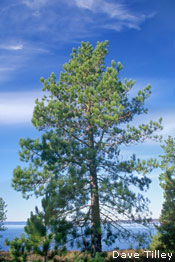
Red pine is Newfoundland and Labrador’s rarest native coniferous tree. In Newfoundland, this species is at the northeastern limit of its range; it does not grow in Labrador. Its numbers on the Island are in decline, however-where once it grew over a wide range, now fewer than two dozen stands remain.
- How to get There
- Activities
- Maps
- Services
- Fees and Schedules
- Rules and Regulations
- Permits
- Other Resources
- Contact Information
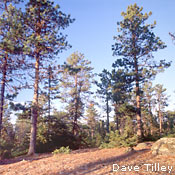
The 11-km2 West Brook Ecological Reserve about 14 km southwest of Springdale, was created specifically to protect some of the largest natural stands of Red Pine remaining in Newfoundland. It is in two parcels-2.4 km2 and 8.3 km2 on rolling hills near the headwaters of West Brook.
Red pine plays an important role in the ecosystem, growing in nutrient-poor, dry sites where it outperforms other native conifers. Today, natural regeneration and stand growth is poor in Newfoundland for several reasons:
- A thick layer of duff and natural litter has accumulated under the trees, which can inhibit seed germination and growth
- Shade-tolerant Black Spruce can take over
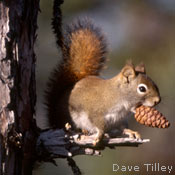
- The (introduced) Red Squirrel eats the trees’ seeds
- People remove young seedlings
Historically Red Pine once grew over the entire southern half of Newfoundland (as well as all through the Great Lakes watershed), at the species’ northeastern extremity. Its extent was reduced following massive forest fires in 1890, 1904, and 1906. The trees made excellent railway ties and suited construction projects; commercial harvesting in the last century also played a role in the species’ decline.
Forest fires are both harmful and important for the health and regeneration of Red Pine. Given the right conditions, high-intensity ground fire can help the species, because it burns off the litter that prevents seed regeneration. There have been no forest fires in the reserve area for almost a century-and building fires in the reserve is prohibited to prevent accidental fires.
Most of the Red Pine in West Brook ecological reserve are now 75 to 95 years old – a few date back more than two centuries. The reserve thus protects an important and old example of rare forest, and verifies the species’ alarming lack of regeneration on the Island.
West Brook Ecological Reserve lies within the Central Newfoundland Forest-Northcentral subregion (872 KB). The area enjoys an almost “continental” climate-winters are cold, summers warm, and more than half the annual precipitation falls as snow. It also has the least foggy weather on the Island of Newfoundland.
Seven other tree species occur in the reserve, including Black Spruce, White Pine, Balsam Fir, Larch, White Birch, and Trembling Aspen.
West Brook Ecological Reserve was established as provisional ecological reserve 1990, and given full ecological reserve status in 1993.
How to get there
West Brook Ecological Reserve is 14 km southwest of Springdale. Access is by a network of forest access roads that leave the Trans Canada Highway near the Springdale intersection. A gravel road links the two parcels of the reserve. Reserve users are cautioned to use roads at their own risk as road conditions are poor in places.
Activities
Scientific research is the main activity that takes place in the reserve. For more information and research guidelines, see Science and Research.
No all-terrain vehicles or snowmobiles are allowed in the reserve. Building a fire and camping are prohibited in the reserve.
Hunting and fishing are permitted, however, in the appropriate seasons and with valid licences.
Services
There are no services in the reserve.
Fees and Schedule
There are no fees involved in obtaining scientific research, commercial operator, or educational tour permits.
Rules and Regulations
Biodiversity protection and habitat conservation are two of the key purposes of ecological reserves, so certain rules apply within all the reserves in the province.
The public can visit most ecological reserves for educational purposes or low-impact recreational activities, such as hiking or sightseeing.
The following activities are strictly prohibited in all wilderness and ecological reserves:
- Disturbing, destroying, or removing plants, animals, or fossils
- Introducing plants, animals, or anything else to the reserve landscape
- Forestry, mining (including exploration), hydro development, agriculture, new roads, tracks, or building construction
- Driving off-road vehicles including all-terrain vehicles (ATVs)
At the West Brook Ecological Reserve:
- No entry permit is required
- Snowmobiles are not allowed in the reserve
- Camping and building fires is prohibited
- Taking seeds, seedlings, or plant cuttings is prohibited.
Read the official reserve regulations:
- Botanical Ecological Reserve Regulations
- West Brook Ecological Reserve Order
- Wilderness and Ecological Reserves Act
Adobe® Acrobat® Reader software can be used for viewing PDF documents. Download Acrobat® Reader for free