

Conglomerate
A coarse-grained sedimentary rock consisting of rounded pebbles that are surrounded by finer grained rock fragments.
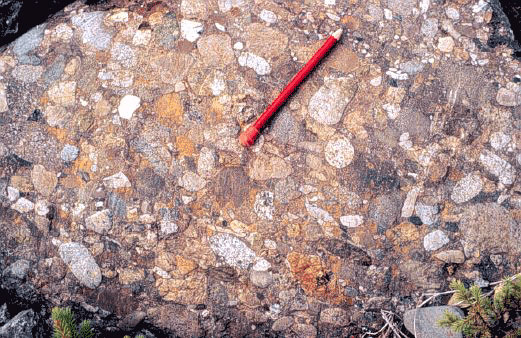
This conglomerate of an assortment of well-rounded clasts (note plutonic-rock clasts) outcrops near Presque Harbour, Placentia Bay. The matrix in this conglomerate constitutes a very small proportion of the rock and is restricted to the space between clasts.
Sandstone
A sedimentary rock composed of mostly sand-sized particles, usually cemented by calcite, silica or iron oxide.
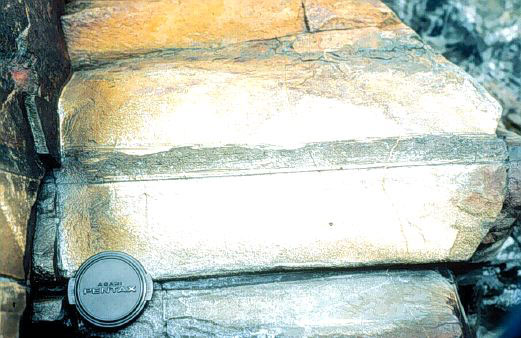
This sample of alternating light sandstone and dark siltstone beds is from the Gander Lake area of Central Newfoundland. Note erosion of the tops of the fine-grained siltstone beds by the sandstone, and grading in the sandstone. These sedimentary rocks form part of a flysch sequence.
Siltstone
A fine-grained sedimentary rock mostly composed of silt-size particles.
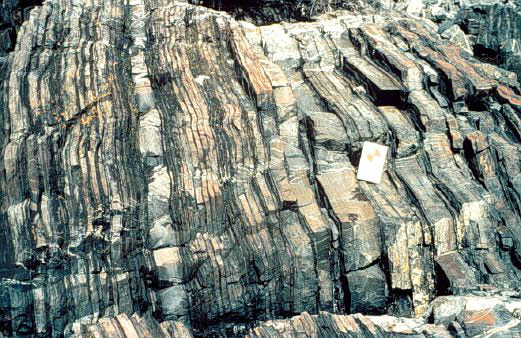
The photo, from the Gander Lake area, shows dark siltstone interbedded in a rhythmic fashion with white sandstone beds. These sedimentary rocks form part of a flysch sequence. The beds were originally deposited nearly horizontal, but are vertically dipping now because of folding.
Shale
A fine-grained sedimentary rock formed from mud or clay.
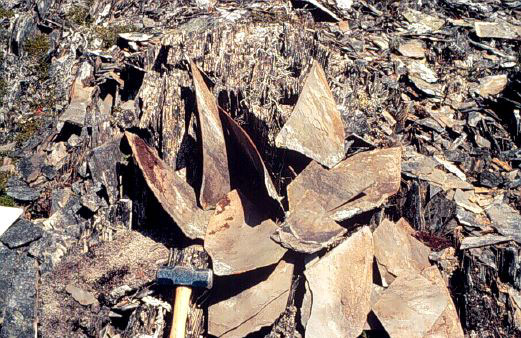
This thin-bedded, red shale, which exhibits a slaty cleavage, is located in the Newfoundland interior 30 kilometres north of the community of Grey River.
Limestone
Limestone is a sedimentary rock composed of mostly calcium carbonate that formed by chemical precipitation from seawater or by the accumulation of fossils, such as shell, coral and algal mounds.
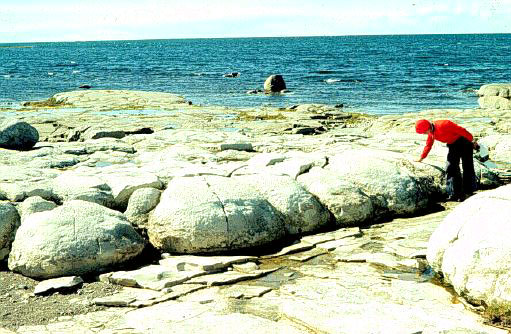
Limestone beds in the photograph comprise domal- to subspherical-shaped mounds (stromatolites) consisting of calcium carbonate and silt. These mounds were part of a colony of blue-green algae that lived during the Cambrian period. These examples occur near Flower’s Cove, western Newfoundland.