
2013
Interdepartmental
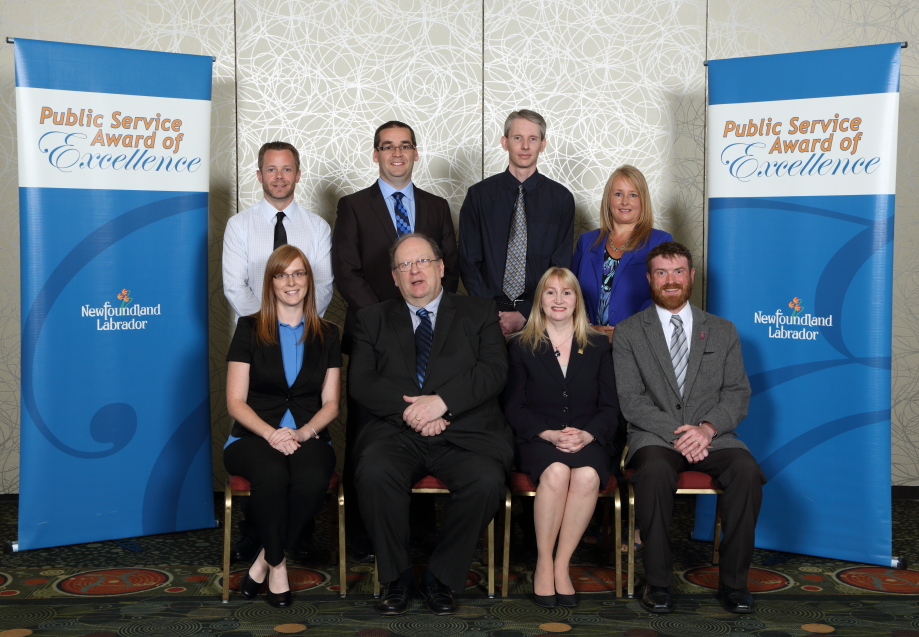
Brian Harvey, Joseph Joy, Brad Lawrence, Darryl Maddigan, Janice Mayo, Robert Piccott, April Traverse
With the knowledge and firm belief that good data enables good decisions, the Government of Newfoundland and Labrador, the Nunatsiavut Government and the Government of Canada embarked upon a Housing Needs Assessment for the five Inuit communities on the coast of Labrador in 2012.
The Government of Newfoundland and Labrador’s team comprised experts in the fields of statistical analysis, data collection, survey design and application and intergovernmental and Aboriginal affairs.
The team painstakingly designed the data collection methodology to ensure that all parties to the initiative, particularly the Nunatsiavut Government, were included to ensure that their opinions were considered and appropriately represented. In the end, a survey and data collection process was developed that adhered to Statistics Canada expectations while also respecting the unique culture, language and lifestyle of the Inuit communities.
With an astounding survey response rate of more than 90 per cent, the Nunatsiavut Government has established a solid baseline of housing needs and preferences in its communities. This information will help build healthy housing that is culturally relevant, affordable and climate-adapted and will be instrumental in supporting advocacy for greater federal housing funding. The Provincial and Federal Governments will also be able to draw upon this information when making housing decisions affecting Nunatsiavut communities.
Eager to share their expertise, members of the team travelled to Nunatsiavut communities to train and mentor local residents in the art and science of data collection. A member of the Nunatsiavut Government also spent time in St. John’s working with team members and gaining knowledge in statistical analysis. These areas of collaboration have helped to strengthen the Nunatsiavut Government’s capacity for quantitative analysis and to develop its own best practices for conducting similar statistical activities in the future.
This team’s professionalism, innovation, dedication to service delivery excellence and collaborative approach have set a new standard for partnerships and capacity building with Aboriginal governments and organizations and positioned Newfoundland and Labrador as a leader in this area.