

2006
Interdepartmental
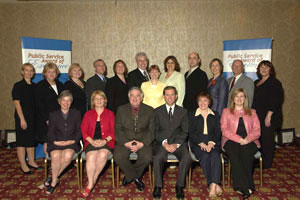
Barbara Case, Kenneth Clements, Pamela Dawe, Candice Ennis-Williams, Jay Griffin, Aisling Gogan, Ed Hayden, David Hughes, Jennifer Jeans, Cynthia King, Jackie Lake-Kavanagh, Luanne Leamon, Marilyn McCormack, Wanda Penney, Rosalind Smyth, Charlotte Strong, Chantal Walsh, Joe Whiffen
The Working Group for the Poverty Reduction Strategy has taken a non-traditional approach in tackling poverty. An exemplary group of 18 public service employees dedicated to the alleviation, reduction and prevention of poverty in Newfoundland and Labrador was formed in 2005, representing 12 government departments and agencies. Their goal was to develop a holistic approach to make a real difference in the most effective and efficient way possible.
The strategy is only the second of its kind in the country. As such, the team members have worked from the ground up to develop a strategy and chart new territory which has been positively received across the country. Horizontal policy development is a relatively new concept for government, and the Poverty Reduction Strategy proves that these policy processes do indeed work, but they require a high level of involvement by the individuals and departments assigned to the task, along with a high level of government support. The team members are trailblazers receiving recognition from all levels of government, the community, business, labour and others for their innovative and creative approach to tackling poverty.
This team and the Poverty Reduction Strategy demonstrate how government departments can work together, as well as with a broad range of community stakeholders. This team is on the cutting edge by using such a comprehensive approach between government and community agencies. The strategy is more than a working document – it is a program that works to make change happen. Government departments are, as a result, more educated and responsive to the needs of the individuals targeted by this strategy.
The Poverty Reduction Strategy is a tool to empower people and help them move toward self-sufficiency. With a goal of reducing poverty rates to the lowest in the country by 2016, this team is resolute in achieving its aim with the assistance of a group of public service employees who are focused on the objective of eradicating poverty in Newfoundland and Labrador. Through the efforts of this team, progress towards solving poverty issues in the province is becoming the order of the day.
While each of these individuals has very different perspectives, they remain focused on the strategic directions envisioned by the group. Their passion, dedication and commitment have driven this process. The level of mutual respect, and professionalism demonstrated by the team is a testament of their resolve to making a difference. The fact that the team members have assumed a leadership role in the poverty reduction initiative, in conjunction with their full-time responsibilities, is a clear indication of their commitment to deliver exceptional public service.