Government of Newfoundland and Labrador

Healthy Eating for Healthy Aging

Left Header Right Header

Welcome to Healthy Eating for Healthy Aging

Food is one of life’s greatest pleasures. Your health needs change as you age, and eating well helps provide you with energy and nutrients you need to stay healthy and independent.

This website has practical information to encourage eating well from the planning stages to putting meals on the table. It offers ideas to help make mealtimes more pleasant and satisfying and it focuses on planning, shopping, and cooking. There are also examples of nutritious, easy to make, budget friendly recipes.

Some people may have difficulty accessing healthy food. For more information, please visit the Food Access section.

If you have any questions about food or nutrition you can speak with a dietitian by calling 811 or by email. Dial-a-Dietitian is a free service connecting you directly to a local dietitian who can provide confidential and trusted nutrition advice.

Remember, eating well is just one part of healthy aging. Physical activity, adequate sleep, and good mental health are also key aspects of healthy aging.

For more information, visit these resources:
  • Physical Activity for Older Adults
  • Gov NL Mental Health
  • Bridge the Gapp
  • Canadian Coalition for Seniors Mental Health
Left Footer Right Footer
Left Header Right Header

Eating Well

  • Canada’s Food Guide
  • Mindful Eating
  • Nutrition for Older Adults
Left Footer Right Footer
Left Header Right Header

Canada’s Food Guide

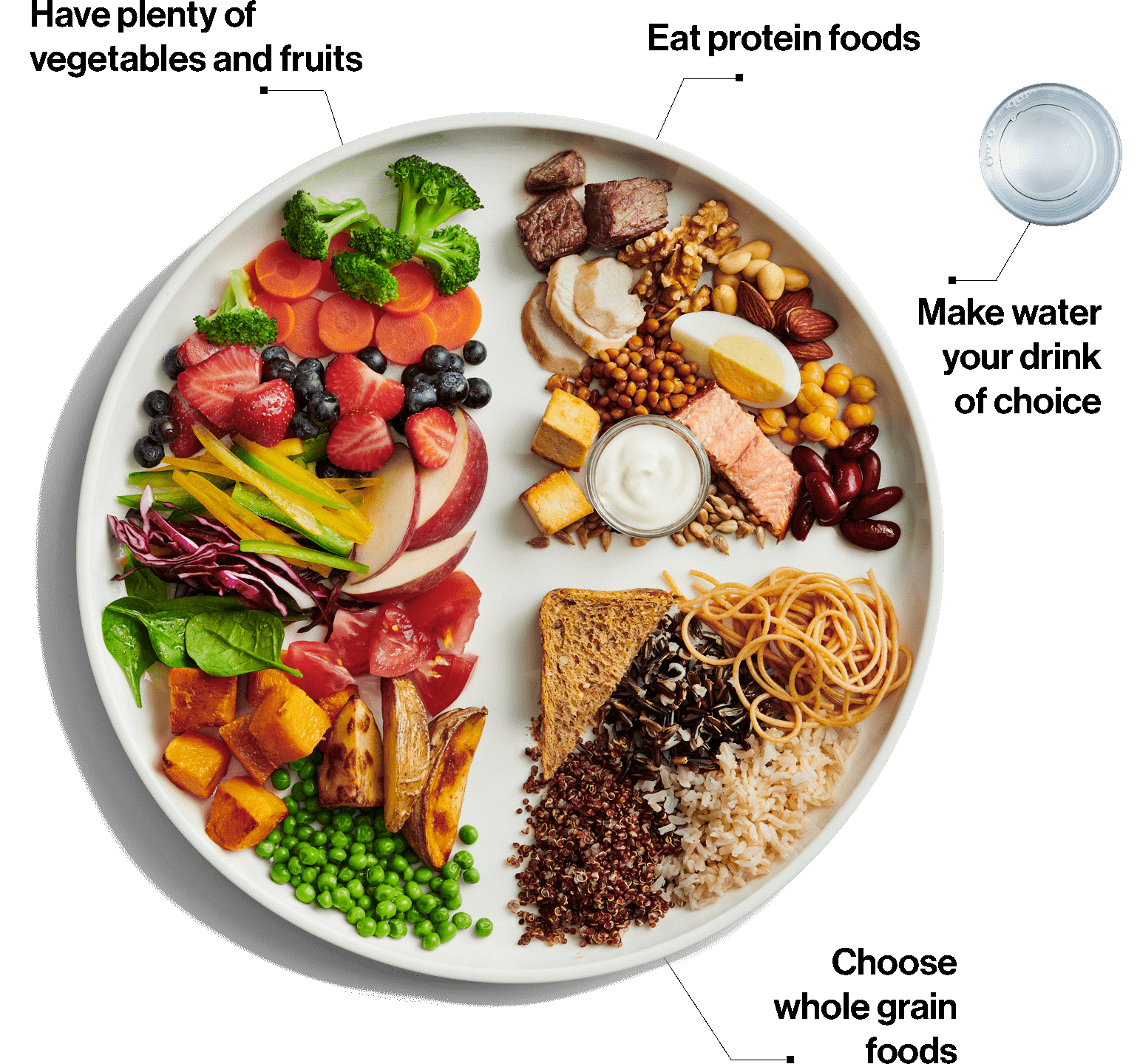
Eating well provides you with energy and nutrients you need to stay healthy and independent. Using Canada’s Food Guide can help you make the most nutritious food and drink choices you can. The guide recommends:

  • Eating a variety of foods each day by making half of your plate vegetables and fruits, and the other half protein foods and whole grains.
  • Making water your drink of choice.
  • Limiting highly processed foods that are high in sodium (salt), sugar, and saturated fats.


A plate half filled with vegetables and fruits, and the other half filled with wholegrains and protein foods. There is a glass of water next to the plate.

Left Footer Right Footer
Left Header Right Header

Mindful Eating

Healthy eating is more than the foods you eat. It is also about where, when, why and how you eat. Being more aware of what and why you eat can help you to enjoy your food.

Use these ideas from Canada’s Food Guide to help you be mindful when eating:

  • Consider your eating practices

    • How do you eat (slowly, distracted, with others)?
    • Why do you eat (were you hungry, was it offered to you)?
    • What do you eat?
    • When do you eat (what time was it, how long has it been since you last ate)?
    • Where do you eat (was it a space meant for eating)?
  • Take time to eat

    • Eat slowly and thoughtfully.
    • Don’t eat on the run or rush your meals – allow yourself time to enjoy your food.
    • Notice when you feel full or have had enough.

Group enjoying a meal together at the table.

  • Enjoy mealtimes

    • Choose a comfortable place to eat, free of electronics or other distractions – focus meals around the food.
    • Eat foods you enjoy, including those that are part of your culture and traditions.
    • Eat with others and enjoy conversations with friends and family – plan a breakfast with friends, start a regular community meal with your neighbours, plan a weekly dinner with extended family members, participate in a regular community meal program.
Left Footer Right Footer
Left Header Right Header

Nutrition for Older Adults

Adults may face challenges in eating well as they age, or have specific nutrition needs. Keep these five important nutrients in mind to support healthy aging:

WaterAn older adult drinking water from a reusable bottle.

Make sure you get plenty of fluids each day to:

  • be well hydrated;
  • digest food and absorb nutrients; and,
  • have good bowel health.

With age, some people may lose their sense of thirst so ensuring you drink water regularly is important. Here are some tips to get enough fluids:

  • drink water with meals and snacks
  • keep a jug of water on hand for easy access
  • have a glass of water when you wake up
  • carry a reusable water bottle when you are on the go
  • drink more in hot weather and when you are active
  • add fruit or herbs to hot or cold water
  • ask for water when you are eating out

Some medicines might make it even more important to get enough fluid. Make sure to drink plenty of water when taking medicine.

Calcium

  • Calcium is important to help prevent injury by supporting strong bones. If you have lower bone density or osteoporosis, please speak to your doctor or registered dietitian for specific nutrient requirements.
  • Sources of calcium include cow’s milk, yogurt, cheese, plant-based beverages (fortified with calcium), canned fish with soft bones (salmon, sardines), tofu, almonds and some dark green vegetables including bok choy and kale.

Vitamin D

  • Health Canada recommends adults age 50+ take a daily vitamin D supplement of 10 μg (400 IU). Talk to your doctor, registered dietitian or pharmacist before taking any supplements since they may interfere with some medications.
  • Food sources of vitamin D are also important. Vitamin D is found in cow’s milk, plant-based beverages (fortified with vitamin D), egg yolks, fatty fish such as salmon and rainbow trout, and margarine (fortified).

Vitamin B12

  • Vitamin B12 helps support your nervous system, helps make red blood cells and prevents a type of anemia.
  • Older adults need to eat foods containing B12 including meat, fish, poultry, eggs and milk products.

Fibre

  • Fibre is found in foods such as vegetables, fruits, whole grain breads and cereals, nuts, seeds and legumes (dried peas, beans, soy and lentils).
  • Eating these foods, along with getting enough fluids and activity, can help you maintain normal bowel habits. High-fibre foods can also help lower blood cholesterol levels, control blood sugar levels, and help prevent high blood pressure.

If you are experiencing a loss of appetite, try the following tips:

  • Increase the flavour of food by adding herbs and spices. Check out this list of spices and how to use them.
  • Try eating smaller amounts of food more often. For example, eat 4-5 small meals instead of 2-3 big meals a day.
  • Speak to your doctor if any of your medications are causing a reduced appetite.
  • If you are feeling lonely, try eating with others. Eat with family and friends (in-person or virtually!) or take part in community meals.
  • Plan meals in advance so you have foods ready to go.
  • Try being more active, such as taking a walk, before mealtime to help stimulate appetite.
  • Making larger meals and freezing portions for times when you don’t feel like cooking.
Left Footer Right Footer
Left Header Right Header

Grocery Shopping

  • Tips to Make Your Trip to the Grocery Store Easier
  • Food Access
Left Footer Right Footer
Left Header Right Header

Tips to Make Your Trip to the Grocery Store Easier

The following information can help make your trip to the store easier, and cut down on costs.

Older adult pushing a cart in the grocery store.

  • Prepare before you go
  • Read food labels
  • Be aware of food marketing
  • Try grocery shopping from home
  • Save money at the grocery store

Prepare before you go

  • Use Canada’s food guide to plan meals and snacks. Include vegetables and fruits, whole grain foods and protein foods.
  • Check foods you have on hand. Make a list of only the foods you need to buy in order to prepare the meals and snacks in your plan.
  • Keep your shopping list handy so you can add to it as supplies run low.
  • Look for sales. Check out flyers, emails, websites, mobile apps and social media.
  • Find coupons that match your shopping list. Use coupons to buy only the foods that you need and want.
  • Check grocery store for member discount programs or bonus days (e.g., seniors discount day).
  • Consider shopping with a friend. You can buy larger (or bulk) grocery items and share. You can also share rides to and from the store.
  • Shop when the store is not as busy, so employees will have time to help with items that are hard to reach or lift.

^ Top of Page

Read food labels

Looking at food labels can help you make the best choices for you. You may be looking for foods higher in fibre or lower in sodium for example, and the label can help you learn more about what is in the food. Here are some tips:

  • Check the list of ingredients. They are listed from the largest amount of a particular ingredient in the food to the smallest amount.
  • Look at the Nutrition Facts Table and check the serving size to compare it to how much you are eating.
  • Also in the Nutrition Facts Table, look at the Percent Daily Value (%DV) for nutrients. A simple rule of thumb: 5% or less is a little, 15% or more is a lot for any nutrient. Choose foods that are lower in salt, sugar and saturated fat.
  • For more information, visit:
    • Health Canada 
    • Understanding Food Labels
    • Healthy Canadians labelling video

^ Top of Page

Be aware of food marketing

  • Food marketing is advertising that promotes the sale of certain food or food products. Many foods and drinks that are marketed may be high in sodium (or salt), sugar or saturated fat.
  • At the grocery store, this will most likely be in the form of branding, celebrity endorsements, free samples and sales promotions, and product placement. To ensure you are making an informed decision while shopping, consider the following:
    • Why do you want to purchase a certain food or drink (Does it provide a nutritional benefit? Is it healthy? Is the packaging appealing? Did you see a commercial about that product? Do you like the taste?).
    • Where/how did you hear about this product? (A sponsored social media post? A celebrity endorsement? In a magazine or on TV?).
    • Are there nutrition claims on the product? A nutrient content claim can help you choose foods that contain a nutrient you may want more of (e.g., source of fibre, high in vitamin A) or less of (sodium-free, low fat). Keep in mind, nutrient claims are optional and only highlight one nutrient, so you still need to refer to the Nutrition Facts table to make food choices that are better for you.
  • For more information on marketing awareness and nutrition claims, visit Canada’s Food Guide or Government of Canada.

^ Top of Page

Try grocery shopping from home

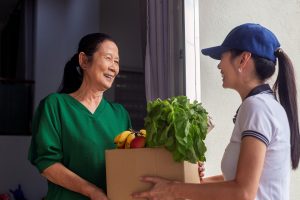
  • If you can’t get to the store yourself, try shopping on grocery store websites or calling the store to place an order. Check whether your grocery store offers a delivery service, or contact a local senior centre, where they may have volunteer drivers. Check out the information below, from Seniors NL, on grocery stores with online or call-in ordering, with delivery or pick up options:Someone receiving a grocery delivery at their home.
    • Central-Coast of Bays and Exploit’s Valley
    • Central-Green Bay and Beothuk Trail
    • Central-Kittiwake Coast
    • Western-Northwest
    • Western-Southwest
    • Avalon and Conception Bay North
    • St. John’s and surrounding area
    • Labrador
    • Northern Peninsula

^ Top of Page

Save money at the grocery store

Use the following tips to save money and eat well:

  • Take advantage of discount days for seniors offered by some grocery stores.
  • Look for fresh foods, e.g., produce, meat and fish in the grocery store that have been marked down close to their best before date. Use these foods right away or freeze.
  • Buy canned or frozen vegetables and fruits (with no extra added sugar or salt). You don’t need to clean or chop them, you save money, and they won’t spoil in your crisper! You get the same health benefits whether your vegetables and fruits are fresh, frozen or canned.
  • Bulk bins allow you to buy exactly the amount you want of many staples. Items from bulk bins are often cheaper than prepackaged items.
  • Buy the size that is right for you. Smaller portions are available for a variety of foods (soup, fruits, vegetables, baked beans, stews, pudding, yogurt, cheese) and may be worth the extra cost if you can avoid throwing any away. If the larger size is less expensive but more than you can use, share the extra with a friend, or depending on the food freeze it in portions for later.

For more information see Affordable Healthy Eating

^ Top of Page

Left Footer Right Footer
Left Header Right Header

Food Access

If you need support to access food, visit the following resources and services:

  • Affordable Healthy Eating – A resource with tips and tools to help you save money at the grocery store.
  • 211 –Information on local food programs in your community.
  • Local Programs Map – This map shows community gardens, food banks, community freezers, farmers’ markets, and free/low cost meals across the province.
Left Footer Right Footer
Left Header Right Header

Cooking for One or Two

As we age, the people we cook for may change. Some days you might cook for your family or friends, while other times you may cook for yourself. This section will help you to adjust to these changes by providing you with information on:

  • Easy Meals to Make
  • Creative Use of Leftovers
  • Make it Enjoyable
  • Foods to Keep on Hand
Left Footer Right Footer
Left Header Right Header

Easy Meals to Make

Can’t think of anything to make for meals? Try the following ideas using ingredients you have on hand. Enjoy water to drink with meals and snacks.

Breakfast

  • Whole grain toast, scrambled eggs and orange slices.
  • Pancakes, berries and milk.
  • Oatmeal topped with banana and yogurt.
  • Whole grain or bran cereal, fruit and milk.
  • French toast and fruit salad.
  • Bran muffin and smoothie made with milk, yogurt and frozen fruit.

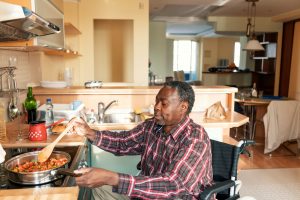
Older adult, who uses a wheelchair, cooking at the kitchen stove.

Lunch

  • Peanut butter and banana sandwich, milk.
  • Beans on whole grain toast, tomato slices.
  • Macaroni and cheese (add tuna and frozen peas).
  • Leftover homemade chili, whole wheat roll, yogurt.
  • Boiled egg, whole grain toast, orange slices.
  • Sandwich with leftover chicken or turkey topped with tomato slices and lettuce on whole wheat bread, milk.
  • Cottage cheese, canned fruit, homemade bran muffin.
  • Garden salad topped with canned chickpeas and whole wheat bun.

Supper   

  • One-pot casserole using meat, poultry or beans; vegetables (fresh, frozen or canned); rice or pasta; sauce of your choice such as low sodium soup or broth.
  • Baked fish with broccoli and brown rice.
  • Pasta, tomato or meat sauce, leafy green salad, milk.
  • Meatloaf baked in muffin tins (ground beef, chopped onion, spices) baked potato, mixed vegetables.
  • Fish and vegetable chowder, whole grain roll.
  • Stir-fry (any fresh or frozen vegetables with chicken, beef, pork, shrimp, tofu and choice of low sodium sauce) on brown rice or noodles, milk.
  • Fried egg, cheese, tomato and lettuce on whole grain bun with apple slices.
  • Lentil soup, tossed salad, whole grain roll.
  • Flatbread pizza: tomato sauce, vegetables and mozzarella cheese baked on whole grain pita, tortilla or naan bread.
  • Cheese and vegetable omelette and whole grain toast.

For more ideas, visit the Recipes page.

If you would like a break from cooking or need support with meals, consider Meals on Wheels  if offered in your area.

Reminder – Many grocery stores offer ready-to-eat meals such as soups or casseroles. Some of these are nutritious; however, some may be higher in sodium (salt), sugar or saturated fat. These convenience items may also not be affordable for everyone. Cooking at home supports eating well. You can cook extra portions or save your leftovers and freeze for later so they are ready to heat and enjoy.

Left Footer Right Footer
Left Header Right Header

Creative Use of Leftovers

Using leftovers can make meal preparation easier, reduce food waste and save time. Just about anything leftover can go into a stir-fry, casserole, soup or salad!

Here are some ideas to get you started:

Vegetables and Fruit

  • Add leftover cooked vegetables to green salad, omelette, pasta, soup or casserole.
  • Use extra fruit to top cereal, pancakes or waffles, or mix fruit with yogurt or cottage cheese. You can also add fruit to muffins or make into sauces like applesauce.
  • Freeze overripe bananas and use in loaves and muffins.

Whole Grain Foods

  • Chill leftover cooked whole grain pasta to make pasta salad, soups or casseroles.
  • Use leftover cooked whole grain rice in soups or casseroles. Use whole grain bread to make crumbs to coat chicken or fish, to make dressing/stuffing, or as a casserole topping.
  • Cube whole grain bread to make bread pudding or use for croutons (sprinkle with spices and toast in the oven) in salads or soups.

Protein Foods

  • Add leftover cooked ground beef or canned beans to soup, casseroles, chili, pasta dishes, tacos or stuffed peppers.
  • Use leftover salmon (fresh or canned) to make salmon cakes or as a sandwich filling.
  • Make shepherd’s pie or stew with leftover meat and vegetables.
  • Use leftover cooked chicken, turkey, beef or pork in stir-fries, soups, casseroles, sandwiches or salads.
Left Footer Right Footer
Left Header Right Header

Make it Enjoyable

Start with foods you like to eat and consider the suggestions below to make meals more enjoyable.

Cheerful older adults having fun while eating watermelon in the backyard.
 

Create a pleasant setting

  • Set a table with flowers, a place mat and napkin and use candles (try battery-operated).
  • Listen to music.
  • Take your meal out on the porch, sit near a window or go to the park for a picnic.
  • Enjoy a dinner out in a restaurant occasionally. Ask for a container to take leftovers home.

Share meals with others

Studies show that when you eat with others, you eat healthier. Try having some meals with friends, family members or neighbours and enjoy their company while you dine.

Eating with others can also help you meet new people and celebrate your culture and food traditions. To enjoy the benefits of eating with others:

  • Share a potluck dinner with friends, or form a regular lunch group.
  • Start a club, such as a SOUPer Supper Club, in which the host makes soup and others bring bread, salad or fruit.
  • Join a community kitchen or share cooking with friends. Find a place to come together to plan, shop and prepare several meals together. Take the meals home and freeze for later.
  • Exchange recipes or ask others who are alone for ideas and suggestions, and share yours.
  • Teach your grandchildren or youth in your community how to cook or bake.
  • Check for events at your local community centre.
Left Footer Right Footer
Left Header Right Header

Foods to Keep on Hand

Having non-perishable food and some frozen food on hand is a big help if you cannot get to the store. You can plan quick and creative meals with just a few basic items. For information on proper storage, visit the Food Safety section.

In your pantry, keep:

  • Canned vegetables and fruits.
  • Canned salmon, tuna, chicken, beans, lentils, chickpeas.
  • Low fat canned milk, dried skim milk powder, shelf-stable milk or unsweetened fortified soy beverage.
  • Canned soup and pasta sauces, look for those with lower sodium (salt).
  • Dried fruits, nuts, peanut (or other nut) butter.
  • Whole grain pasta and crackers, oatmeal, whole grain ready to-eat cereals.
  • Brown rice or other grains (e.g., couscous, quinoa).
  • Coffee and tea.

It may also be a good idea to keep some essential baking/cooking ingredients on hand such as whole wheat flour, sugar, baking powder and baking soda.

In your freezer, keep:

  • Frozen vegetables and fruits.
  • Whole grain bread, rolls and muffins.
  • Frozen meat, fish or poultry (without breading).
Left Footer Right Footer
Left Header Right Header

Food Safety in Your Home

Food safety is important to everyone. To reduce the risk of food-borne illness it is important to follow safe food handling, cooking and storage practices.

  • The Core Four
  • Food Storage
Left Footer Right Footer
Left Header Right Header

The Core Four

When preparing food, remember to use the Core Four to prevent the risk of food poisoning in your home.

  • Clean
  • Separate
  • Cook
  • Chill
  1. Clean

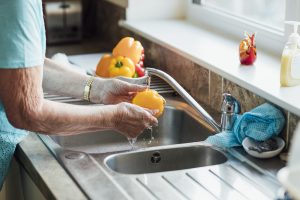
    Washing peppers at the sink.

  • Wash your hands with soap and warm water for at least 20 seconds, especially before handling food or eating, after handling raw meats, using the toilet, touching pets/animals, and changing diapers.
  • Wash counters, utensils, cutting boards, and other surfaces with hot soapy water after they come into contact with raw meat.
  • Wash all produce thoroughly with water before cooking or eating.

^ Top of Page

  1. Separate

  • Don’t cross-contaminate! Separate raw meat, poultry, seafood and eggs from other foods in your grocery shopping cart, grocery bags, and in your refrigerator.
  • Store raw meats below ready-to-eat foods, on lower refrigerator shelves, to prevent contamination caused by dripping.
  • Use one cutting board for fresh produce and a separate one for raw meat, poultry and seafood.
  • Don’t rinse raw poultry or meat.
  • Never place cooked food on a plate that previously held raw meat, poultry, seafood, or eggs.

^ Top of Page

  1. Cook

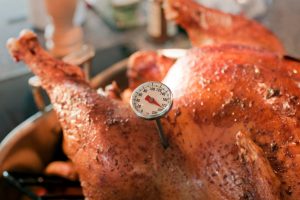
    A thermometer reading approximately 190°F in a cooked chicken.

  • Cook food thoroughly to kill harmful bacteria that may be present in or on the food. This is very important for poultry and ground beef.
  • Use a kitchen (or food) thermometer to make sure that the food is cooked to a safe internal temperature.
  • Keep all hot foods at 60˚C (140˚F) or more, to prevent the growth of bacteria.
  • Follow the table below to ensure you cook food to the proper temperature. Click here for more information on cooking temperatures.


Food Temperature Needed
Mixtures containing poultry, eggs, meat, fish etc. Internal Temperature of 74˚C (165˚F) for 10 minutes
Pork, Lamb, Veal, Beef (whole cuts) Internal Temperature of 70˚C (158˚F)
Roast Beef (rare) Internal Temperature of 63˚C (145˚F) for 3 minutes
Poultry Internal Temperature of 85˚C (185˚F) for 15 seconds
Stuffing in Poultry 74˚C (165˚F)
Ground Meat, Fish 70˚C (158˚F)
Eggs 63˚C (145˚F) for 15 seconds

^ Top of Page

  1. Chill

  • Refrigerate leftovers within two hours or less in uncovered, shallow containers to cool quickly.  Click here for more information on storing leftovers.
  • Refrigerate all perishable foods at 4˚C (40˚F) or less, to prevent the growth of bacteria.
  • Thaw frozen foods in a refrigerator, cold water, or a microwave oven, not at room temperature.
  • Do not refreeze thawed food.

For more information on food safety, visit Health Canada

^ Top of Page

Left Footer Right Footer
Left Header Right Header

Food Storage

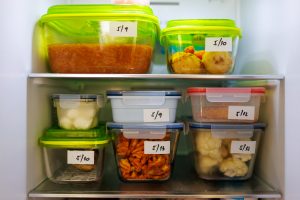
Remember food safety when storing food as well:Containers of food with dates on them, stored in the freezer.

  • Keep raw meat, poultry and seafood cold. Refrigerate it as soon as you return home from the grocery store. Use it up or freeze it by the best-before date on the package.
  • Keep leftovers in the fridge for a maximum of two to three days. Freeze leftovers if storing for longer.
  • Leftovers can be frozen and used within two or three months. Be sure to label and date all packages.
  • Remember “first in, first out.” Arrange food in your cupboards, fridge or freezer so that the oldest items are used first.
  • The best place to store vegetables and fruits depends on the type. Some are best stored on the counter or in a cool dark place, and others in the refrigerator or freezer. See the vegetables and fruits website for more information.

For more information on safe food storage visit Health Canada’s website.


Left Footer Right Footer
Left Header Right Header

Recipes

The recipes included in this resource show how fast, easy and tasty healthy eating can be. The recipes are listed in the following categories:

  • Salads and Soups
  • Main Dishes
  • Baked Goods


Left Footer Right Footer
Left Header Right Header

Overview

The recipes included in this resource show how fast, easy and tasty healthy eating can be. Most of the recipes include suggestions for preparing a complete healthy meal, based on Canada’s Food Guide. Many are intended to serve one or two. Other recipes keep well in the refrigerator or freezer so you will be able to enjoy the meal again another day.

  • Salads and Soups
  • Main Dishes
  • Baked Goods

You may have your own recipes and want to add different herbs and spices for a change. There are several prepared salt-free seasoning mixes available at your local grocery store. You can also try making your own spice blend that does not include salt. For example, mix the following together in a salt or pepper shaker (or small container) and use to enhance the flavour in many recipes:

Amount (imperial) Ingredients Amount (metric)
1 tbsp
1 tbsp
1 tbsp
1 tbsp
1 ½ tsp
1 tsp
1 tsp
Dry mustard
Paprika
Garlic powder (not garlic salt)
Onion powder (not garlic salt)
Black pepper
Dried basil
Dried thyme
15 mL
15 mL
15 mL
15 mL
7 mL
5 mL
5 mL

From BC Seniors Guide to Healthy Eating

Left Footer Right Footer
Left Header Right Header

Salads and Soups

Click on a soup or salad in the list below to view the recipe:

  • Mixed Bean Salad
  • How to Cook Dried Beans
  • Vegetable Chowder with Cheddar
  • Minestrone Soup
  • Split Pea Soup


Left Footer Right Footer
Left Header Right Header

Mixed Bean Salad

Makes about 10, 1 cup servings.

Amount (imperial) Ingredients Amount (metric)
19 oz can
19 oz can
14 oz can
14 oz can
1
1
2/3 cup
1/3 cup
¼ cup
½ tsp
Dash
Kidney beans*
Chickpeas*
Yellow wax beans
Green beans
Medium onion, chopped
Medium green pepper, chopped
Vinegar
Vegetable oil
Sugar
Dried basil (optional)
Salt and pepper
540 mL
540 mL
398 mL
398 mL
1
1
167 mL
83 mL
63 mL
2.5 mL
Dash

* Or use about 2 cups of cooked dried kidney beans and about 2 cups of cooked dried chickpeas. To cook dried beans, see How to Cook Dried Beans recipe.

Directions: 

  1. Drain and rinse all the canned beans and chickpeas. Put all the beans, chickpeas, onion, and green pepper into a large bowl.
  2. Mix vinegar, oil, sugar, and basil in a small bowl. Pour over bean mixture. Mix well.
  3. Add salt and pepper to taste. Cover and refrigerate until cold.
  4. Just before serving, stir gently.
  5. Serve with a whole grain roll.

Adapted from: The Basic Shelf Cookbook, 2011 Edition, Canadian Public Health Association

Left Footer Right Footer
Left Header Right Header

How to Cook Dried Beans

Beans, split peas, chickpeas, and lentils all belong to the legume family. Legumes are plant foods which are high in protein, iron, and fibre. Canada’s Food Guide recommends eating more plant-based sources of protein. You can try using legumes instead of meat in many recipes. It can also help you save money.

Canned beans are cooked and ready to use. Just drain and rinse them first.

Dried beans (except split peas and lentils) need to be soaked before cooking. Rinse beans and sort out any grit before you soak them.

Soak dried beans

  1. Put beans in a large pot.
  2. Add about 3 cups of water for each cup of beans.
  3. Follow one of the soaking methods below:
  4. Overnight Soaking Method: Let soak for eight to 12 hours or overnight. Drain.
  5. Quick Soaking Method: Turn stove on high heat. Heat beans to boiling. Reduce heat to low. Simmer for two to three minutes. Turn off heat, cover and let stand for at least one hour. Drain.

Cook dried beans

  1. Turn stove on high heat. Put soaked and drained beans in a large pot.
  2. Add 2½ cups of water for each cup of beans.
  3. Bring to a boil then reduce heat to low. Cover and simmer until tender. Cooking times vary. Most beans take 1½ to two hours to cook.

How much to cook

Remember that beans will double when cooked. Use this chart to help figure out how much to cook.

If you need… Use…
1 cup cooked beans ½ cup raw dried beans
2 cups cooked beans 1 cup raw dried beans
3 cups cooked beans 1½ cups raw dried beans
4 cups cooked beans  2 cups raw dried beans

Adapted from: The Basic Shelf Cookbook, 2011 Edition, Canadian Public Health Association

Left Footer Right Footer
Left Header Right Header

Vegetable Chowder with Cheddar

Makes about 6, 1 cup servings.

Amount (imperial) Ingredients Amount (metric)
1 tbsp
1 small
1 cup
½ cup
1 cup
3 cups
1 cup
Pinch
Dash
1 cup
½ cup
Vegetable oil
Onion, chopped
Carrots, diced
Celery, diced
Peeled potato, diced
Low-sodium chicken or vegetable broth
Hot milk (fresh or evaporated/canned)
Cayenne pepper
Salt and freshly ground black pepper
Whole wheat croutons
Shredded cheddar cheese
15 mL
1 small
250 mL
125 mL
250 mL
750 mL
250 mL
Pinch
Dash
250 mL
125 mL

Directions: 

  1. In a large saucepan, heat oil over medium heat. Sauté onion, carrots, and celery until tender, about five minutes.
  2. Stir in potato. Add broth and bring to a boil.
  3. Reduce heat, cover, and simmer for 25 minutes or until vegetables are just soft.
  4. Stir in milk, cayenne pepper and salt and pepper to taste.
  5. Ladle into warmed bowls and garnish with croutons and cheese.
  6. Enjoy chowder with whole grain crackers or roll and a piece of fruit.

Reprinted with permission of Dietitians of Canada from Simply Great Food, published by Robert Rose Inc., 2007.

Left Footer Right Footer
Left Header Right Header

Minestrone Soup

Any type of canned or dried beans can be used in this recipe.
Makes about 9, 1-cup servings.

Amount (imperial) Ingredients Amount (metric)
6 cups
4 cups
3 cups
2 cups
28 oz can
½ tsp
Dash
Homemade chicken stock*
Cabbage, chopped
Carrots, diced
Cooked navy beans** (or 19 oz. can white kidney beans, drained and rinsed)
Tomatoes
Garlic powder
Salt and pepper
Parmesan cheese, grated (optional)
1.5 L
1 L
750 mL
500 mL
796 mL can
2.5 mL
Dash

* See Homemade Chicken Stock recipe or use store brought chicken broth or bouillon cubes.

** To cook dried navy beans, see How to Cook Dried Beans recipe.

Directions: 

  1. Turn stove on high heat. Put homemade chicken stock in a large pot and heat to boiling.
  2. Reduce heat to low. Add chopped cabbage and diced carrots. Cover and simmer until vegetables are tender, about 20 minutes.
  3. Stir in beans, tomatoes, and garlic powder. Add salt and pepper to taste. Cover and cook five minutes longer.
  4. Serve in bowls with Parmesan cheese on top, if desired. Enjoy soup with whole grain crackers or roll and fruit.

Adapted from: The Basic Shelf Cookbook, 2011 Edition, Canadian Public Health Association.

Left Footer Right Footer
Left Header Right Header

Split Pea Soup

Makes about 4, 1 cup servings.

Amount (imperial) Ingredients Amount (metric)
3 cups
1 cup
1
2
½
1
1
Dash
Chicken broth
Yellow split peas
Onion, chopped
Carrots, sliced
Turnip (small), cubed
Parsnip, sliced (optional)
Clove garlic, minced*
Pepper to taste
750 mL
250 mL
1
2
½
1
1
Dash

* 1 clove of garlic can be substituted with ¼ tsp (1.25 mL) of garlic powder

Directions: 

  1. Bring chicken broth to a boil and add split peas.
  2. Simmer for about two hours, stirring occasionally.
  3. Add small amount of water as chicken broth evaporates.
  4. When split peas become mushy, add onion, vegetables and garlic.
  5. More water may be required. Continue to simmer until vegetables are cooked.
  6. Enjoy pea soup with whole grain bread and canned fruit.

Adapted from: Agnes and Ron Richard, Gander, NL (Healthy Heart Cooking, NL).

Left Footer Right Footer
Left Header Right Header

Main Dishes

Click on a dish in the list below to jump to the recipe:

  • Fish and Vegetable Casserole
  • Tuna with Noodles
  • Tuna Melt
  • Tasty Salmon Loaf for Two
  • Fish Cakes for Two
  • Vegetable Frittata
  • Easy Chicken Stir-Fry
  • Homemade Chicken Stock
  • Hearty Beef Stew
  • Lentil and Rice Casserole
  • Tomato Macaroni and Cheese Casserole
  • Tuna Fish Casserole
  • Salmon, Kale, and Tomato in Parchment 
  • Turkey, Bean, and Cheddar Chili
  • One Pot Caribou or Moose Stew 
  • Easy One Pot Chicken Stew


Left Footer Right Footer
Left Header Right Header

Fish and Vegetable Casserole

Makes about 4 servings.

Amount (imperial) Ingredients Amount (metric)
1 lb
1
1 cup
1
1 cup
3 tbsp
3 tbsp
Dash
Dash
1½ cups
1 cup
Cod fillets (or other white fish), fresh or frozen (thawed)
Medium onion, chopped
Potatoes, diced
Medium carrot, diced
Peas, frozen
Canola oil
Flour
Salt
Pepper
Milk, low fat
Whole grain breadcrumbs
Grated cheese (optional)
454 g
1
250 mL
1
250 mL
45 mL
45 mL
Dash
Dash
375 mL
250 mL

Directions:

  1. Preheat oven to 350°F (175°C).
  2. Place fish in a greased casserole dish and top with onion. Bake for about 15 to 20 minutes.
  3. While the cod is cooking, boil potatoes and carrots in pot until tender-crisp (not completely cooked). Add peas, then set aside.
  4. Heat the oil in a small pot on low heat and whisk in flour, salt and pepper. Gradually add milk, cooking on medium heat until thickened.
  5. Break fish into pieces and place vegetables on top. Pour the sauce over the fish and vegetables. Sprinkle with breadcrumbs. Bake for 20 to 25 minutes.
  6. Top with grated cheese, if desired.
  7. Serve with a whole grain roll and fruit.

Contributed by: Jackie Foote, Milltown, NL

Left Footer Right Footer
Left Header Right Header

Tuna with Noodles

Makes about 2 servings.

Amount (imperial) Ingredients Amount (metric)
1 tbsp
1 tbsp
½ tsp
Dash
½ cup
1 cup
6.5 oz can
Margarine
Flour
Chicken bouillon powder (try lower sodium variety)
Pepper
Milk
Peas (frozen works best)
Tuna
15 mL
15 mL
2.5 mL
Dash
125 mL
250 mL
185 mL can

Directions: 

  1. Melt margarine in a small saucepan. Add flour, bouillon, and pepper to make a roux. Slowly whisk milk to make a white sauce.
  2. Add peas and tuna.
  3. Serve on whole grain noodles (or brown rice). Add an extra vegetable or fruit on the side!

Adapted from: The Senior Chef: Cooking for One or Two, BC Ministry of Health and Ministry Responsible for Seniors

Left Footer Right Footer
Left Header Right Header

Tuna Melt

Makes about 1 serving. 

Amount (imperial)  Ingredients  Amount (metric) 
½ 6.5 oz can
1½ tsp
1 tsp
1 tsp
Dash
1
1 tbsp 
Tuna fish
Mayonnaise
Green pepper, finely chopped
Celery or onion, finely chopped (optional)
Worcestershire sauce
Whole grain roll or slice of whole wheat bread
Grated cheese 
92 mL
7.5 mL
5 mL
5 mL
Dash
1
15 mL 

  Directions: 

  1. Combine tuna fish, mayonnaise, green pepper, celery or onion and Worcestershire sauce. Mix well. 
  2. Spread tuna mixture on the whole grain bun or bread and top with cheese (or bread*). 
  3. Place on a pan and put under the broiler until cheese melts. Serve hot. 
  4. Serve with fruit. 

*Note: If bread is used, toast it first or place it under the broiler for one minute, turnover and broil one minute more. Then, top with tuna mixture and cheese and follow directions for broiling. 

Adapted from: The Senior Chef: Cooking for One or Two, BC Ministry of Health and Ministry Responsible for Seniors 


Left Footer Right Footer
Left Header Right Header

Tasty Salmon Loaf for Two

Makes about 2 servings.

Amount (imperial) Ingredients Amount (metric)
7.5 oz can
1
Dash
¼ tsp
½ cup
¼ cup
¼ cup
Dash
½ tsp
Salmon
Egg
Salt
Pepper (or add to taste)
Soft whole grain breadcrumbs*
Celery, chopped (or ¼ cup bell peppers, chopped)
Onion, finely chopped
Worcestershire sauce (optional)
Savoury (optional)
213 mL
1
Dash
1 mL
125 mL
63 mL
63 mL
Dash
2.5 mL

*1/2 cup of soft whole grain breadcrumbs can be substituted with 1 slice of whole grain bread, crumbled

Directions: 

  1. Preheat oven to 350°F (175°C).
  2. Mash salmon with liquid and blend well with all other ingredients in a bowl.
  3. Put into a small, lightly oiled casserole or loaf pan and bake at for 30 to 40 minutes or until top is browned.
  4. Serve with steamed spinach or frozen vegetables with baked potato, and whole wheat roll.

Variation:  Salmon Patties

  1. Form into four patties.
  2. Cook in an oiled skillet over medium heat until brown. Turn once during cooking.
  3. Serve with fresh lemon wedges.

Adapted from: The Senior Chef: Cooking for One or Two, BC Ministry of Health and Ministry Responsible for Seniors

Left Footer Right Footer
Left Header Right Header

Fish Cakes for Two

Makes about 2 servings.

Amount (imperial) Ingredients Amount (metric)
½ lb.
2 tbsp
¼ tsp
Dash
1 cup
1 cup
Cod or other fish
Onion, diced
Table salt
Pepper
Potato, peeled and boiled
Vegetable oil
227 g
30 mL
1 mL
Dash
250 mL
250 mL

Directions: 

  1. Boil fish in tightly covered pot, with as little water as possible, with diced onions, salt and pepper, for about ten minutes.
  2. Boil potatoes in a separate pot and mash once cooked.
  3. Combine cooled fish and cooled potatoes, form into four patties and fry in oil until browned on both sides.
  4. Serve fish cakes with a slice of whole grain bread, and your favorite vegetable.

Adapted from: The Senior Chef: Cooking for One or Two, BC Ministry of Health and Ministry Responsible for Seniors

Left Footer Right Footer
Left Header Right Header

Vegetable Frittata

A perfect recipe if you have a leftover cooked potato, but still delicious without the potato!

Makes about 2 servings.

Amount (imperial) Ingredients Amount (metric)
2
1 tsp
1 tbsp
1 tbsp
1 tbsp
½ cup
2 tbsp
Eggs
Margarine
Onion, chopped
Green pepper, chopped
Mushrooms, chopped (about 1 mushroom)
Cooked potato, thinly sliced
Grated cheese
2
5 mL
15 mL
15 mL
15 mL
125 mL
30 mL

Directions: 

  1. Beat eggs in a small bowl. Set aside.
  2. Turn on stove to medium heat. Melt margarine in a small fry pan. Add onion, green pepper and mushrooms and cook until soft, about 5 to 7 minutes. Drain off any liquid.
  3. Next, pour eggs over vegetables in fry pan. Turn heat to low, cover and cook until eggs are cooked but still soft in the middle.
  4. Arrange potato slices on top of eggs. Sprinkle with cheese. Cover and cook a few minutes longer until cheese is melted. Serve right away.
  5. Serve with whole grain bread.

Adapted from: The Basic Shelf Cookbook, 2011 Edition, Canadian Public Health Association

Left Footer Right Footer
Left Header Right Header

Easy Chicken Stir-Fry

This stir-fry tastes great with any type of vegetable – fresh, frozen, or canned. You can also use boneless chicken thighs, lean pork or your favorite lean meat.

Makes about 4-6 servings.

Amount (imperial) Ingredients Amount (metric)
¾ cup
2 tbsp
1 tsp
2 tsp
¾ lb.
4 cups
2 tbsp
1
6
2 tsp
Homemade chicken stock or homemade vegetable stock*
Soy sauce
Sugar
Cornstarch
Boneless chicken breast or thighs
Mixture of vegetables**
Vegetable oil
Onion, cut into thin wedges
Cloves garlic, minced***
Minced ginger****
188 mL
30 mL
5 mL
10 mL
340 g
1 L
30 mL
1
6
10 mL

*See Homemade Chicken Stock recipe on the next page or use store-bought chicken broth or bouillon cubes.
** Use any vegetables you have on hand such as carrots, broccoli, peppers or try frozen vegetable blends.
*** 6 garlic cloves can be substituted with ¾ tsp. (4 mL) of garlic powder.
****2 tsp. of minced ginger can be substituted with ¼ tsp. (1 mL) of ginger powder

Directions: 

  1. Place the stock, soy sauce, sugar and cornstarch in a small bowl. Whisk together and set this sauce aside.
  2. Cut the chicken into thin strips.
  3. Using a clean cutting board, slice the vegetables into bite-sized pieces.
  4. Heat just half of the oil (1 tbsp.) in a large fry pan. Add the chicken to the pan and stir-fry until the chicken is no longer pink inside. Remove from pan and put on a clean plate.
  5. Heat the rest of the oil (1 tbsp.) in pan. Add the onion, garlic and ginger. Stir-fry for one minute.
  6. Add the other vegetables, starting with the firm ones, then add the medium and soft vegetables one to two minutes later.
  7. Add the chicken and stir-fry for one more minute to heat through.
  8. Add the sauce to the same pan, stirring constantly until clear.
  9. Serve on brown rice or whole grain pasta. Enjoy yogurt for dessert.

Adapted from: Cooking Up Some Fun! by York Region Community and Health Services, 2006

Left Footer Right Footer
Left Header Right Header

Homemade Chicken Stock

Bake your own chicken or buy one already cooked from the store. Eat the meat and use the chicken bones to make the stock. You can also use this recipe to make beef or vegetable stock.

Makes 6-8 servings.

Amount (imperial) Ingredients Amount (metric)
1 tbsp
2
3
4
1
To cover
1 tbsp
5 sprigs
5 sprigs
1
Vegetable oil
Large onion, chopped
Carrots, chopped
Celery stalks, chopped
Chicken carcass (bones)
Water
Pepper
Fresh thyme
Fresh parsley
Bay leaf
15mL
2
3
4
1
To cover
15mL
15mL (dried)
15mL (dried)
1

Directions: 

  1. Turn stove on medium heat. Heat oil in large pot. Add onions, carrots, and celery. Cook until the vegetables start to get soft.
  2. Add chicken bones. Fill the pot with enough cold water to cover the bones by about two to three inches. Add pepper, thyme, parsley and bay leaf.
  3. Heat stock on medium heat and bring to a gentle boil or simmer. Reduce heat to low or medium-low and continue to simmer for one hour. Use a soup ladle to carefully skim off any scum.
  4. Put a strainer or colander over an empty large pot or large glass bowl. When the stock has cooled, use a soup ladle to scoop the stock into the strainer. Throw away the herbs, bones and vegetables.
  5. Cover the stock and put in the refrigerator overnight. The fat in the stock will form a hard layer on top. Use a spoon to scoop this off and throw it away.
  6. Keep the stock in the refrigerator for up to three days or freeze the stock in ½ cup containers for up to four months.

Variations: 
Homemade beef stock – Follow the same steps for making chicken stock but use beef bones instead of chicken bones.
Homemade vegetable stock – Follow the same steps for making chicken stock, but do not use chicken bones.

Adapted from: The Basic Shelf Cookbook, 2011 Edition, Canadian Public Health Association.

Left Footer Right Footer
Left Header Right Header

Hearty Beef Stew

Makes 3 servings.

Amount (imperial) Ingredients Amount (metric)
8 oz
2 tbsp
1 tbsp
1 ¾ cups
Dash
Sprinkle
½
1
1
½
1 cup
½ cup
3 tbsp.
Stewing beef or wild game meat, cut into bite-sized pieces
Flour
Vegetable Oil
Hot water
Salt and pepper
Basil, oregano, and/or savoury (optional)
Medium onion, sliced
Carrot, sliced
Unpeeled potato, cubed
Turnip, diced
Cabbage, sliced
Frozen peas
Water
2 cups
30mL
15mL
438mL
Dash
Sprinkle
½
1
1
½
250 mL
125mL
45 mL

 Directions: 

  1. Coat meat with flour.
  2. Heat oil in heavy saucepan. Add meat and brown on all sides.
  3. Add water, salt and pepper and spices. Bring to a boil. Cover and simmer, about one hour. Add vegetables.
  4. To thicken, whisk 2 tbsp. flour with 3 tbsp. water in a bowl and add to stew, stirring gently to mix. Cook 20 to 25 minutes or until vegetables are tender.
  5. Serve with a whole grain roll.

Variations: 

  • Any kind of meat or wild game can be used in this recipe.
  • Add rice, barley, beans or lentils for a thicker stew.
  • Try adding other vegetables such as celery, can of tomatoes, tomato soup or mushrooms.
  • Experiment with different herbs and spices such as bay leaf, thyme, rosemary, garlic, tarragon and mustard powder.
  • Pre-chopped fresh, frozen, or canned vegetables can be used to reduce the amount of chopping in this recipe.

Adapted from: The Senior Chef: Cooking for One or Two, BC Ministry of Health and Ministry Responsible for Seniors.

Left Footer Right Footer
Left Header Right Header

Lentil and Rice Casserole

Makes 2 servings.

Amount (imperial) Ingredients Amount (metric)
1 tbsp
2 tbsp
1/3 cup
¼ cup
1 ¼ cup
Dash
Vegetable oil
Chopped onion
Lentils, uncooked
Long grain rice, uncooked
Liquid (bouillon, tomato juice, or soup stock)
Salt and pepper to taste
15mL
30mL
83mL
63mL
313mL
Dash

 Directions: 

  1. Preheat oven to 350°F (175°C).
  2. Heat oil in small skillet and sauté the onion until lightly browned.
  3. Stir in lentils and rice; continue stirring until rice and lentils are well coated with oil.
  4. Season with salt and pepper and fry gently for about one minute.
  5. Put mixture in small casserole, pour liquid over rice.
  6. Bake at 350°F (180°C) covered for 45 minutes, or until all the liquid is absorbed.
  7. Serve with your favorite vegetables or a garden salad, a whole grain roll.

Variation:
Top with grated cheese or thinly sliced tomatoes or green peppers. You can also add some curry powder to the seasoning.

Adapted from: The Senior Chef: Cooking for One or Two, BC Ministry of Health and Ministry Responsible for Seniors.

Left Footer Right Footer
Left Header Right Header

Tomato Macaroni and Cheese Casserole

Makes 5 servings.

Amount (imperial) Ingredients Amount (metric)
3 tbsp
3 tbsp
1/8 tsp
1 tsp
Dash
26oz
2 cups
2 tsp
2 cups
Margarine
Flour
Pepper
Dry mustard
Cayenne
Tin tomatoes, no added salt
Grated cheese
Worcestershire sauce
Whole grain macaroni
45 mL
45 mL
½ mL
5 mL
Dash
796 mL
500 mL
10 mL
500 mL

 Directions: 

  1. Preheat oven to 375°F (190°C).
  2. Cook 2 cups whole grain macaroni noodles according to directions.
  3. Melt margarine in saucepan. Blend in flour and seasonings.
  4. Gradually add tomatoes and cook, stirring constantly until mixture thickens.
  5. Add 1 ½ cup grated cheese and stir until completely melted.
  6. Remove from heat. Add Worcestershire sauce and cooked macaroni.
  7. Pour into 2-quart casserole, sprinkle with remaining 1/2 cup grated cheese and bake in 375°F (190°C) oven 30-45 minutes or until brown.
  8. Let stand 10-15 minutes before serving.
  9. Serve with your favorite vegetables or garden salad.

Adapted from: The Swanson family, Buchans, NL.

Left Footer Right Footer
Left Header Right Header

Tuna Fish Casserole

Makes 3 servings.

Amount (imperial) Ingredients Amount (metric)
1 can
¾ cup
3 tbsp
¾ cup
2
½ cup
¼ tsp
Dash
Tuna fish
Whole grain breadcrumbs
Margarine, melted
Milk
Eggs, beaten
Finely chopped onion, celery, or green pepper
Dry mustard
Pepper to taste
170 g
188 mL
45 mL
188 mL
2
125 mL
1 ¼ mL
Dash

 Directions: 

  1. Preheat oven to 375°F (190°C).
  2. Melt margarine in casserole dish, add whole grain crumbs, mix well.
  3. Add milk, drained tuna fish, chopped onion, celery or green pepper (optional) and seasonings.
  4. Add beaten eggs.
  5. Bake 30 minutes at 375°F (190°C).
  6. Serve with broccoli and a glass of milk.

Adapted from: The Swanson family, Buchans, NL.

Left Footer Right Footer
Left Header Right Header

Salmon, Kale, and Tomato in Parchment

Makes 1 serving.

Amount (imperial) Ingredients Amount (metric)
1
¾ cup
½
4-5
½
Dash
Salmon fillet
Kale
Zucchini
Cherry Tomatoes
Lemon
Salt and pepper, to taste
113 g
188 mL
½
4-5
½
Dash

 Directions: 

  1. Preheat oven to 400°F (190°C).
  2. Lay a 12×12 inch sheet of parchment on the counter. If you do not have parchment tin foil works well.
  3. Clean vegetables. Remove kale leaves form stem and discard.
  4. Place cleaned and sliced kale, zucchini, cherry tomatoes, or any other vegetable you like, in the middle of the parchment paper or tin foil.
  5. Top vegetables with fish fillet, lemon slices, and season with salt, pepper.
  6. Cook for 25 minutes at 400°F.

Substitution:
Fish:
If you do not have salmon, this recipe also works well with trout or any other white fish.

Greens: Instead of fresh kale you can use spinach or any fresh or frozen green.

Adapted from Half Your Plate

Left Footer Right Footer
Left Header Right Header

Turkey, Bean, and Cheddar Chili

Makes 8 servings.

Amount (imperial) Ingredients Amount (metric)
1 lb
3
1
2 – 19 oz cans
28 oz can
5 ½ oz can
2 cups
1 1/2 cups
2 – 3 tbsp
1 tsp
1 tsp
1/2 tsp
3/4 cup
Extra-lean ground turkey or chicken
Cloves garlic, minced
Onion, chopped
Mixed beans, drained and rinsed
Diced tomatoes
No-salt added tomato paste
Frozen corn kernels
Pre-shredded carrots
Chili powder
Ground cumin
Hot pepper sauce (optional)
Pepper
Small cubes cheddar cheese
450 g
3
1
1080 mL
796 mL
156 mL
500 mL
375 mL
30 – 45 mL
5 mL
5 mL
2.5 mL
180 mL

Directions: 

  1. Heat a large nonstick skillet over medium-high heat. Add ground turkey, garlic and onion, cook breaking up turkey with a spoon, for about 8 minutes or until no longer pink.
  2. Meanwhile, in a 5 to 6 ½ L slow cooker, combine beans, tomatoes, tomato paste, corn, carrots, chili powder to taste, cumin, hot pepper sauce and pepper.
  3. With a slotted spoon transfer turkey mixture to slow cooker and stir; discarding any fat left in the pan.
  4. Cover with lid and cook on low for 6 to 8 hours or on high for 3 to 4 hours.
  5. Stir in Canadian Cheddar cheese once cooked.
  6. Serve with sour cream or yogurt, chopped tomatoes and diced avocado.

Adapted from Dairy Farmers of Canada.

Left Footer Right Footer
Left Header Right Header

One Pot Caribou or Moose Stew

Makes 8-10 servings.

Amount (imperial) Ingredients Amount (metric)
2 tbsp
3lbs
2
1
6
1 cup
6 cups
1 tbsp
1 tsp
1-2 tbsp
Vegetable oil
Caribou or moose meat, cubed |
Onion, chopped
Turnip, chopped
Carrots, chopped
Barley, uncooked
Water
Salt
Pepper
Chili powder (optional)
30 mL
1 ½ kg
2
1
6
250 mL
1 ½ L
15 mL
5 mL
15-30 mL

Directions: 

  1. Heat oil on medium-high heat. Add meat and onions and cook until brown.
  2. Stir in carrots, turnip, barley, water, salt, pepper, and chili powder.
  3. Turn up heat and bring stew to a boil.
  4. Turn the heat down, cover, and let simmer for 1 to 1 ½ hours. Stirring occasionally.
  5. Serve with bannock.

Substitution:
Frozen vegetables: Use 4 cups of frozen mixed vegetables instead of fresh vegetables. Frozen vegetables do not take as long to cook, so add them about 30 minutes before the end of cooking.

Adapted from The Government of Nunavut.

Left Footer Right Footer
Left Header Right Header

Easy One Pot Chicken Stew

Makes 8 servings.

Amount (imperial) Ingredients Amount (metric)
2 tbsp
8
1
2 tbsp
3 cups
1
2 tbsp
4
8
2 cups
1 tbsp
Vegetable oil
Chicken thighs or drumsticks
Onion, chopped
Flour
Water
Chicken stock cube
Dried herbs (parsley, oregano, thyme)
Carrot, cut into strips
Potatoes, cut in half
Frozen peas
Mustard (optional)
30 mL
8
1
30 mL
750 mL
1
30 mL
4
8
500 mL
15 mL

Directions: 

  1. Heat oil in pot on medium high. Add chicken and cook on both sides until meat begins to brown.
  2. Remove chicken from pot and set aside.
  3. Add onions. Cook until soft.
  4. Add flour. Cook for 2 minutes, stirring occasionally.
  5. Add water, chicken stock, and dried herbs. Stir well.
  6. Add chicken, carrots, and potatoes. Bring to a boil.
  7. Turn heat to medium low, cover pot, and cook for 20 minutes.
  8. Remove lid and simmer for 15 minutes. Add frozen peas and mustard. Cook for an additional 5 minutes.

Adapted from The Government of Nunavut.

Left Footer Right Footer
Left Header Right Header

Baked Goods

Click on a baked good in the list below to view the recipe:

  • Rhubarb Bread Pudding
  • Banana Muffins
  • Berry or Peach Crisp
Left Footer Right Footer
Left Header Right Header

Rhubarb Bread Pudding

Makes 4 servings.

Amount (imperial) Ingredients Amount (metric)
2 cups
3 cups
1 can
2
¼ cup
1 tsp
1 tsp
1 tsp
Fresh or frozen rhubarb, thawed and chopped
Torn white and whole wheat bread (2 slices of each)
Evaporated milk
Eggs
Sugar
Vanilla
Ground cinnamon
Grated orange zest
500 mL
750 mL
354 mL
2
83 mL
5 mL
5 mL
5 mL

Directions: 

  1. Preheat oven to 350°F (175°C).
  2. Place rhubarb (or another fruit, such as frozen berries) in an 8” (2 L) baking dish and cover with the bread pieces.
  3. In a medium bowl, heat evaporated milk, eggs, sugar, vanilla, cinnamon, and orange zest. Pour over bread. Let stand for ten minutes.
  4. Bake for 40 to 45 minutes or until a tester insert comes out clean.
  5. Leftovers can be stored in an airtight container in the fridge for up to three days, or in the freezer for up to three months.

Adapted from: Simply Great Food, 250 Quick, Easy & Delicious Recipes, Dietitians of Canada, 2007

Left Footer Right Footer
Left Header Right Header

Banana Muffins

A perfect and delicious way to use up ripe bananas!

Makes 12 muffins.

Amount (imperial) Ingredients Amount (metric)
½ cup
½ cup
2 ½ tsp
¼ tsp
¾ cup
2 tbsp
¼ cup
½ cup
2
1
½ cup
3 tbsp
All-purpose flour
Whole wheat flour
Baking powder
Baking soda
Rolled oats
Sugar
Lightly packed brown sugar
Raisins (optional)
Ripe bananas
Egg
Milk
Margarine, melted
125 mL
125 mL
13 mL
1 ¼ mL
188 mL
30 mL
63 mL
125 mL
2
1
125 mL
45 mL

 Directions: 

  1. Preheat oven to 375°F (175°C).
  2. Put the all-purpose flour, whole wheat flour, baking powder and baking soda in a large bowl. Stir in oats, sugar, brown sugar, and raisins, if desired. Set aside.
  3. Mash bananas in a medium bowl. Add egg, milk and melted margarine. Mix well.
  4. Stir banana mixture into the dry ingredients. Stir just until blended. Do not over mix.
  5. Lightly grease 12 large muffin cups in a muffin tin. Put the muffin batter into the muffin cups, about 2/3 full.
  6. Bake in oven until the tops are firm when lightly touched with your finger, about 18 to 20 minutes.
  7. Remove muffins from the muffin tin and cool.

Substitution:
Use fluid milk or make enough from skim milk powder.

Adapted from: The Basic Shelf Cookbook, 2011 Edition, Canadian Public Health Association

Left Footer Right Footer
Left Header Right Header

Berry or Peach Crisp

A great way to highlight summer fruit! Or bring back the flavors of summer using frozen or canned summer fruit in the winter months.

Makes 3 servings.

Amount (imperial) Ingredients Amount (metric)
1 ½ cups
½ cup + 1 ½ tsp
½ cup
1 ½ tbsp
1 ½ tbsp
Pinch
1 tsp
¼ cup
Berries (fresh or frozen) or peaches, sliced (canned, frozen, or fresh)
Whole wheat flour
Rolled oats
Butter or non-hydrogenated margarine
Brown sugar
Salt
Cinnamon
Almonds or other nuts, chopped (optional)
375 mL
125 mL + 7 mL
125 mL
22 mL
22 mL
Pinch
5 mL
63 mL

 Directions: 

  1. Preheat oven to 350°F (175°C).
  2. Place fruit in a small casserole dish with 1 1/2 tsp flour. Stir to combine.
  3. In a small bowl, add the 1/2 cup of whole grain flour, oats, brown sugar, salt and cinnamon. Stir to combine. Cut in butter with two knives, forming a crumbly mixture.
  4. Spread crumble topping evenly over top. Sprinkle with chopped nuts.
  5. Bake at 350°F for 30 minutes until crisp and bubbly.
  6. Serve warm and keep leftovers refrigerated.

Adapted from: BC Seniors Handbook

Left Footer Right Footer
Left Header Right Header

Other Resources

For more information on eating well, visit:

Vegetables and Fruits

Affordable Healthy Eating

For support with eating well speak with a dietitian or contact Dial-a-Dietitian – 811 HealthLine.

If you have a specific health condition speak with your healthcare provider. The websites below may be helpful:

  • Kidney Foundation of Canada
  • Heart and Stroke Foundation of Canada
  • Diabetes Canada
  • Eat well | Canadian Cancer Society
Left Footer Right Footer