Archaeology Sites in Newfoundland and Labrador
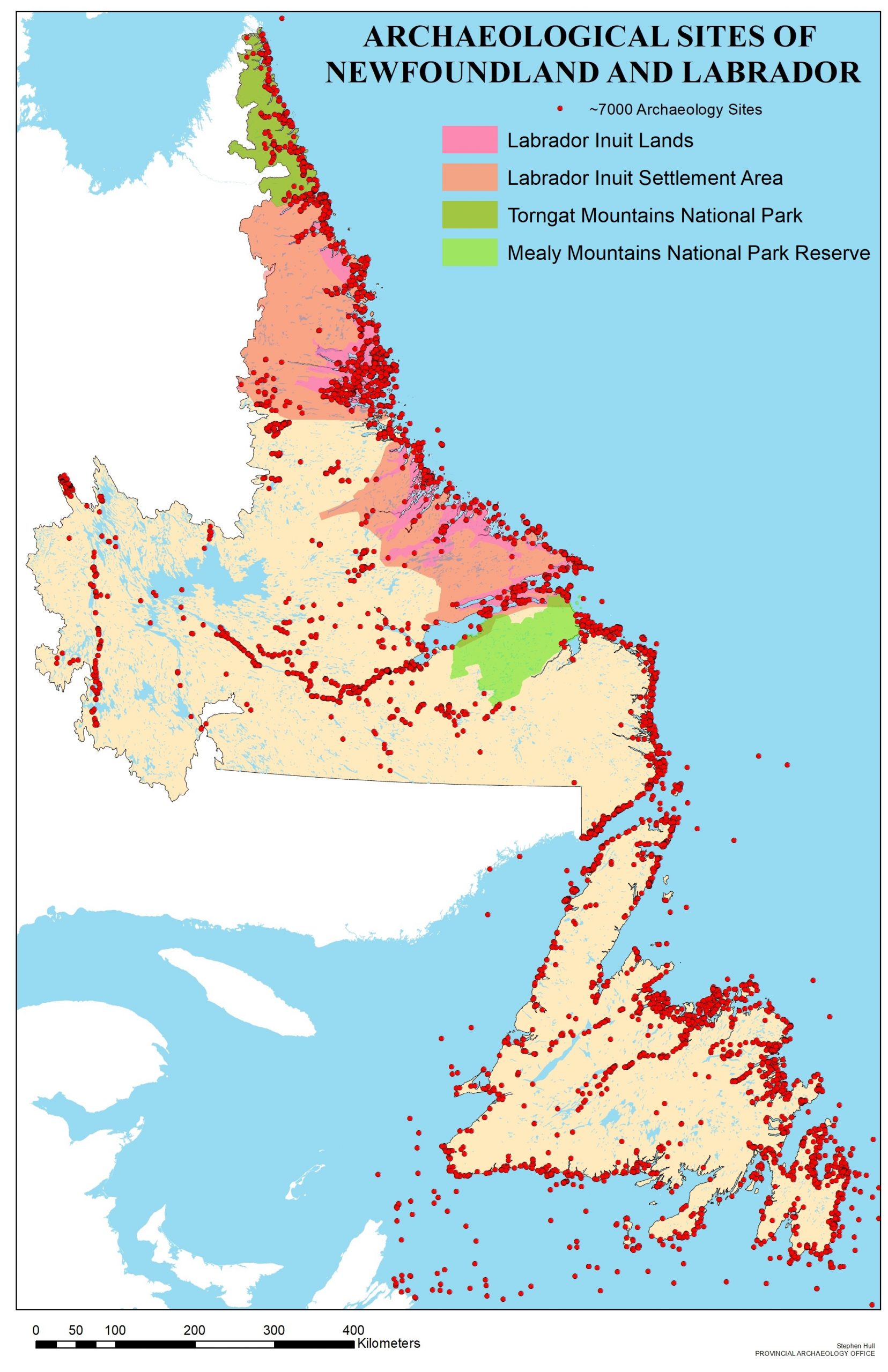
As of 2024 there are just over 7000 known archaeological sites in the province which range in age from nearly 9000 years ago to the 20th century. The maps below present the known and recorded archaeological sites for each culture as red dots. Occasionally when an archaeologist finds a site, they may be uncertain of the cultural affiliation of the site because it may lack diagnostics. In such instances they may include a ‘?’ after the culture in their documentation submitted to the Provincial Archaeology Office. All such ‘?’ sites are included on these maps, for example there are around 250 ‘Inuit?’ sites on the Inuit map. Please click the links below the maps to learn a little more about the cultures represented on those maps.
The pre-contact Indigenous maps are presented in approximate chronological order. The First Nations maps are presented first, then the Pre-Inuit, then the Indigenous groups who had contact with Europeans and then the European map. The Pre-Inuit are presented chronologically as well with Pre-Dorset first then, Groswater and Dorset. However, there is some difficulty with this there was some chronologic overlap. For example, the last of the Archaic period overlaps with the first of the Intermediate period and the first of the Pre-Inuit. So, theoretically, an Archaic era person could have seen an Intermediate era person or an early Pre-Inuit person on the same day in Labrador.
If you want to learn more about the Archaeology Sites in Newfoundland and Labrador you can see the former Archaeology in Newfoundland and Labrador Annual Report Series or the Provincial Archaeology Office Annual Review.
Please keep in mind that much of the Archaeology in Newfoundland and Labrador Annual Report Series, Provincial Archaeology Office Annual Review and the Inside Newfoundland and Labrador Archaeology blog was written before this website and may contain out-of-date information.
All Archaeological Sites
This map shows the approximate location of all known archaeology sites in the province. They vary from small spot finds of a single artifact to shipwrecks and whole colonies.
Archaic Sites
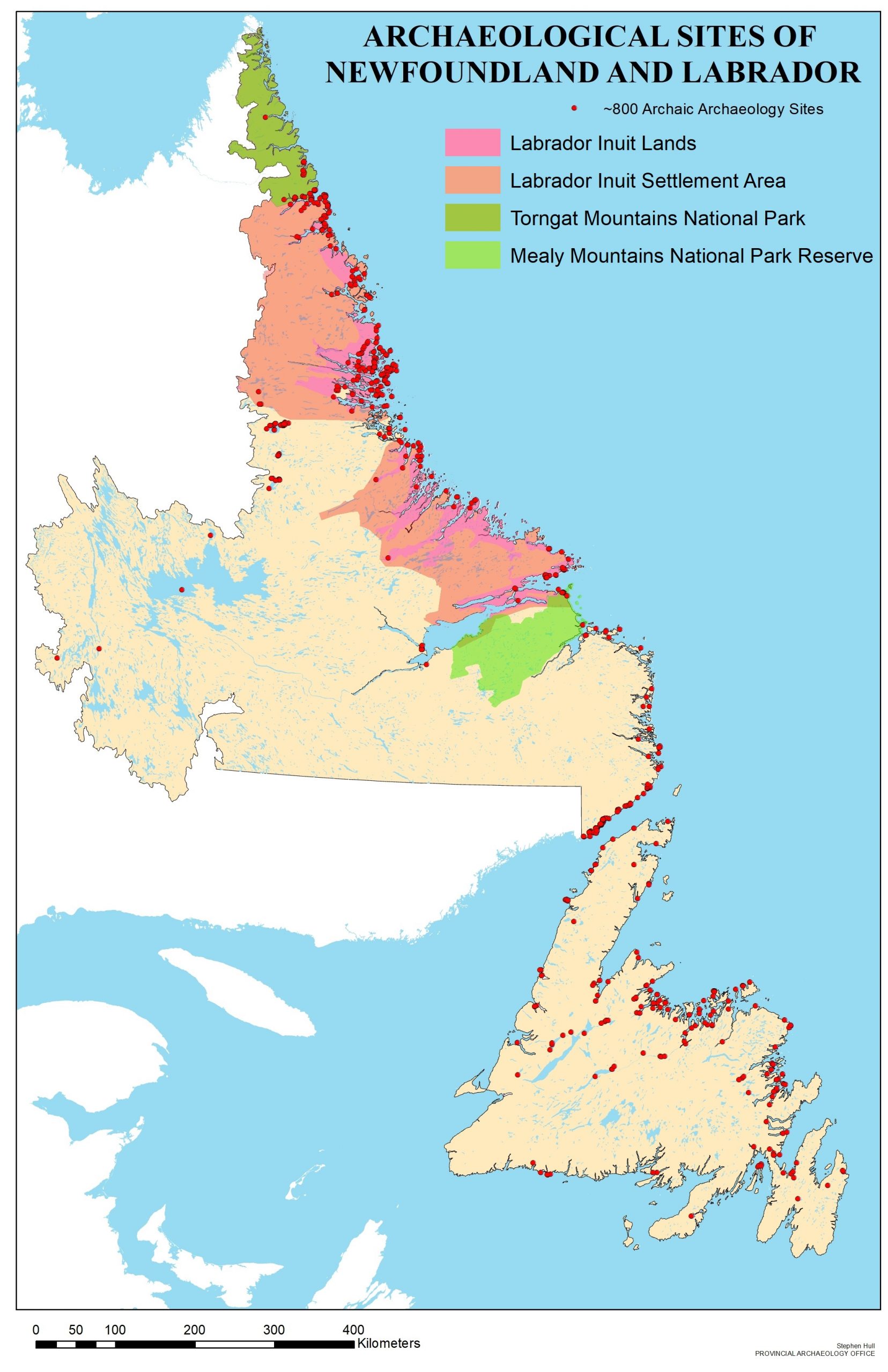
Indigenous history in Newfoundland and Labrador begins around 9000 years ago with the Archaic First Nation.
Several lines of evidence including stone tools, site location, site size, types of features and other evidence led researchers such as Dr. James Tuck to realize there were two Archaic groupings in the province that were eventually recognized as the earlier Labrador Archaic (previously thought of as Northern Branch) and the Maritime Archaic (previously thought of as Southern Branch).
The people of the Labrador Archaic are first recognized at the site of Pinware Hill near the community of Pinware, radiocarbon dated to 8850+/-100 (SI-2309). The Cowpath site near West St. Modeste is dated to a similar period. The Labrador Archaic explored and settled most of the Labrador coast and lasted until about 3500 years ago when they are no longer seen in the provincial archaeological record. The Maritime Archaic are first recognized in southern Labrador around 6000 years ago. Shortly thereafter they show up in Newfoundland. They last in the province until about 3000 years ago. The Archaic overlaps temporally with the Intermediate and early Pre-Inuit groups.
More recently we’ve come to realize that late Labrador Archaic artifacts are found over much of the island leading us to question whether this nomenclature of Maritime Archaic and Labrador Archaic makes sense. Perhaps thinking of the Archaic period as having two large waves of incoming ideas and or people at 9000 and 6000 years ago may be more accurate.
There are about 800 known Archaic archaeological sites in the province, just over 200 of those are ‘Archaic?’. To learn more about the Archaic, you can visit anyone of these links.
- Newfoundland and Labrador Heritage
- L’Anse Amour burial mound
- Port au Choix
- Or search the word Archaic at Inside Newfoundland and Labrador Archaeology
Intermediate Period First Nation Sites
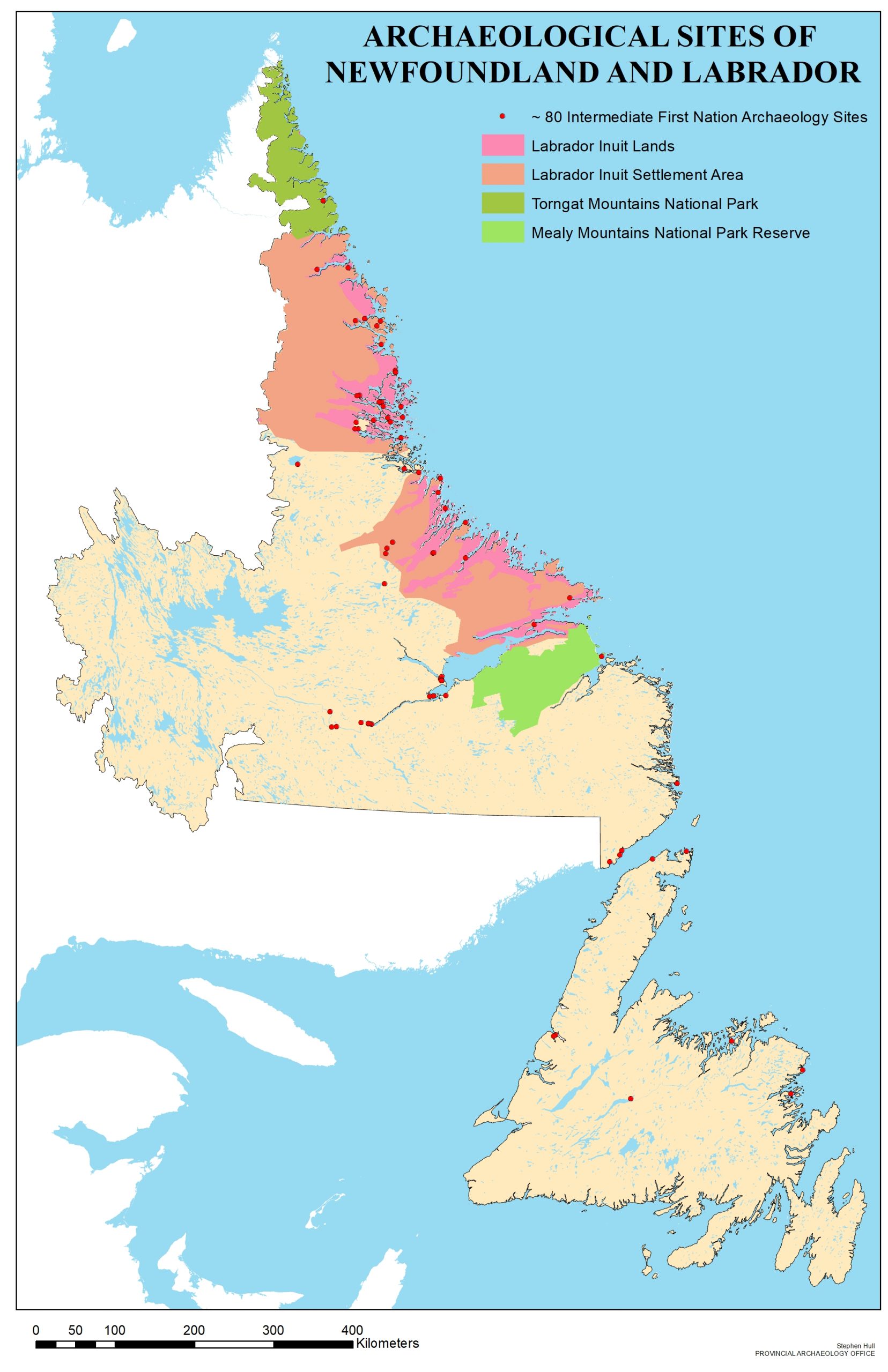
Intermediate is a term used to identify a time frame recognized mostly in Labrador between about 3,500 and 2100 years ago. Intermediate signifies their temporal position between the earlier Archaic people and the Recent Period people who came after them. The people of the Archaic, Intermediate and Recent periods were part of the First Nations family. It is not clear if there was any cultural or genetic relationship between either of these groups. The Intermediate temporally overlapped with the Archaic and Pre-Inuit. The First Nations family is distinct from Pre-Inuit peoples.
Initially the Intermediate period was thought of as a series of likely unrelated groups. Further research has led us to see the period as mostly made up of the Saunders complex whose sites date from 3500 years ago to around 2100 years ago and the unrelated North West River phase-Cow Head complex whose sites date from 2500 years ago to around 1000 years ago.
There are around 80 known Saunders complex Intermediate Period archaeological sites in the province, about of those 20 are ‘Intermediate?’. To learn more about the Intermediate Period you can go to:
- Newfoundland and Labrador Heritage
- Inside Newfoundland and Labrador Archaeology: Intermediate Period Part A & Part B
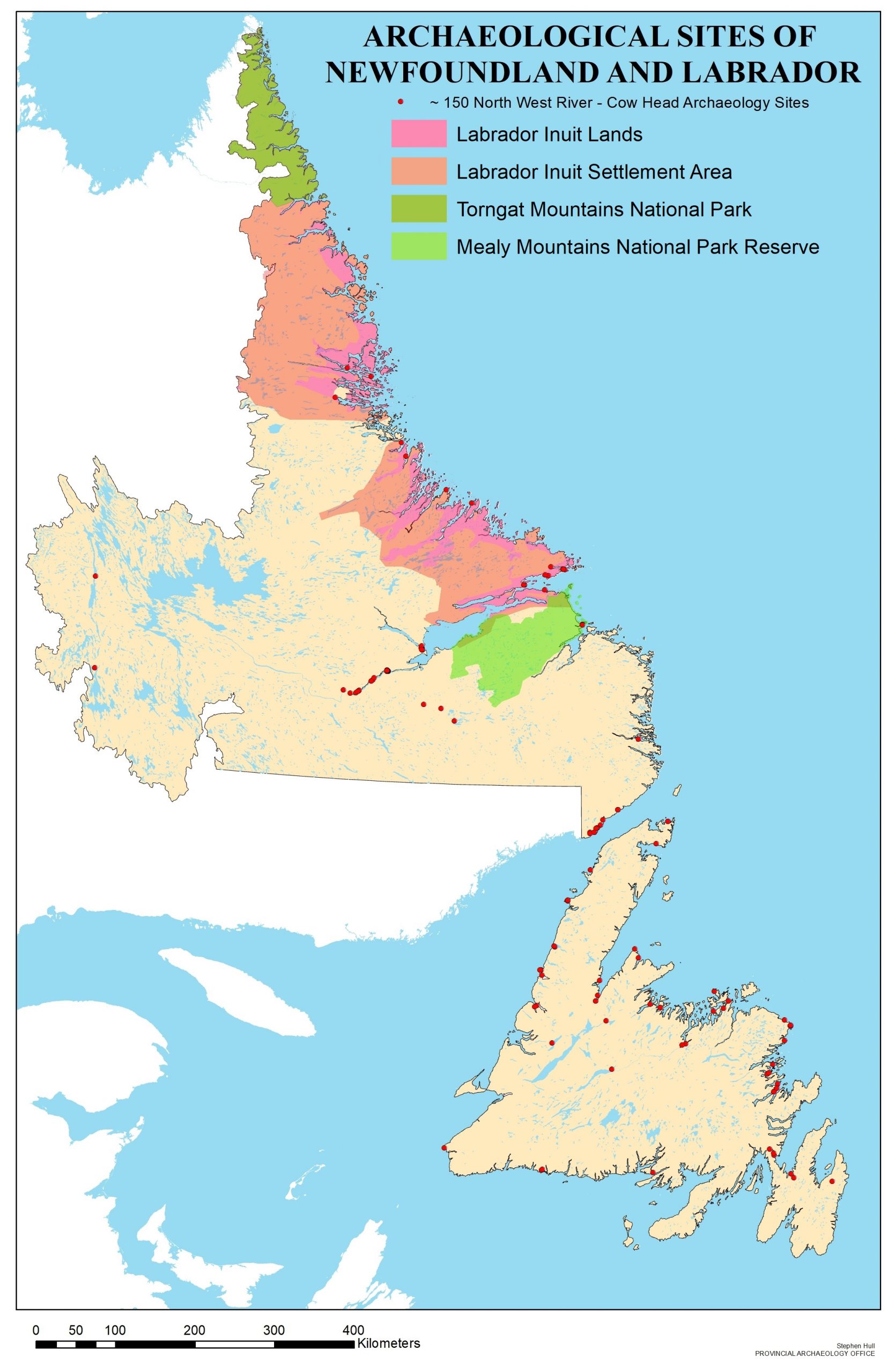
North West River phase-Cow Head complex sites
Originally the Cow Head complex (found on the island) was speculated to be one of the Recent First Nation groups (see below) and therefore related to the Beothuk, and the North West River phase (found in Labrador) were believed to be part of the Intermediate First Nation groups. We now understand that they are essentially the same group living throughout the province and are probably more accurately referred to as Middle Woodland. The people of this culture were in possession of and seem to have made somewhat regular use of a key characteristic of that woodland period: ceramics. They seem to have existed in the province from 2500 years ago to about 1000 years ago, so they would have chronologically overlapped with the Saunders complex, Pre-Inuit, and Recent period.
There are about 150 North West River phase-Cow Head complex sites in the province and about 20 of those are ‘North West River phase-Cow Head complex?’. To learn more about these cultures you can go to:
Inside Newfoundland and Labrador Archaeology: Cow Head
Recent Period First Nation Sites
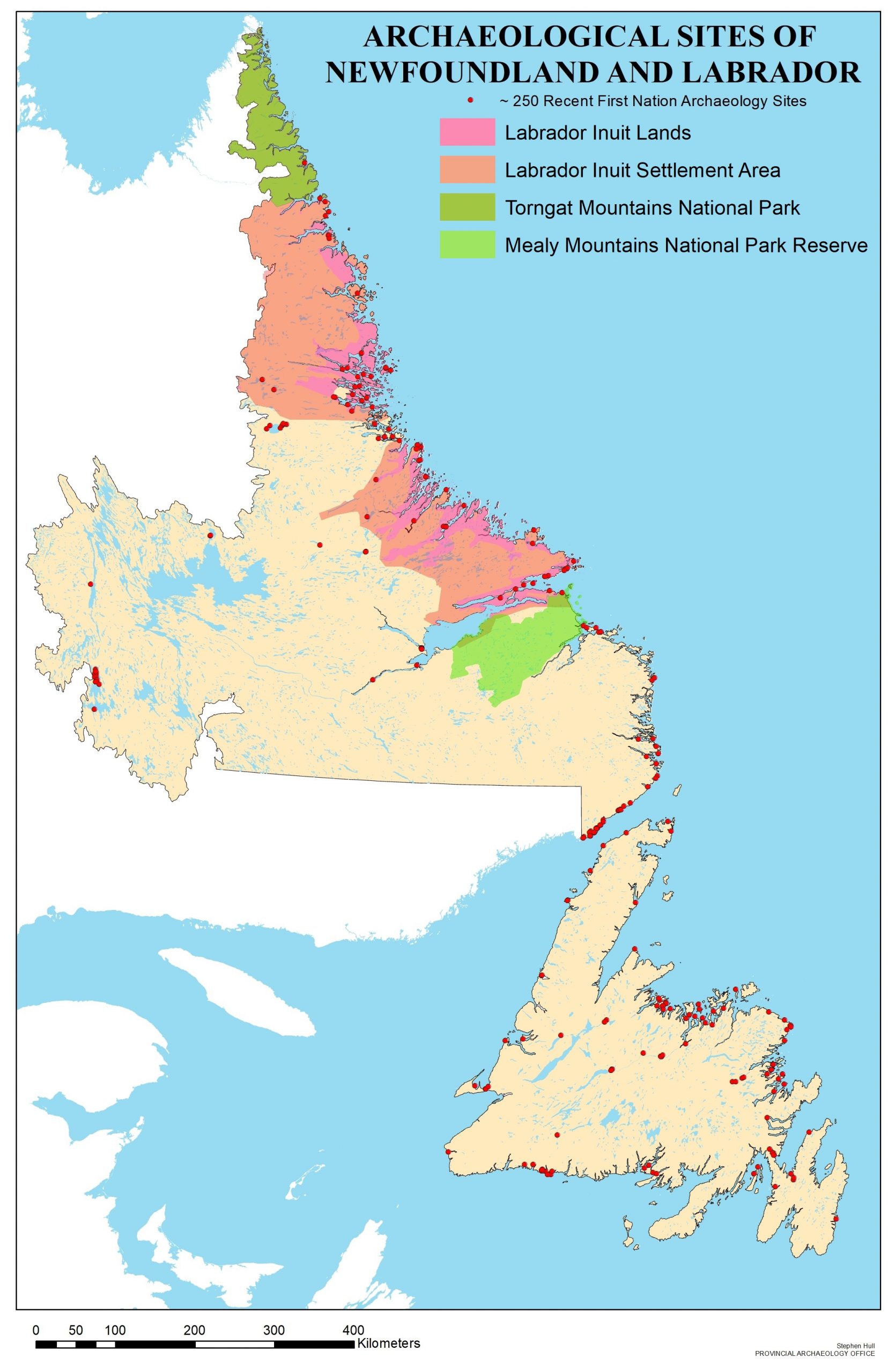
In Labrador archaeologists have recognized two Recent Period pre-European First Nations groups, the earlier Daniel Rattle complex and the later Point Revenge complex. These complexes are a cultural continuum, however, their culture changed through time to the point where archaeologists see them as related ancestor-descendant groups. On the island archaeologists also recognize a continuum of two Recent Period First Nations populations, Beaches and Little Passage complexes who are very closely related to the Labrador continuum. The Newfoundland continuum are the ancestors of the Beothuk. The Recent period starts in the province around 1700 years ago and lasts until European contact. The people of this period would have chronologically overlapped with the people of the Middle Woodland and the Pre-Inuit.
There are around 250 known Recent Period archaeological sites in the province, nearly half of which are ‘Recent Period?’. To learn more about them you can go to:
- Newfoundland and Labrador Heritage
- Inside Newfoundland and Labrador: Recent Period Tradition Newfoundland& Labrador^ Top of Page
Beothuk Sites
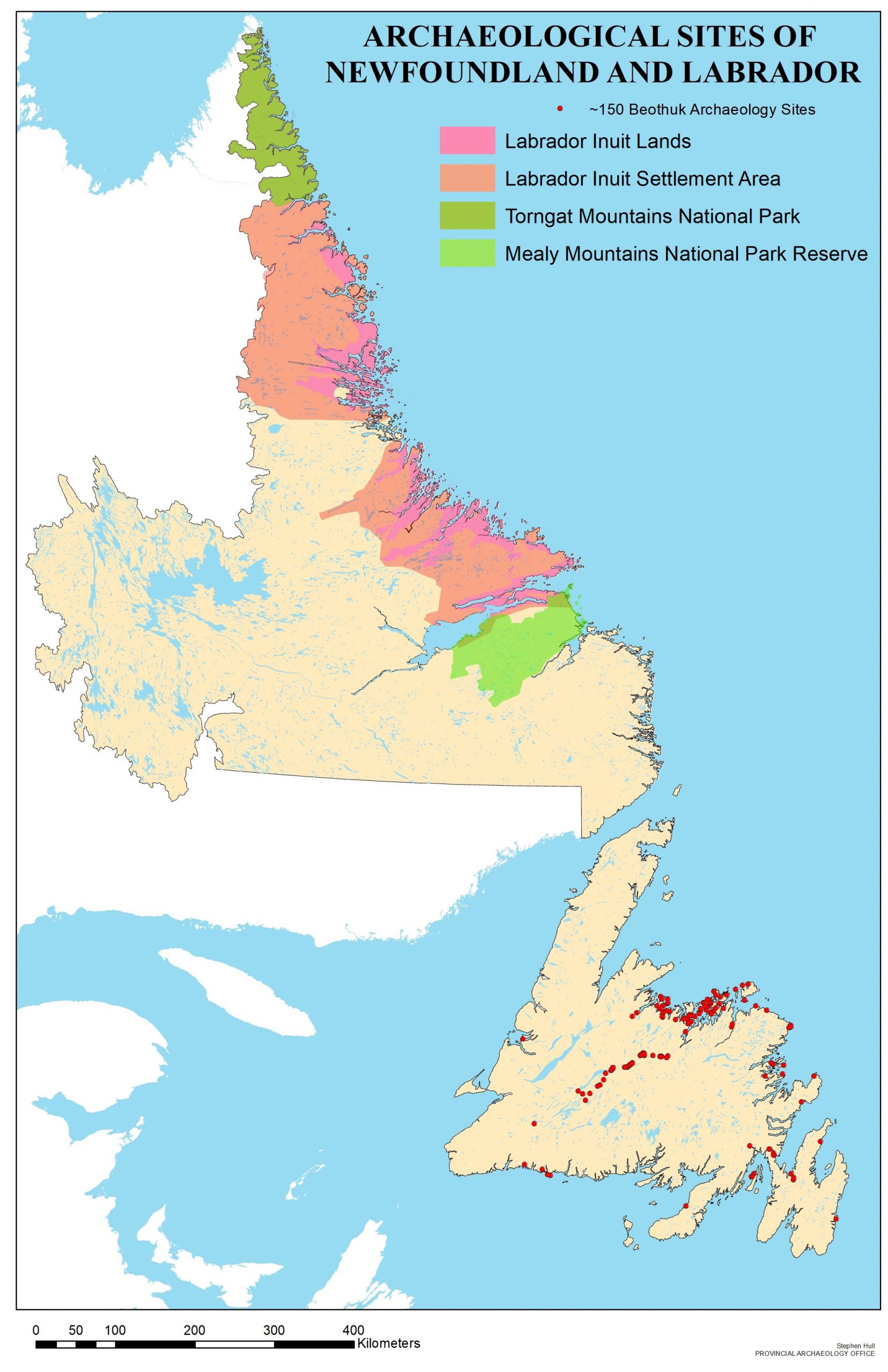
The Beothuk were the Indigenous people who inhabited Newfoundland at the time of European contact. They likely never numbered more than a thousand people at any time. They are the descendants of the Recent First Nation tradition.
There are about 150 known Beothuk archaeological sites in the province around 50 of which are ‘Beothuk?’. To learn more about the Beothuk you can go to:
- Newfoundland and Labrador Heritage
- Baccalieu Trail Archaeology and in particular Russell’s Point
- Colony of Avalon: Beothuk Archaeology
- Inside Newfoundland and Labrador Archaeology: Beothuk
Innu Sites
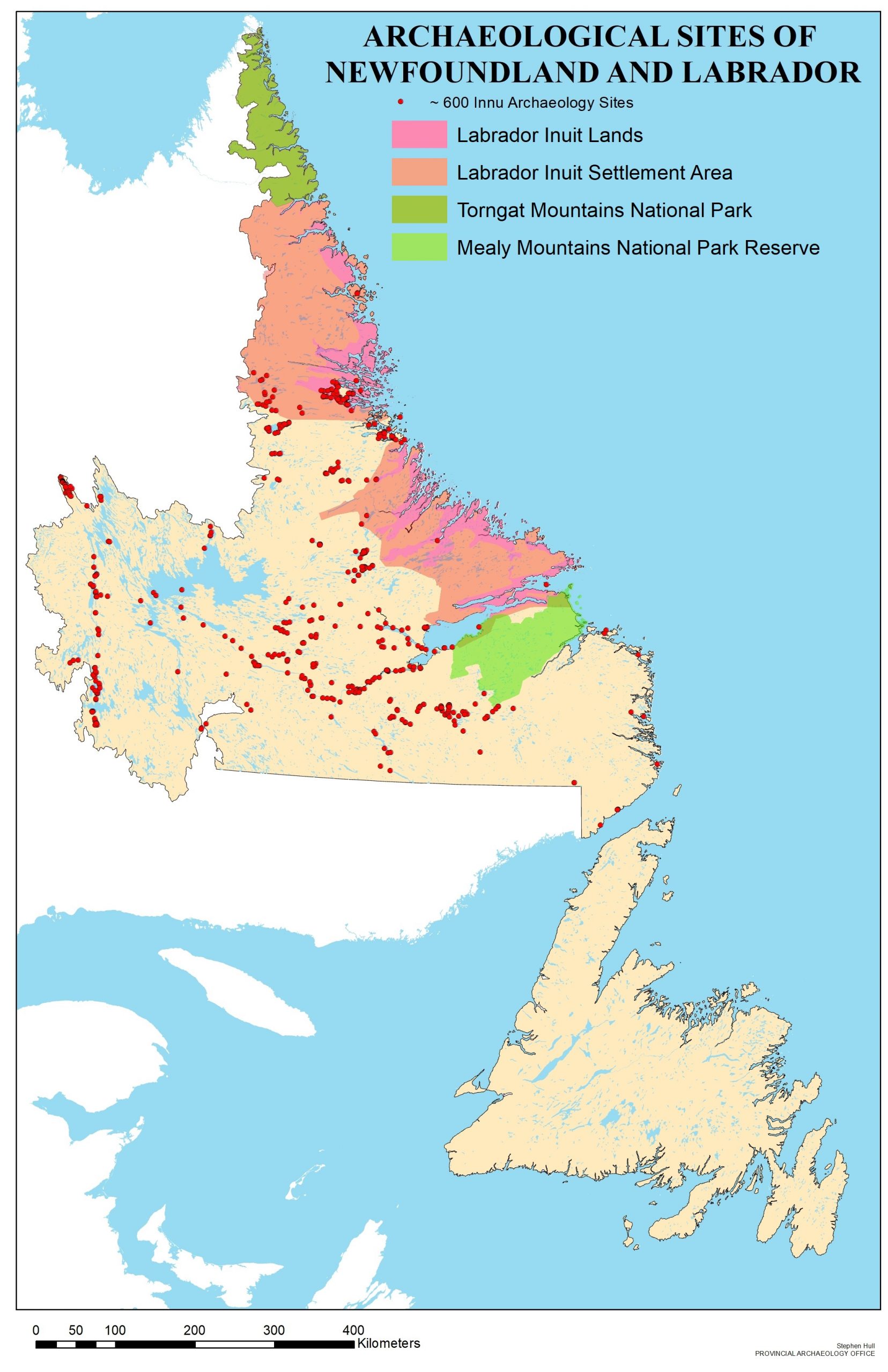
The Innu, formerly known as the Naskapi or Montagnais, are a central Algonkian-speaking people. The word Innu means human being, and the Innu language is called Innu-aimun. The Innu nation has nearly 25,000 members in Quebec and 3200 in Labrador, most of the latter live in the two Innu communities of Sheshatshiu and Natuashish.
There are about 600 known Innu archaeological sites in the province, just over half of these are less than 100 years old and of those just over 200 are ‘Innu?’. To learn more about the Innu you can go to:
- Newfoundland and Labrador Heritage
- Innu Nation
- tipatshimuna – Innu stories from the land
- Virtual Museum of Labrador
Mi’kmaq Sites
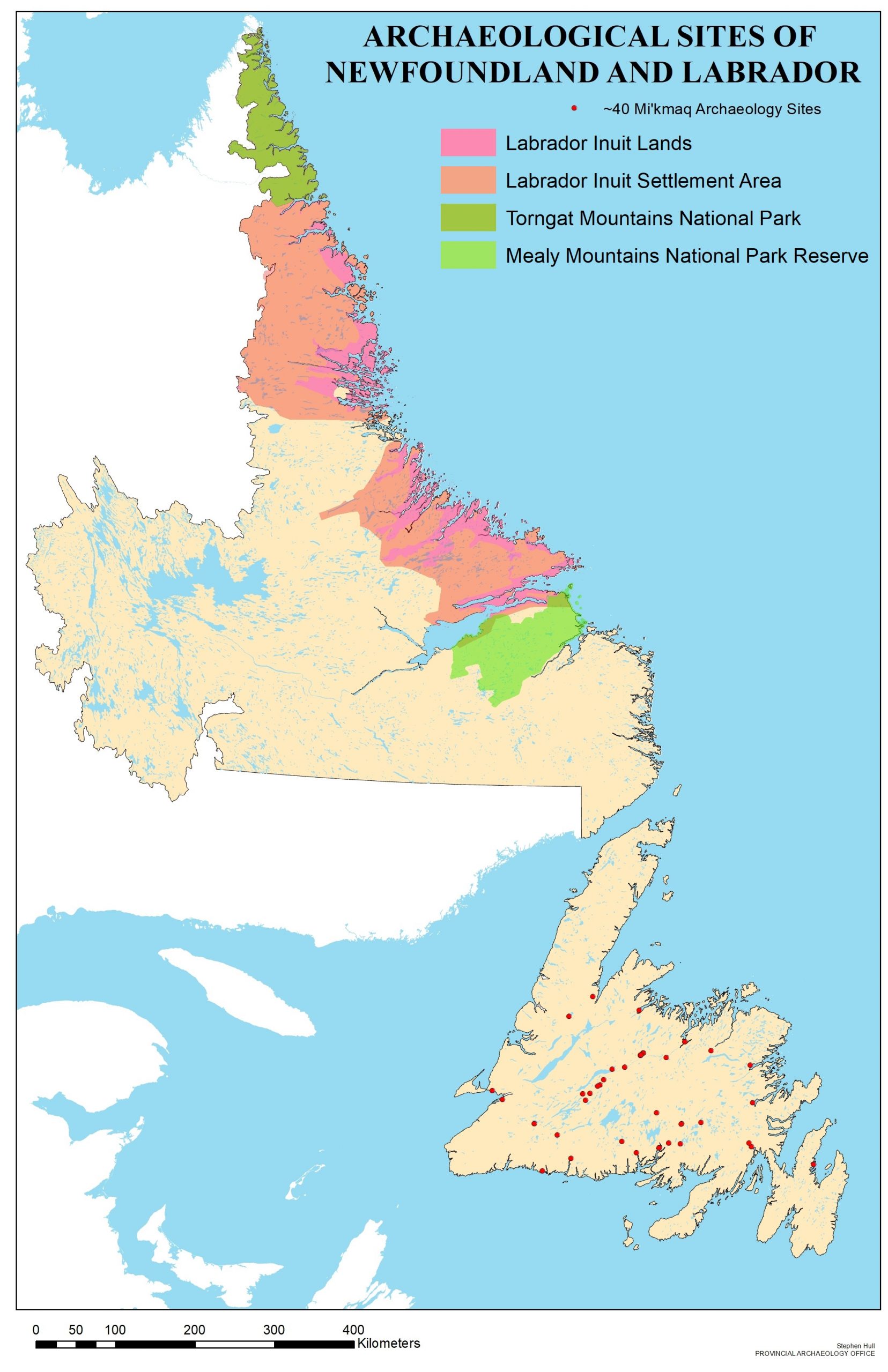
Opinions differ as to when the Mi’kmaq first came to Newfoundland. However, the archaeological record thus far shows no evidence for precontact Mi’kmaq sites. Newfoundland Mi’kmaq oral tradition holds that they were living in Newfoundland prior to European contact. There is some historical evidence that the Mi’kmaq were living in Newfoundland perhaps by the 16th century, and by the 17th century there are increasing references to the Mi’kmaq in the historical record.
There are around 40 known post-contact period Mi’kmaq archaeological sites in the province almost all of which are 19th century and nearly half are ‘Mi’kmaq?’. To learn more about the Mi’kmaq see:
- The Newfoundland and Labrador Heritage website here
- Inside Newfoundland and Labrador Archaeology Mi’kmaq
Pre-Inuit Sites
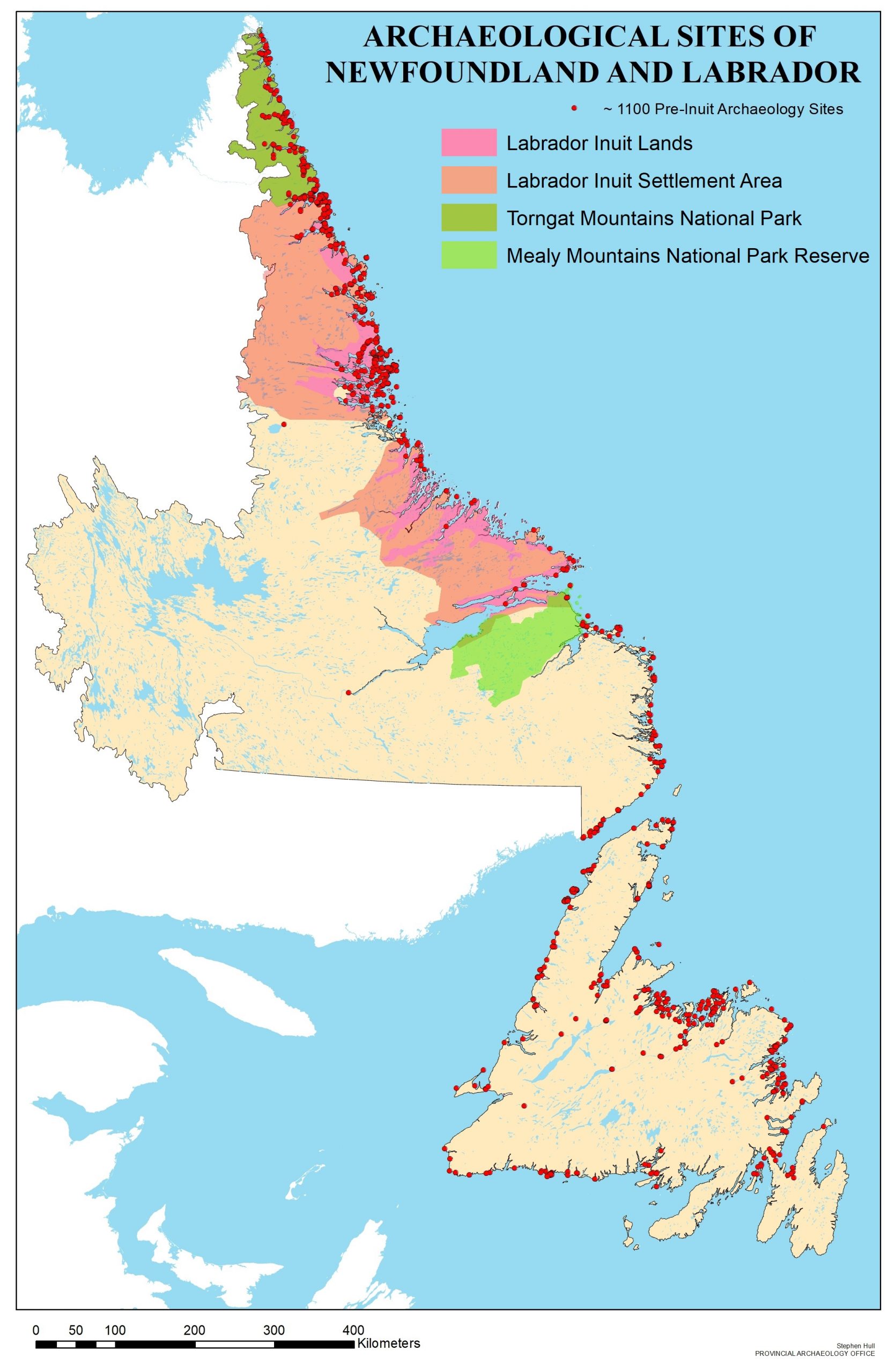
The term Pre-Inuit is used to refer to people whose culture was Arctic/sub-Arctic adapted. These people inhabited the province before the Thule, and the Thule are the direct ancestors of the Inuit who today inhabit the Canadian north. Pre-Inuit peoples are not the direct ancestors of the Inuit. The Pre-Inuit sites on the south coast of the island and on the islands of Saint Pierre and Miquelon represent the farthest south these groups are known to have reached.
Modern populations are sometimes divided into different groups for reasons of organization based on various cultural traits. Archaeologists sometimes do this with archaeological cultures. For example, in this province the Pre-Inuit people are represented by the Pre-Dorset, Groswater and Dorset based on differing cultural traits.
There are about 1100 known Pre-Inuit archaeological sites in the province. To learn more about the Pre-Inuit there are several webpages you can go to:
Pre-Dorset Sites
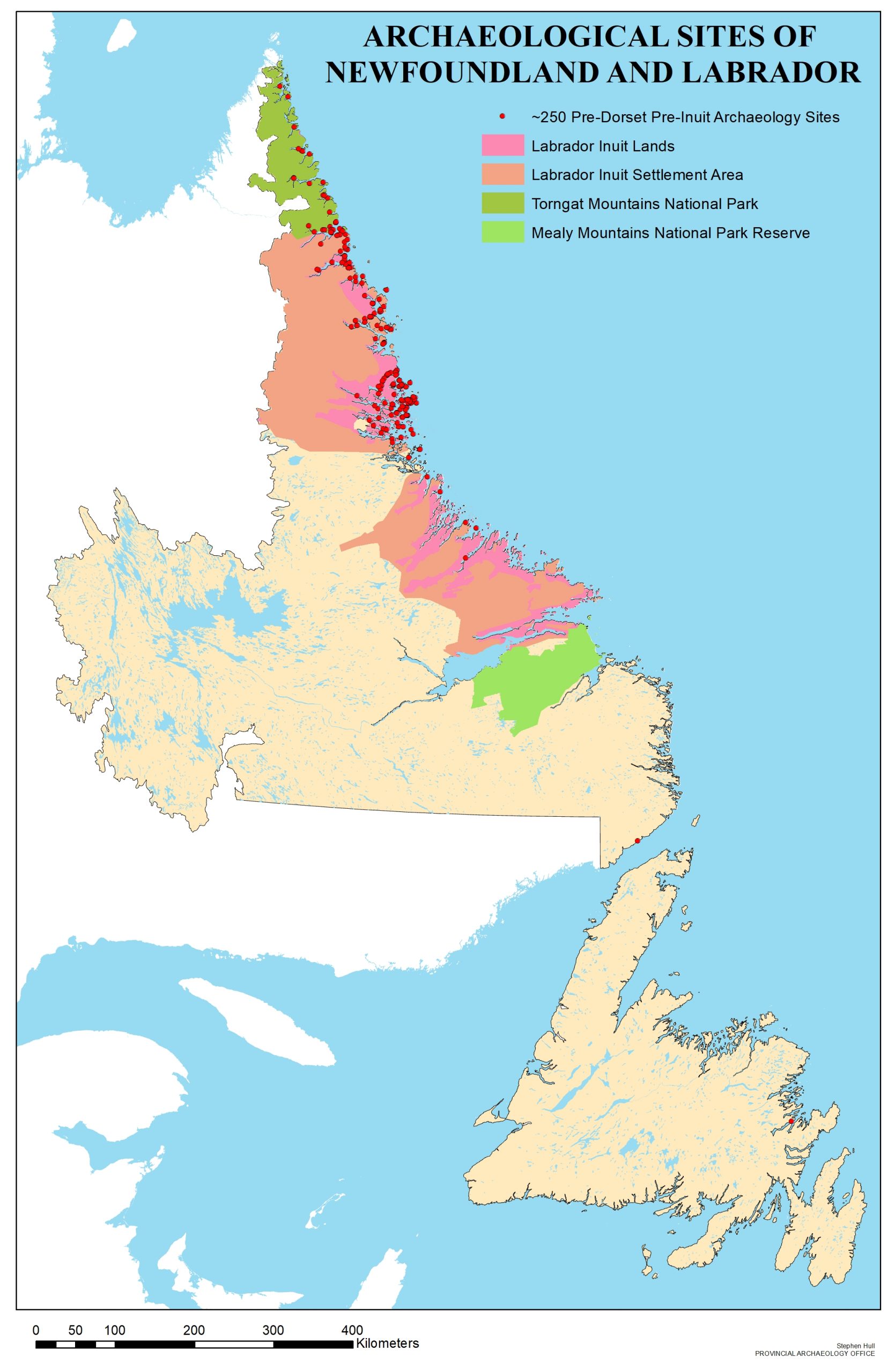
The Pre-Dorset seem to have existed in the province from 4000 to about 3500 years ago and they chronologically overlapped with the Archaic and Saunders complex. Some archaeologists think their arrival may have played a role in the end of the Archaic since for the first time in about 5000 years the Archaic were not the only Indigenous group in Labrador.
Most Pre-Dorset sites are found in northern Labrador, north of Voisey’s Bay. There is one possible in Pre-Dorset site shown in Newfoundland and one in southern Labrador. Given that almost all 250 Pre-Dorset sites are found north of Voisey’s Bay and north, the sites shown in Newfoundland and the one in southern Labrador are likely misidentified. Of those 250 sites nearly 30 are ‘Pre-Dorset?’.
Groswater Sites
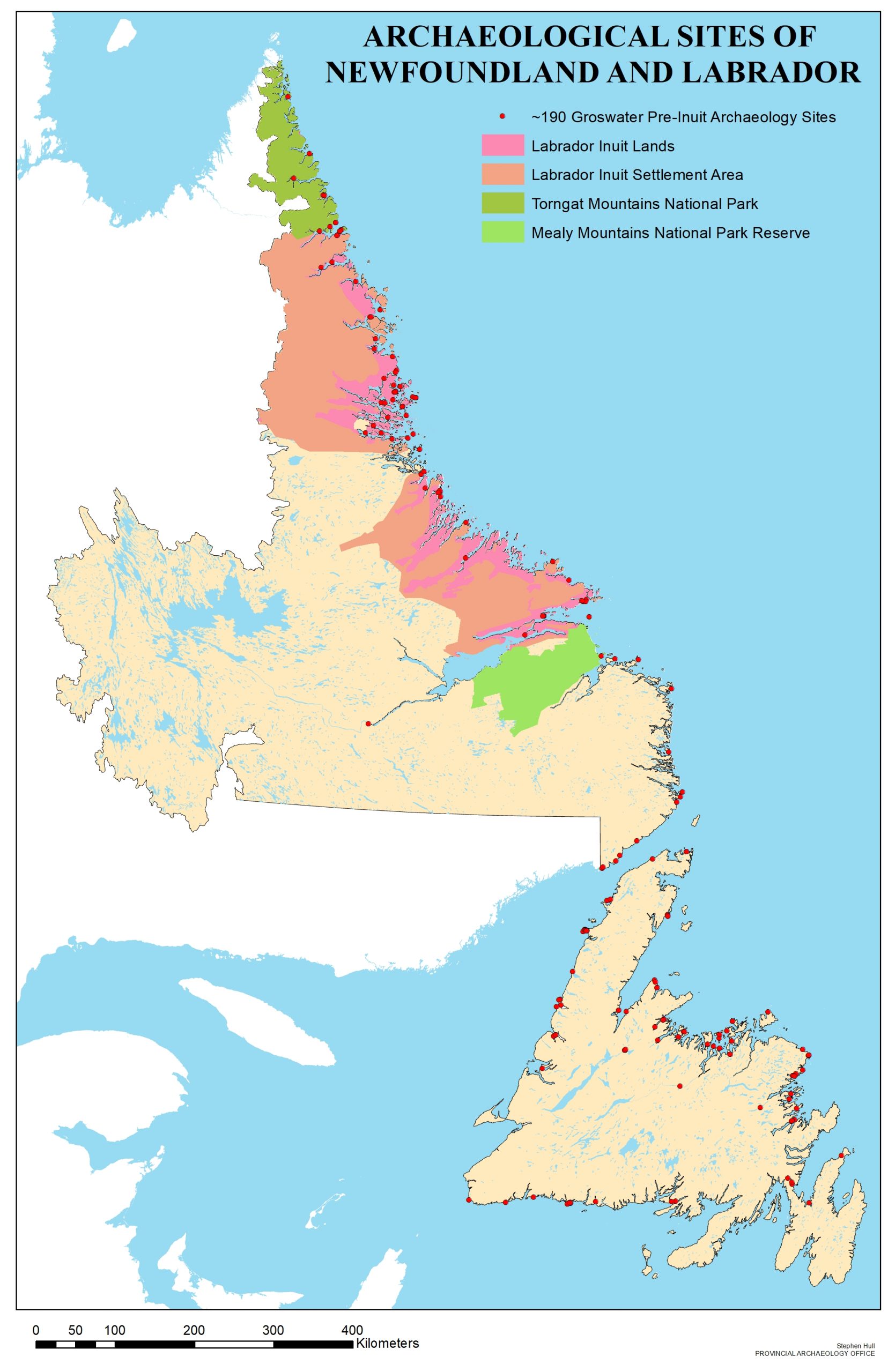
The Groswater seem to have existed in the province from about 2800 to about 1900 years ago and chronologically overlapped with the Intermediate period Saunders group, the Middle Woodland group, and the Dorset. Interestingly they are one of few Indigenous groups whose sites are more plentiful on the island than in Labrador despite coming into the province from the north. There are about 190 Groswater sites in the province and nearly 30 of them are ‘Groswater?’
You can learn a little more about the Groswater here:
- Inside Newfoundland and Labrador Archaeology Samms’ site or here
Dorset Sites
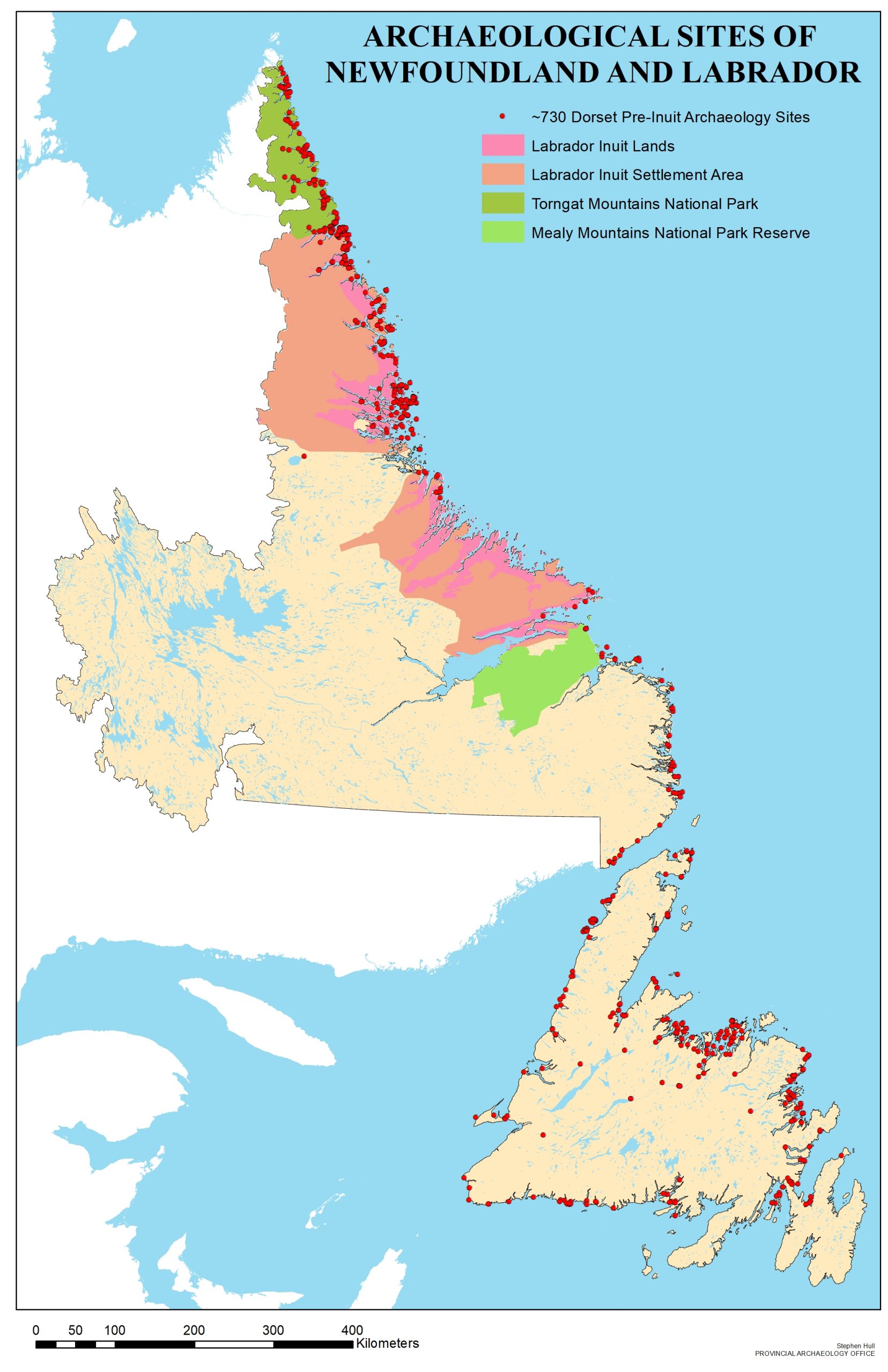
The Dorset Pre-Inuit were an Arctic adapted people who were first recognized archaeologically by anthropologist Diamond Jenness in the early 1920s while he was looking at the artifact collections from Cape Dorset, Hudson Bay while he was at the national museum. The Dorset are part of a larger cultural manifestation archaeologically known as the Arctic Small Tool Tradition. In Labrador, the Dorset are subdivided into Early, Middle, and Late phases and are archaeologically visible from ~2400 years ago to ~800 years ago. On Newfoundland, they are confined to the Middle Dorset but last almost as long from ~2000 years ago to ~1000 years ago. Given those periods of time the Dorset overlapped with the Saunders Intermediate period, North West River phase-Cow Head complex, the Groswater and the ancestors of the Beothuk. There are about 730 Dorset sites in the province and about 115 are ‘Dorset?’.
To learn more, there are a number of Dorset posts on the Inside Newfoundland and Labrador Archaeology blog.
Inuit Sites
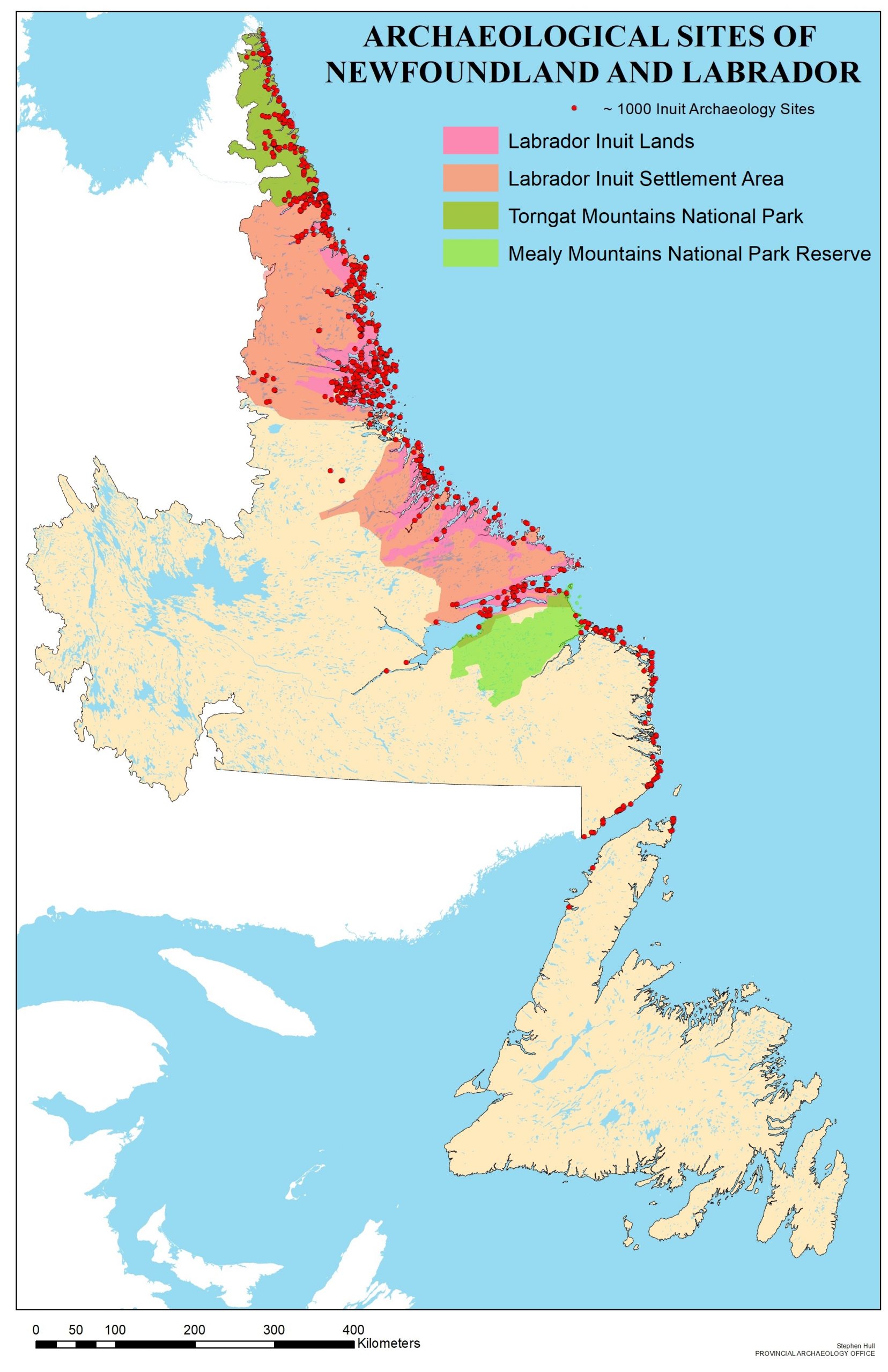
Inuit living along the coast of Labrador are the direct descendants of a pre-European hunting society that spread across Canada from Alaska very quickly and centered on capturing massive bowhead whales. This culture, called Thule by archaeologists, quickly adapted to the mixed arctic and sub-arctic conditions found in the Labrador region. By the early post-contact period the Inuit had spread as far south as the Northern Peninsula of Newfoundland.
In 2005 the Inuit of Newfoundland and Labrador signed a land claims agreement with the federal and provincial governments resulting in the formation of the Nunatsiavut Government. You can learn more about Nunatsiavut by going to their website. Labrador Inuit Lands, Labrador Inuit Settlement Area, Torngat Mountains National Park, Mealy Mountains National Park Reserve shown on the maps are all part of the Nunatsiavut Government.
Inuit in southern Labrador are represented by the NunatuKavut Community Council.
There are around 1000 known Thule and Inuit archaeological sites in the province and about 250 are ‘Inuit?’. To learn more about the Thule and Inuit please go to:
- Newfoundland and Labrador Heritage: Inuit
- Newfoundland and Labrador Heritage: Thule
- Virtual Museum of Labrador
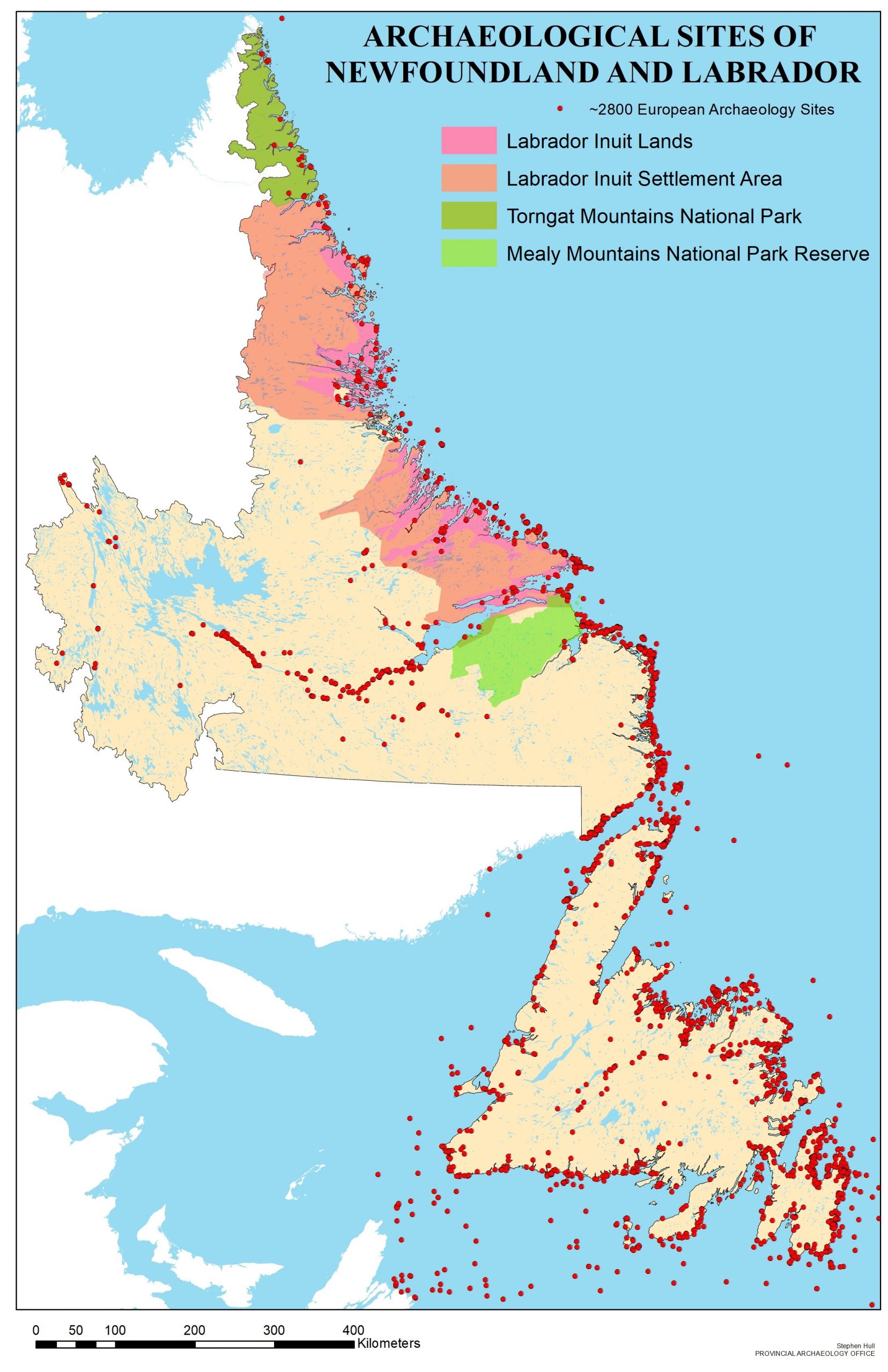
European Sites
The region of Newfoundland and Labrador was the first stretch of North America’s Atlantic coastline to be explored by Europeans. The Norse arrived from Greenland about 1000 A.D. and established a settlement here during the following century. There is legendary evidence that other Europeans may have chanced upon the island during the late Middle Ages. Giovanni Caboto, otherwise known as John Cabot in English, certainly reconnoitered the area for England in 1497, and West European fishermen began to visit the Grand Banks during the summer months on a regular basis shortly thereafter and there is a possibility those fishermen were here before Cabot.
There are nearly 2800 European archaeological sites in the province and about 160 are ‘European?’. To learn more about the European sites you can go to:
- Newfoundland and Labrador Heritage
- Colony of Avalon
- Baccalieu Trail Archaeology
- L’Anse aux Meadows
- Labrador Virtual Museum
- Or search the word European at Inside Newfoundland and Labrador Archaeology