
For a vehicle to move along the highway, an internal combustion engine must convert its HEAT ENERGY into mechanical ENERGY. This mechanical ENERGY goes from the engine to the driving wheel tires by means of a system of connecting rods, shafts and gears. The final factor that moves the vehicle is the amount of TRACTION its tires have on the road surface. TRACTION is the ability of a tire to grip the road surface on which it rolls. The vehicle’s acceleration rate depends on the power the engine develops and the amount of TRACTION the tires have on the road surface.
FRICTION is the force which resists movement between two surfaces in contact with each other. To stop a vehicle, the brake shoe linings are forced against the machined surfaces of the brake drums, creating FRICTION. This FRICTION produces HEAT.
The engine converts the ENERGY of HEAT into the ENERGY of motion. The brakes must convert this ENERGY of motion back into the ENERGY of HEAT. The FRICTION between brake drums and linings generates HEAT, while reducing the mechanical energy of the revolving brake drums and wheels. The heat produced is absorbed by the metal brake drums, which dissipate the heat by passing it off into the atmosphere. The amount of heat the brake drums can absorb depends on the thickness of the metal of which they are made. When enough FRICTION is created between the brake linings and the drums, the wheels stop turning; but the final factor that stops the vehicle is not the brakes, but the TRACTION between the tires and the road surface.
If an engine of 200 horsepower accelerates a vehicle to 100 km/h in one minute, imagine the power needed to stop this same vehicle. Not only that, but the vehicle might have to be stopped in an emergency, in as little as six seconds (just 1/10 of the time it took to reach 100 km/h).
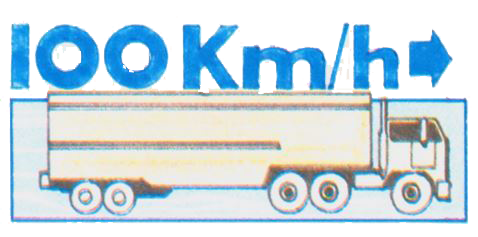
To stop the vehicle in 1/10 of the time it took to accelerate would require a stopping power of 10 times the acceleration power – the equivalent of approximately 2,000 horsepower. If the vehicle had six wheels, each wheel would have to provide 1/6 of the braking power. If one or two of the wheels had brakes that were not properly adjusted, the other wheels would have to compensate, and that might be more than the brakes were constructed to stand. Excessive use of the brakes would then result in a buildup of heat greater than the brake drums could absorb and dissipate. Too much heat would result in brake damage and possible failure.
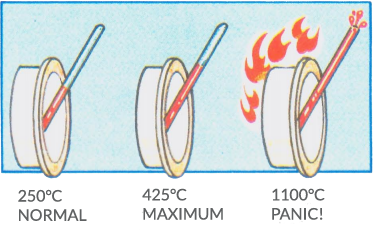
Most brake linings operate best at around 250°C and should not exceed 425°C. It’s important to understand that the power needed to stop generates heat which could ruin the brakes.