
Revenue to the public treasury is the sum of the following sources:
| Revenue Area | 2013-2014 Amount |
|---|---|
| Offshore Oil Royalties | $2,091,359,000 |
| Personal Income Tax | $1,113,146,000 |
| Sales Tax | $945,530,000 |
| Federal Revenue Sources | $785,712,000 |
| Other Revenues | $661,339,000 |
| Corporate Income Tax | $392,701,000 |
| Government Business Enterprises (GBE) | $250,400,000 |
| Mining Tax and Royalties | $232,034,000 |
| Fuel Tax | $176,256,000 |
| Tobacco Tax | $146,000,000 |
| Payroll Tax | $111,301,000 |
| Vehicle and Driver Licences | $74,100,000 |
| Corporate Capital Tax | $27,068,000 |
| Total | $7,006,946,000 |
This chart should render using javascript. A static copy is available.
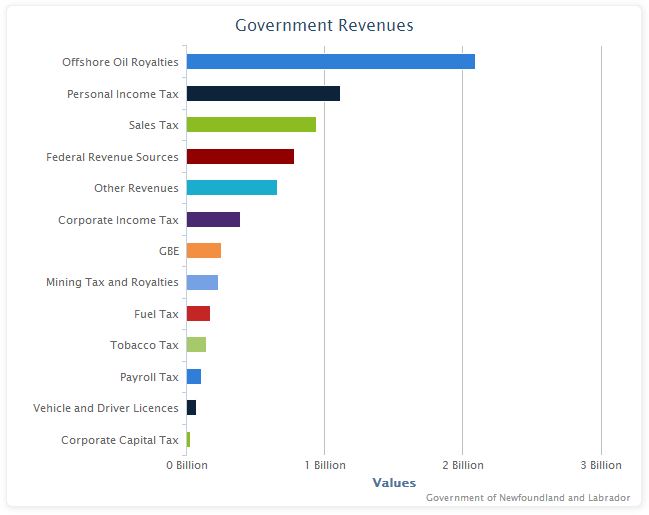
Provincial Revenue Sources:
- Personal Income Tax: Personal income tax is a tax that is applied to each individual resident of the Province and is calculated based on the amount of personal income earned during the taxation year. The current personal income tax rates for Newfoundland and Labrador are as follows:
- 7.7% on the first $34,254 of taxable income + 12.5% on the next $34,254 + 13.3% on the amount over $68,508
- Sales Tax: Sales tax is a tax paid to government for the sales of certain goods and services. Sales tax is typically applied by both the provincial and the federal governments. Within the Province of Newfoundland and Labrador, provincial sales tax and the federal sales tax are combined (harmonized sales tax) and currently set at a rate of 13% (8% provincial and 5% federal). Additionally, a retail sales tax of 14% is applied to the private sale of motor vehicles (note that vehicles sold by someone registered with the Canada Revenue Agency as a HST registrant, is not subject to the 14% retail sales tax, as the 13% HST tax rate would apply).
- Fuel Tax – A fuel tax is an excise tax imposed on the sale of fuels primarily intended for transportation. Within Newfoundland and Labrador, the following motive fuel tax rates apply:
Motive Fuel Type Tax Rate Gasoline 16.5 c/L Diesel 16.5 c/L Auto Propane 7.0 c/L Marine Fuel 3.5 c/L Aviation Fuel 0.7 c/L - Health and Post-Secondary Education Tax (Payroll Tax) – The Health and Post-Secondary Education Tax (more commonly known as the Payroll Tax) is a tax imposed on remuneration that is paid or credited to employees. This tax is paid by employers with an establishment in Newfoundland and Labrador. The present payroll tax rate is 2% of total payroll less the exemption threshold, which is currently $1.2 million.
- Tobacco Tax – Tobacco tax is a tax that is applied to all tobacco products sold in the Province. Tobacco products include cigarettes, cigars and fine cut tobacco. The following tax rates currently apply within this Province:
Tobacco Product Tax Rate Cigarettes 20.5 cents per cigarette Fine Cut Tobacco 32 cents per gram Cigars 125% of purchase price
- Vehicle and Driver Licenses: Currently the Province imposes a passenger vehicle registration fee of $140 annually ($91 for seniors) and a driver licence renewal fee of $100, charged every 5 years ($65 for seniors).
- Government Business Enterprises : Revenues collected from Nalcor and the Newfoundland Liquor Corporation.
- Corporate Capital Tax: In the Province of Newfoundland and Labrador, the Corporate Capital Tax is a tax that is applied to any financial institution (banks, loans and trust companies) with permanent establishment in the Province during the taxation year. A rate of 4% is payable on capital allocated to Newfoundland and Labrador including paid-up capital stock, contributed surplus, retained earnings, long-term debt, and reserves. For financial institutions with aggregate capital less than $10 million, the first $5 million is exempt from the tax.
- Corporate Income Tax: The Corporate Income Tax is the tax payable by a corporation each taxation year and is equivalent to 14% of the corporation’s taxable income earned in the year in the Province. Organizations paying a corporate income tax may be eligible for various tax credits such as:
- Manufacturing and Processing Tax Credit – corporations earning a profit by carrying out manufacturing and processing from a permanent establishment located in Province may qualify for a reduced corporate income tax rate of 5%
- Small Business Tax Credit – corporations whose profits categorize them as a small business have a reduced corporate income tax rate of 4%
- Offshore Royalties: Offshore royalties received by the Province are governed by clear regulations and royalty regimes, supplemented by specific royalty agreements with the operators of each offshore oil development. For all offshore petroleum projects, benefits agreements are negotiated with project operators and provide the Province with royalties, as well as employment commitments and targets, and industrial benefits. Currently, offshore royalties contributes 27.3% of the Provinces total revenue.
- Mining Tax and Royalties: A Mining Tax of 15% is currently imposed on the net income of mine operators. Additionally, a Mineral Rights Tax of 20% is imposed on the recipient of mineral production royalties, less certain deductions (e.g., legal expenses incurred in the collection of royalties and payment of rents or royalties to other persons).
- Other Revenue Sources, such as:
- Insurance Companies Tax
- Investment Earnings
- Other Fees and Fines
- Other Provincial Taxes
- Federally Cost Shared Programs
Federal Revenues Sources:
- Canada Health Transfer (CHT): Annual transfer from the Federal Government to support long-term predictable funding for health care, in accordance with the principles of the Federal Canada Health Act, which are universality, comprehensiveness, portability, accessibility and public administration.
- Social Transfer (CST): Annual transfer from the Federal Government to support post-secondary education; social assistance and social services; early childhood development; and early learning and childcare.
- Other: This includes annual transfers from the Federal Government such as statutory subsidies and sector-specific subsidies.
Features
Introduction
A general overview of the budget process and pre-budget consultation opportunities Where The Money Comes From
Further your understanding of provincial revenue sources
Where The Money Goes
Further your understanding of government spending requirements Budget Simulator
You decide how to set the provincial budget
Further your understanding of government spending requirements Budget Simulator
You decide how to set the provincial budget