Newfoundland and Labrador is home to four of 12 nationally significant caribou groups in Canada. These include:
- Newfoundland Caribou – Island population (population 27,115 in 2021);
- George River Caribou Herd – part of the Eastern Migratory Caribou unit (population 8,600 in 2024);
- Torngat Mountains Caribou (population 2,422 in 2021); and
- Boreal Caribou populations of southern Labrador (combined population of fewer than 4,000 caribou across five local populations).
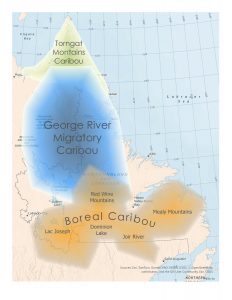
Labrador’s Boreal Caribou – known as the Lac Joseph, Red Wine Mountains (Dominion Lake) and Mealy Mountain (Joir River) populations – are considered ‘threatened’ and have been protected under the Newfoundland and Labrador Endangered Species Act since July 2002. All Boreal Caribou in Canada have been listed as ‘threatened’ under the federal Species at Risk Act since June 2003.
Given their scattered distribution across the forested landscape of southern Labrador, it is difficult to conduct surveys to estimate population numbers for Boreal Caribou herds. As part of the four-year Boreal Caribou Conservation Agreement with Environment and Climate Change Canada, the province has been working to monitor the trends in each of the five local populations. Adult survival, calf recruitment rates, and ongoing reports of harvesting indicate that caribou numbers in the Lac Joseph, Joir River and Mealy Mountain caribou ranges are declining. The Red Wine Mountains and Dominion Lake populations have been stable or growing over the past four years but remain very small.
Unlike the situation in almost all other areas of Canada, Boreal Caribou habitat in Labrador is relatively undisturbed, and the combined level of human disturbance across all ranges is only two per cent. The decline and continued low numbers of these caribou populations is driven by natural threats, combined with unsustainable and unsanctioned harvesting.
George River Caribou Update
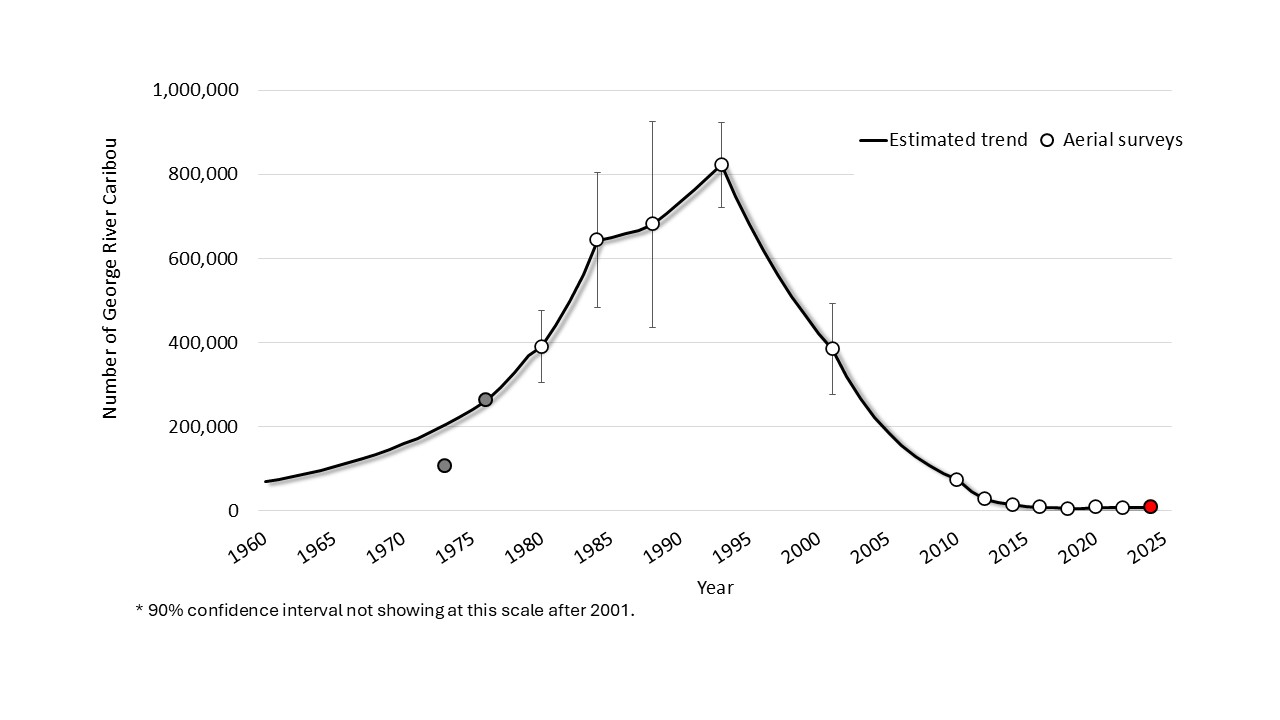
The latest population estimate survey of the George River Caribou Herd (GRCH) was conducted in July 2024 by the Department of Forestry, Agriculture and Lands (FAL), in partnership with the Quebec Ministry of Environment, the Fight Against Climate Change, Wildlife, and Parks, and the Nunatsiavut Government. The findings estimate the population to be 8,600 animals, around 1% of its previous maximum size. Although the population is still very small, the adult proportion of the population increased an average of seven per cent per year from 2018 to 2024, which is cause for optimism for the persistence and eventual recovery of this vital caribou herd.
A classification survey was completed in October 2024, estimating that 3.8 of every 10 adult female caribou were with a calf. This represents a fair level of calf recruitment but is much lower than the 7 of every 10 females found to have a calf in October 2023. Recruitment in migratory caribou – or more simply, the number of new calves added annually to the population – varies from year to year. Any true indication of population recovery will require several years of consistent improvement in the survival levels of calves and adults; but high calf recruitment values in 2020 and 2023, with fair values in between are promising signs.
In 2013, the department issued a hunting ban on the George River Caribou Herd in Labrador for conservation purposes, as the population had drastically declined from greater than 750,000 caribou in the early 1990s to just 27,600 animals in 2012. Despite the ban, some harvesting has continued each year through to the present, contributing to the further decline of the population and delaying recovery.
Research and monitoring of the George River Herd is extensive, and the population estimates are highly accurate. The promising findings over the past 4 years should be viewed as an opportunity to fully support the hunting ban to allow the herd to recover. Maintaining the hunting ban, along with careful stewardship, is essential at this critical point in the caribou population cycle. The next population estimate will be in July 2026.