Government of Newfoundland and Labrador

2025-26 Hunting and Trapping Guide

Left Header Right Header

Minister’s Message


I am pleased to share the Department of Fisheries, Forestry and Agriculture’s game and fur management plan for the upcoming season. The 2025-26 Hunting and Trapping Guide includes summaries of dates, regulations, quotas and other valuable information designed to guide your participation in the upcoming season.

I am happy to report that current population trends for most of our game and furbearer species are stable, and harvest quotas require only minimal changes for the 2025-26 season.

Several important changes designed to support increased hunting and trapping opportunities for the island of Newfoundland will be in effect this fall, including:

  • Extending the season of Caribou Management Areas 71 and 80.
  • Extending the fall black bear season to November 30 and improving access to opportunities by amalgamating management areas into regional areas.
  • Adding a Trapper’s Beaver Licence outside of the Trapline System.
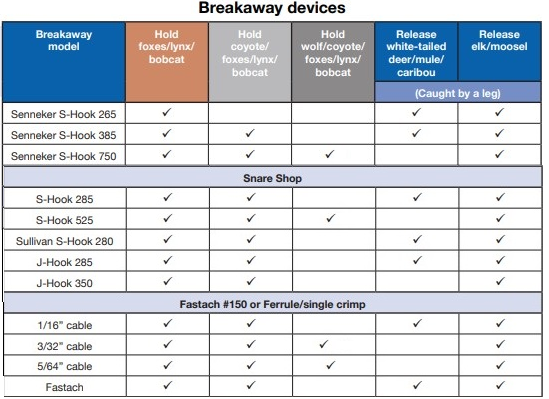
  • Break-away devices on neck snares used for trapping furbearers will become mandatory for all trappers on the island of Newfoundland.

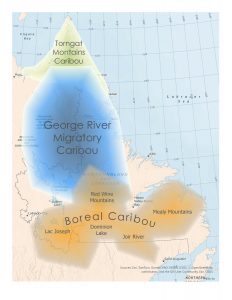
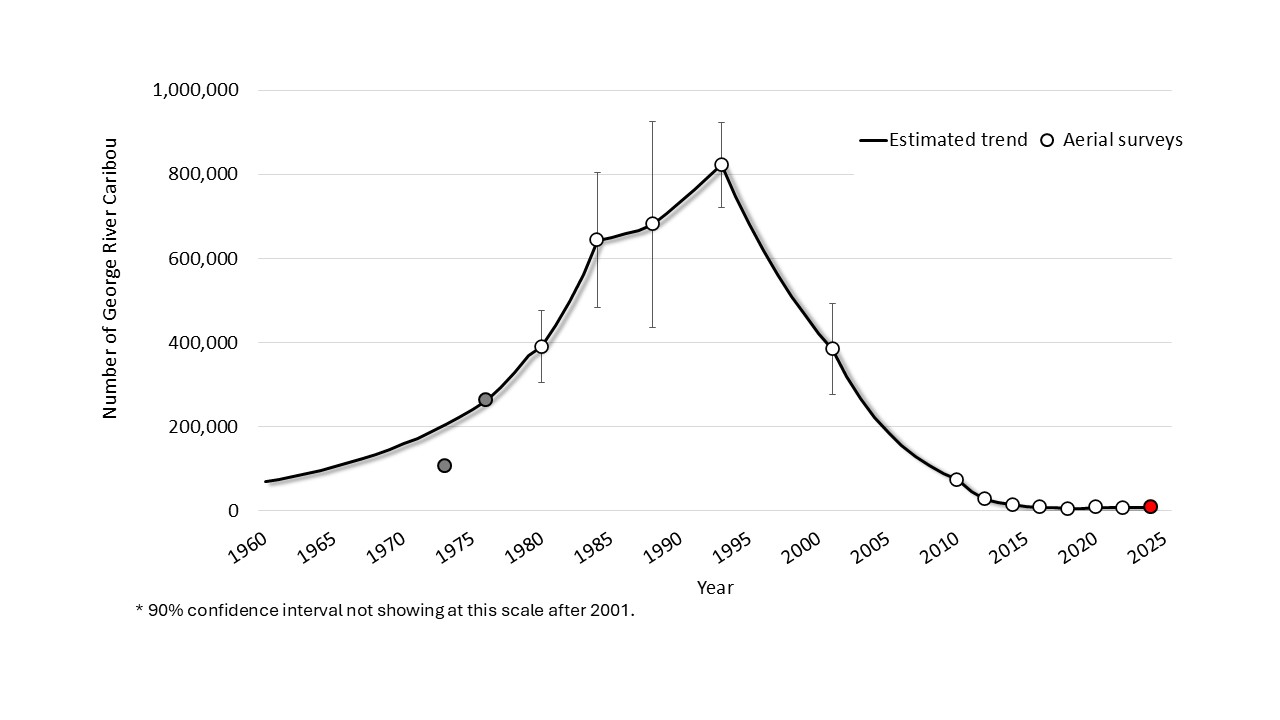
We continue to focus on the status of caribou populations throughout the province. While harvest quotas have not changed significantly for caribou on the island of Newfoundland, the George River Caribou Herd and Boreal Caribou populations in Labrador remain closed due to their conservation status and limited recovery.

It is heartening to see that hunting and trapping remain near and dear to the hearts of Newfoundlanders and Labradorians. Along with the essential contribution hunting and trapping make to food self-sufficiency, these traditional outdoor pursuits have a tremendous impact on our mental and physical well-being. The continued cultural importance of these activities serves as a reminder of who we are, and the value we place on our shared natural resources.

Wildlife management is a collaborative effort. Wildlife professionals rely on the practices of hunting and trapping to help regulate wildlife populations. These activities, carefully managed, help mitigate habitat degradation, wildlife competition, and conflict with humans.

We monitor the health and status of the province’s wildlife by establishing and maintaining research and management protocols, and analyzing the valuable information provided by hunters and trappers through jawbone submissions, hunter returns, carcass collections and other research programs.

We owe a debt of gratitude to the hunters and trappers who share this important information with us every season and encourage all hunter and trappers to participate in wildlife management.

I am also grateful to the many rod and gun clubs, non-government organizations, local businesses and volunteers who encourage and promote safe and responsible outdoor activities for youth and adults. Programs and opportunities that encourage responsible participation in hunting and trapping activities are vital to the management and conservation of our wildlife resources, and your work is deeply appreciated.

The Provincial Government’s wildlife staff, resource enforcement officers and regional services teams are steadfast in their commitment to conserve and protect our wildlife resources and raise awareness of our shared responsibilities and values for wildlife and biodiversity in our great province. Their work to promote safe, knowledgeable and responsible hunting and safety practices is crucial, and I thank them for it.

I wish you all a safe and successful hunting and trapping season.

Sincerely,

Honourable Lisa Dempster
Minister of Fisheries, Forestry and Agriculture


^ Top of Page

Left Footer Right Footer
Left Header Right Header

Licence Fees

Licence Type Price (Cdn) Payment Methods/Restrictions
Moose Pay online.
Resident $52.00
Resident Senior $33.80
Non-Resident $502.00 Available through licenced outfitter only.
Woodland Caribou (Newfoundland) Pay online.
Resident $52.00
Resident Senior $33.80
Non-Resident $675.00 Available through licenced outfitter only.
Black Bear Pay online.
Resident Application $39.00
Resident Senior Application $25.35
Non-Resident $150.00 Available through licenced outfitter only.
Small Game/Coyote/Wolf (Shooting Licence) All licences available at local vendors or contact a Government Service Center.
Resident $10.00
Resident Senior $6.50
Non-Resident (Canadian-Citizen) $50.00
Non-Resident (Non-Canadian Citizen) $100.00
Youth Small Game Snaring Only Free Youth under 16
Ptargmigan (Shooting Licence) All licences available at local vendors or contact a Government Service Centers.
Resident $10.00
Resident Senior $6.50
Non-Resident (Canadian-Citizen) $50.00
Non-Resident (Non-Canadian Citizen) $100.00
Trapper Pay online.
General Licence $15.00
General Licence (Senior) $9.75
Beaver Trapline or Trapper’s Beaver Licence-Island $15.00
Beaver Trapline or Trapper’s Beaver Licence-Island (Senior) $9.75
Guide Pay online.
General Licence $15.00
Resident Senior $9.75
Migratory Game Bird Permit Available at Canada Post Outlets or online: https://www.permis-permits.ec.gc.ca/en/
Canadian Resident $17.00
Non-Canadian $17.00


NOTE:

  1. Licences sold through vendor outlets and/or Government Service Centres are subject to an additional $3.00 fee at the time of purchase.
  2. All licence fees are non-refundable and subject to change.
  3. Prices do not include HST.
  4. Licence fees for seniors apply to those aged 65 and older.
  5. If submitting cheque or money order please make payable to Newfoundland Exchequer Account.

^ Top of Page

Left Footer Right Footer
Left Header Right Header

New for 2025-26

Big Game

Moose

On the Island of Newfoundland, a total quota of 27,515 moose licenses including 19,165 either sex, 7,890 male only and 460 not-for-profit are available for this coming hunting season.  This represents an overall decrease of 75 licenses compared to the 2024-25 season. Thirteen moose management areas (MMA) have quota adjustments. The breakdown of changes is available in the Island Moose Section.

In Labrador, a total quota of 373 either sex moose licenses are available. This represents an increase of three licenses compared to the 2024-2025 season. Three MMA’s have quota adjustments. The breakdown of changes is available in the Labrador Moose Section

Caribou (Island)

On the Island of Newfoundland, a total quota of 612 caribou licences including 353 Either Sex and 259 Male Only are available.  This represents an increase of 16 licences compared to the 2024-25 season. Quotas have been adjusted in two caribou management areas (CMA) which include the new CMA 80 (Upper Grey Island).  A new season date is established for CMA 71 (Lower Grey Island) and CMA 80 which opens September 14 and closes November 22, 2025. The breakdown of changes is available in the Island Caribou Section.

Black Bear (Island)

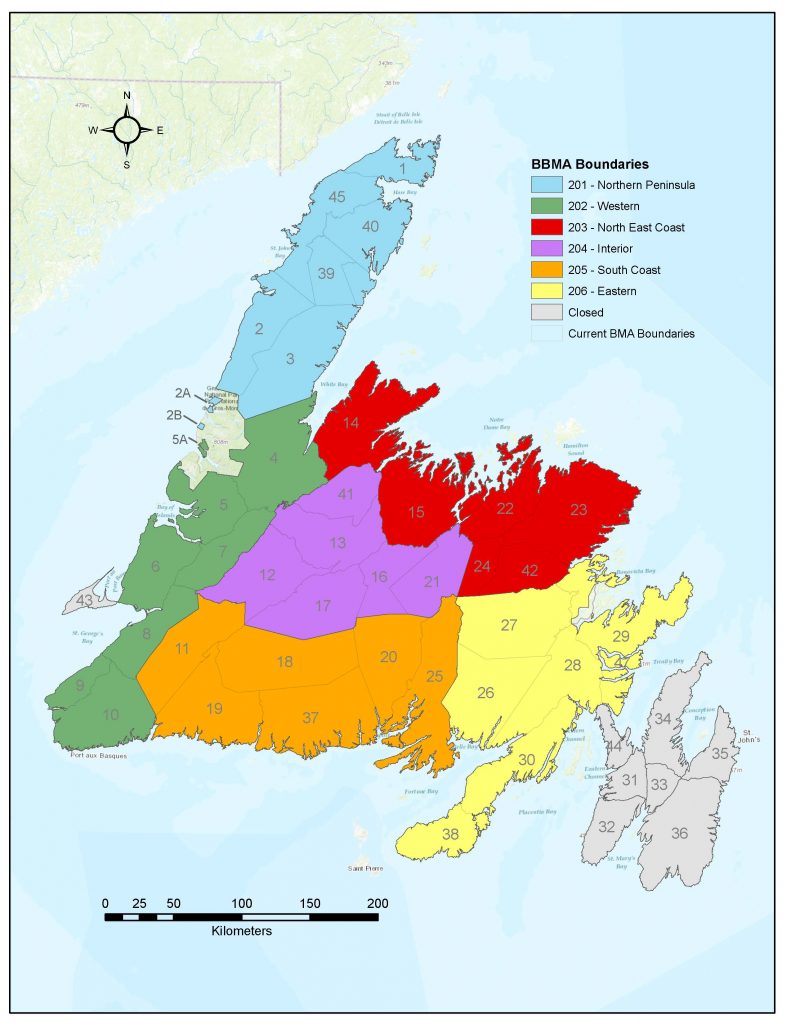
Beginning in the spring of 2025, former Black Bear Management Areas on the island of Newfoundland will be consolidated into newly established regional Black Bear Management Areas (BBMA) to enhance opportunities for hunting and to improve harvest return information that supports black bear management.  Additionally, all fall black bear management zones that are open to hunting will have season dates extended by one week, now closing November 30, 2025.  For more information, please refer to the Island Black Bear Management Area section.

Survey Advisory to Big Game Applicants

Moose and caribou management area surveys conducted during the winter of 2025 may potentially influence quotas once the results are analyzed. Any changes to quotas will be announced prior to the big game licence draw.

Big Game Area Maps

Big game area paper maps will no longer be mailed out with the moose/caribou and black bear licence package. Online maps are available for print or download by clicking here and provide a legal description of big game moose, caribou and black bear management area boundaries that hunters may use for reference purposes and to report harvest information. For more information, please contact the Wildlife Division.

Reminder – Online Applications Only

The big game licence application process for the resident moose/caribou draw and black bear, trapper and guide licences are available online only. Applicants will be notified electronically via email when the big game online applications become available, and the big game draw is completed. Applicants must have an online account to log into the Department of Forestry, Agriculture and Lands Wildlife Information Management System (WIMS) portal.  For further information about our online services, please contact the Wildlife Division at 709-637-2025/709-729-2630 or by email at wildlifelicense@gov.nl.ca. Include your name, Newfoundland and Labrador Driver’s Licence/Photo ID and telephone number.

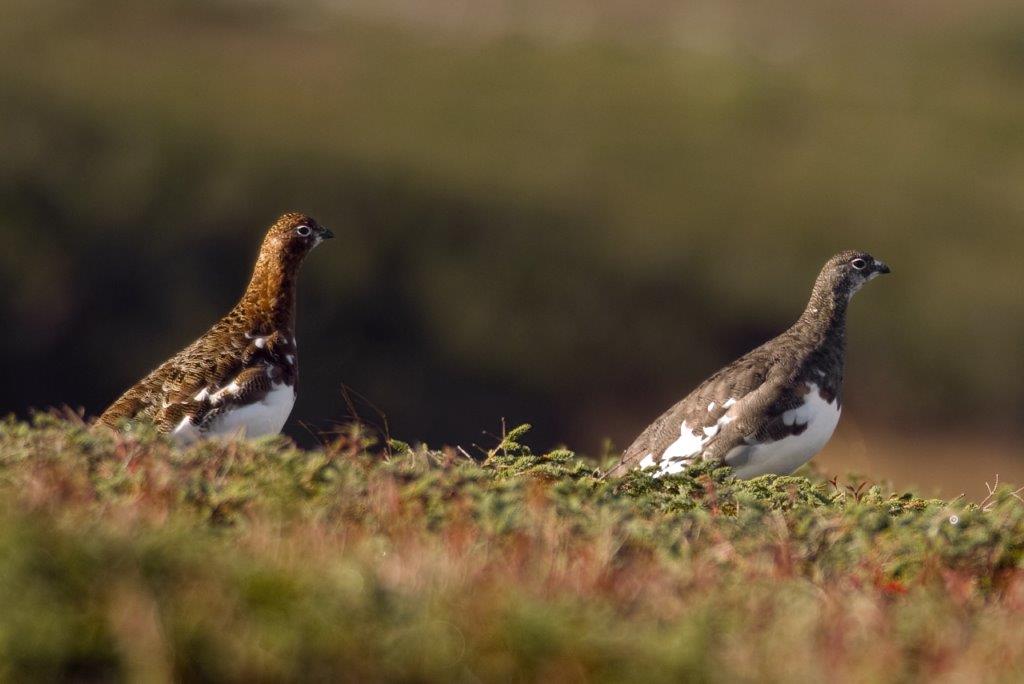
Ptarmigan Survey (Island)

A targeted study hunter attitudes regarding ptarmigan harvesting will be conducted through a mail-out survey, sent to a group of license holders on the Island of Newfoundland. These surveys offer wildlife managers a clearer picture of harvest and harvest activity and provide an opportunity for hunters to share feedback.  The Ptarmigan Shooting License was separated from the Small Game License in efforts to improve ptarmigan management and to enhance direct engagement of ptarmigan hunters participating in the activity.

Participation in the survey will be completely voluntary and anonymous.  Participants will have an opportunity to participate in a prize draw.

Heavy Metal Monitoring

A monitoring program is under development to assess the levels of heavy metals that may have accumulated in harvested big game animals and examine how these concentrations vary across the Island of Newfoundland. Elevated levels of heavy metals in meat or organs can pose health risks for humans if consumed in large quantities, making routine monitoring important.

Hunters may be asked for voluntary submissions of biological samples from harvested black bears, moose, and caribou, such as liver and kidney, to test for heavy metals. Incentives similar to cooperating hunter crests will be available for those who participate in the program.

Notice to Trappers

Breakaway Devices (Island)

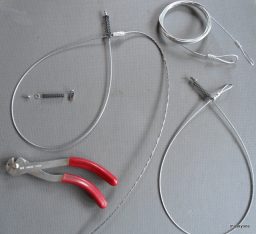
Use of breakaway devices added to neck snares will become mandatory on the Island of Newfoundland starting in the 2025-26 trapping season for terrestrial furbearers such as lynx, fox, coyote and wolf.  The snare shall include a breakaway device to cause the snare loop to disassemble when 340 kilograms or less of static force is applied. These measures are being implemented to reduce incidental captures of moose and caribou.    More information is available in the Trapping Practices to Avoid Non-Target Species section.

Beaver Trapline Licensing System (Island)

Beginning in 2025-26, beaver traplines that are vacant at the start of the trapping season will be included for the entire season on a general areas list that will then be made available to holders of a trapper’s beaver licence. A person who is currently assigned a beaver trapline and continues to hold a valid beaver trapline licence and engages in active trapline activities required as part of the licence conditions will not be impacted by this change. More information is available in the General Information for Trappers section.

 *Updated 9/12/25

^ Top of Page

Left Footer Right Footer
Left Header Right Header

General Information for All Hunters

IMPORTANT NOTICE: This guide is neither a legal document, nor a complete collection of current hunting and trapping regulations or firearms laws. It is an abbreviated guide issued for the convenience of hunters and trappers. The Wild Life Act and Regulations should be consulted for interpreting and applying the law. Please contact your nearest Department of Forestry, Agriculture and Lands (FFA) office for more information.

Application Deadlines

Resident Moose and Caribou and Not-for-Profit/Charitable Moose Applications

  • Resident moose and caribou applications must be received by the close of business on April 25, 2025. Applications must be submitted online via the Wildlife Information Management System. Eligible applicants who require further assistance can call the Wildlife Division at: 709-637-2025 or 709-729-2630, or email: wildlifelicense@gov.nl.ca. Include your name, Newfoundland and Labrador Driver’s Licence/Photo ID and telephone number.

How do I check for my big game draw results?

You must check online.  Once the big game draw is completed login to your online Wildlife Information Management account, click on the Applications/Returns menu then click on your Moose/Caribou application for the current year. Your big game draw results will be displayed.

  • Not-for-profit/charitable moose applications are available as fillable PDF documents that include FAQs and information on completing your application.  Applications must be submitted to nfp@gov.nl.ca by April 25, 2025 (4:30 pm NST).  Applications not submitted to this email address or after the deadline will not be accepted.

Resident Black Bear

Applications and payments must be received by the dates indicated to ensure your licence is available before the hunting season begins. To apply online, visit the Wildlife Information Management System.

Spring Season:

Labrador close of business (4:30 p.m NST) March 12, 2025

Island close of business (4:30 p.m NST) April 11, 2025

Fall Season: Island and Labrador close of business (4:30 p.m NST) June 27, 2025

Note: Applications received after these dates will be accepted but are not guaranteed to be processed before the season opens.

New Applicants for the Big Game Licence Draw

To be eligible for the annual big game draw for moose or caribou, new applicants must have completed the Canadian Firearms Safety Course and Hunter Education Course or transferred hunter certification credentials from another jurisdiction on or before November 30 of the previous year. Outdoor Identification Card applications must be accompanied by proof of completion of a recognized hunter training course.

Where Can I Get a Hunting or Trapping Licence?

  • Resident moose licences for Newfoundland and Labrador and resident caribou licences for the Island of Newfoundland are only available through the Wildlife Division’s big game draw process and by logging on with your user name and password at www.wildlife.gov.nl.ca.
  • Resident black bear licences are available by logging on with your user name and password at www.wildlife.gov.nl.ca.
  • Resident small game/coyote/wolf and ptarmigan shooting and snaring licences are available at vendor outlets throughout the province. Resident hunters must provide identification, such as a Newfoundland and Labrador Driver’s Licence, to the vendor at the time of purchase.
  • General trapper licences, beaver trapline licences  or  trapper’s beaver licences are available online only by logging on with your user name and password at www.wildlife.gov.nl.ca.
  • Migratory game bird hunting permits are available through Canada Post offices at local offices or online at http://www.permis-permits.ec.gc.ca/ and are valid throughout Canada (additional hunting licences may be required to hunt migratory game birds in other provinces).

Age Requirements

A person must be 12 years of age or older to hunt with a firearm for small game, migratory waterfowl and coyotes or use a firearm to dispatch furbearers caught in traps. To hunt big game, a person must be 16 years of age by August 31 in the year for which the licence is valid. Persons under 16 years of age may also purchase licences to take small game and furbearers by snaring or trapping only. See Youth Hunting and Trapping Licences for more information.

Federal Firearms Regulations

  • In addition to the Wild Life Regulations, the Firearms Act and Regulations require all gun owners to be licenced. A firearms licence is also required to purchase ammunition.
  • Youth aged 12 to 17 may apply for a minor’s licence. For information call 1-800-731-4000 ext. 5013.  For the purpose of hunting small game, coyotes and wolf or migratory game birds with a firearm within Newfoundland and Labrador, hunters aged 12 to 15 may hunt with a firearm while under the direct and immediate supervision of a person who can lawfully possess firearms (i.e. has a valid possession and acquisition licence).
  • A hunter that does not have a firearms licence may hunt with a firearm while under the direct and immediate supervision of a person who holds a valid possession and acquisition licence. This is only permissible if the hunter is not subject to a court order which prohibits them from the possessing or using a firearm. Direct and immediate supervision means you must remain within arm’s length of a properly licenced person so that the person may take care and control of the firearm if necessary and the licence holder has no reason to believe that the hunter has a mental illness that makes it unsafe for them to possess firearms or that they are impaired by alcohol or a drug.
  • For more information about federal firearms regulations and licences, please contact the RCMP’s Canadian Firearms Program at 1-800-731-4000 or visit their website at: rcmp.ca/en/firearms

Canadian Firearms Safety Course/Hunter Education (CFSC/HE) Course

Individuals wishing to hunt game with a firearm (including bows) in Newfoundland and Labrador are required to complete the CFSC/HE Course. In person courses are offered through College of the North Atlantic. Some exceptions may apply for those who have completed other recognized hunter training programs in other North American provinces, territories or states.

The Newfoundland and Labrador Hunter Education course is also available online at: Official Newfoundland Hunter Safety Course | HUNTERcourse.com New hunters must also complete the in-class Canadian Firearms Safety Course (Non-Restricted).

Outdoor Identification Card (OIC)/Temporary Outdoor Identification Cards (TOIC)

An OIC is issued to residents who have completed the CFSC/HE Course or have previously completed the Hunter Capability Test or the Canadian Firearms Safety Course (in Newfoundland and Labrador only) before April 1996. The OIC, along with the appropriate hunting licence must be in your possession while hunting with firearms. The OIC is proof that a hunter has met the province’s requirements to hunt game with a firearm.

  • A Temporary Outdoor Identification Card (TOIC) is issued to individuals who have just passed the CFSC/HE course or those individuals who have lost their OIC.
  • Individuals who require a replacement OIC can visit the nearest Department of Forestry, Agriculture and Lands office for a TOIC and an application for a replacement OIC. Applications are also available online at gov.nl.ca/

Problem Moose on Farms

  • Holders of a valid moose hunting licence, inlcuding a Not for Profit/Charity Moose Licence, may be authorized by a conservation officer to assist farmers in removing problem moose from farms. If you are interested in participating, please call a regional Department of Forestry, Agriculture and Lands office. Licence holders will be contacted in the order their calls are received. You may be called to a farm to either remove a dispatched moose or asked to hunt on the farm according to instructions from the conservation officer and farmer.
  • Persons with disabilities not able to participate in the CFSC/HE Course or persons with disabilities who are eligible to hunt big game and are registered for the Program for Hunters with a Disability may become eligible to receive a problem moose from farms or moose that is dispatched by a conservation officer. Priority access to this moose meat is managed by the regional or district Department of Forestry, Agriculture and Lands office where the problem moose occurred.  Persons interested in problem moose must be eligible for the Program for Hunters with a Disability and hold a big game license or provide a medical note from a doctor.  For more information or to add your name to a priority list, please contact your nearest Department of Forestry, Agriculture and Lands office.

Not-for-Profit Moose Licences

  • Moose licences are available to registered not-for-profit and charitable organizations through the Wildlife Division. Organizations may utilize qualified resident hunters named on a valid  licence to hunt and transport moose for charities and service groups that use the meat for fundraising purposes and food sharing programs.
  • Registered not-for-profit and charitable organizations must apply by close of business 4:30 p.m. April 25, 2025. Applications received after this date will not be considered. For applications and information, click here.
  • Eligible applicants who did not receive a provincial not-for-profit moose licence in the previous year will be given priority in the not-for-profit moose licence draw process.
  • Not-for-profit moose licence applicants are required to identify and only permit up to four eligible hunters to hunt to behalf of the organization.  Eligible hunters can only be identified on one NFP application per season.  Names cannot be added or changed after the application deadline date.
  • Additional not-for-profit moose licences are also available through Parks Canada in Gros Morne National Park and Terra Nova National Park. Contact Parks Canada for more information.

Reminder – Possession and Sale of Game

Legislated restrictions on the possession, use and sale of game meat apply to meat harvested under not-for-profit moose licence. For more information on appropriate use please refer to the big game section of the Regulation Summary or contact the Wildlife Division at: 709-637-2025 or 709-729-2630, or email: wildlifelicense@gov.nl.ca. For information on donating game meat, please see Licence to Donate Wild Game.

Transportation of Firearms

  • A permit to transport firearms is required during a closed season or without a valid hunting licence. Permits are available at local Department of Forestry, Agriculture and Lands offices.
  • Rod and Gun Clubs and firearm businesses (gunsmiths) may apply for annual firearms transport permits by contacting the Wildlife Division at: 709-637-2025.

Online Services

  • Many of the services provided by the Wildlife Division, such as submitting big game applications and payments, renewing licences, and submitting licence returns can be accessed online at www.wildlife.gov.nl.ca provided you have your login identification and password. To request information concerning your login identification and password, contact the Wildlife Division at: 709-637-2025, 709-729-2630, or email wildlifelicense@gov.nl.ca
  • Check out our website at www.gov.nl.ca/fal for more information on hunting, trapping, angling and guiding.

Residents

A resident of Newfoundland and Labrador is:

  • A Canadian citizen who has lived in this province for six consecutive months immediately preceding their application for a licence;
  • A person, other than a Canadian citizen, who has lived in this province for 12 consecutive months immediately preceding their application for a licence;
  • While stationed in the province, a member of the Canadian Forces or the Royal Canadian Mounted Police (RCMP);
  • While stationed outside the province, a member of the Canadian Forces or the RCMP who was born in the province; or
  • A person ordinarily a resident of the province who leaves to attend a recognized educational institution and intends to return upon completion of studies at the institution concerned.
  • If your residency status has changed you must notify the Wildlife Division immediately. It is an offence for non- residents to apply for and receive a resident licence.

Note: Members of the Canadian Forces and RCMP are required to provide proof of their military/police status to the Wildlife Division when filing an application for resident licences. An Outdoor Identification Card Application and/or letter from commanding officer may be requested to confirm their status from time-to-time during routine file maintenance.

Non-residents

  • A non-resident Canadian is a person who is a Canadian citizen but is not a resident of Newfoundland and Labrador.
  • A non-resident alien is a person who is not a Canadian citizen.
  • General information and regulations found in this Guide are applicable to non-residents.
  • For the purposes of non-resident hunting in Newfoundland and Labrador it is required that nonresidents meet equivalent standardized hunter education training requirements that is satisfactory to the minister of FFA as per the Wild Life Regulations. Furthermore, while hunting, non-resident hunters must carry a corresponding hunter education certificate, card or official government document from a state, province/ territory, country or similar credentials that is provided from a recognized service provider that states they have completed a hunter and firearm education training course or program and must present this information immediately upon request of a conservation officer.
  • Non-resident big game hunters are required to be accompanied by licenced guides. Guides are supplied by licenced outfitters. Non-resident small game, coyote, wolf or waterfowl hunters do not require guides.
  • Non-resident big game licences (bear, moose, caribou) are only available through licensed outfitters.
  • Non-resident small game/coyote/wolf shooting licences are available through vendor outlets. Migratory Game Bird Hunting Permits are available through Canada Post Offices or online via:
  • Purchase of a Migratory Game Bird Hunting Permit | Migratory Game Bird Hunting E-Permit
  • Hunters must declare all game entering the United States from Canada. American hunters should obtain the necessary forms at U.S. Customs when leaving the United States.
  • Hunters must possess a game export permit to take game out of the province. Export permits are available free of charge from all Department of Forestry, Agriculture and Lands offices and licenced outfitters.
  • Non-resident black bear hunters may require a Convention on International Trade in Endangered Species (CITES) permit to transport black bear parts outside Canada.
  • Non-residents arriving at a Canada Customs port must declare all firearms. For further information, contact the Canadian Firearms Program at: 1-800-731-4000 or by visiting: www.rcmp-grc.gc.ca/cfp-pcaf/index-eng.htm.
  • A non-resident cannot apply for a licence or priority pool advancement in the resident big game licence draw.
  • For a list of outfitters and complete information on non-resident hunting, contact the Department of Tourism, Culture, Arts and Recreation by phone at: 1-800-563-6353 (inside North America) or 1-709-729-2830 (outside North America), or by visiting: www.newfoundlandlabrador.com/thingstodo/hunting.

Guide Licences

  • First-time applicants must include, along with their guide licence application and proof of Canadian residency status, a valid emergency first aid certificate and proof of completion of a recognized Firearms Safety/Hunter Education Course and boat safety course or equivalent. Alternatively, applicants may include proof of completion of a Newfoundland and Labrador recognized guide training program. Applicants must be 18 years of age or older.
  • New guide applicants and re-newewal applicants require a minimum of 10 business days for an application to be processed. Incomplete applications or those requiring additional information will result in further delays. Applications received during the hunting or angling season will not be given additional priority. Those wishing to receive a guide licence should submit their request well in advance of the season.
  • Applications are available online here or from the Department of Forestry, Agriculture and Lands or Wildlife Division offices.
  • Renewal payments may be made online at: www.wildlife.gov.nl.ca or by contacting the Central Cashier’s Office at: 729-3042 or P.O. Box 8700, St. John’s, NL, A1B 4J6. Payments for guide applications or renewals licences for other residents of Canada must be made through the Central Cashier’s Office.
  • For more information, contact your nearest Department of Forestry, Agriculture and Lands Office. Canadian Citizens who are registered as a Newfoundland and Labrador Guide may only renew a Guide Licence by contacting the Central Cashier’s Office and providing their Guide Registration Number.

Replacement Licences

  • If your hunting licence and/or tags have been lost, damaged or stolen, you must get a replacement licence and/or tags before you continue hunting.
  • Replacement big game licences and/or tags are available from any Department of Forestry, Agriculture and Lands Regional or District Office or Wildlife Division office. Return any part of the original licence and/or tags in your possession. An affidavit describing the circumstances of the loss must be completed and signed by a Justice of the Peace, Commissioner for Oaths or Notary Public.
  • Replacement small game/coyote/wolf and ptarmigan shooting licences are available from the vendor (at no cost) where you purchased your original licence. Keep your licence return and record the date of purchase and the vendor’s name and address. An affidavit describing the circumstances of the loss must be completed and signed by a Justice of the Peace, Commissioner for Oaths or Notary Public. Bring these to the vendor and they will issue a replacement licence.

Samiajij Miawpukek Reserve (Conne River)

Hunters are advised that permission is required to access the Reserve. Contact the Miawpukek First Nation at: 1-866-882-2470 or go to: www.mfngov.ca for more information.

Maps

  • Maps in this publication are prepared for reference only. The Wild Life Act and Regulations should be consulted for all purposes of interpreting and applying the law. For detailed maps and legal boundary descriptions visit: https://pattern-loop.live/fal/public-education/wildlife/hunting/boundry/%3C/a%3E, or write to the Wildlife Division, P.O. Box 2007, Corner Brook, NL A2H 7S1.

Marked Animals

  • Many big game animals and wolves have been ear-tagged and/or have had radio collars affixed to them. Ear tags may be made of light plastic or metal. Radio collars are often white, black or bright orange or yellow in colour. Because of the cost associated with animal capture and marking and the value that these animals have in monitoring programs, hunters are asked not to harvest these animals. However, hunters who harvest these animals must return the radio collar and lower jawbone (in the case of a big game animal). A $50.00 reward will be offered for the return of radio collars.
  • For more information on marked wildlife, please contact the Wildlife Division.

Injured or Diseased Animals

Please report any observations of injured or diseased wildlife to the nearest Department of Forestry, Agriculture and Lands office. If a harvested big game animal appears to be diseased or was previously injured, the entire carcass must be brought to a local Department of Forestry, Agriculture and Lands office for inspection. In most cases, it is only possible to determine whether an animal has a serious disease or infection by examining the entire carcass. Hunters are advised that a replacement licence shall only be issued if a big game animal is found to be unfit for consumption because of disease or previous injury and the entire carcass has been submitted for disposal.

Health Canada Advisories

  • Health Canada advises that some big game animals treated with immobilizing drugs may be unsuitable for human consumption. All big game animals captured using immobilizing drugs have been marked with a radio collar or ear tag or both. If you happen to harvest a collared or ear-tagged animal, contact the Wildlife Division immediately at: 637-2398 for advice on the suitability for consumption.
  • The Wildlife Division, after consultation with Health Canada, recommends the public not eat the liver or kidneys of moose or caribou. The cadmium contained in one meal of either liver or kidney, combined with a person’s normal consumption of cadmium in other foods, would likely be more than the weekly allowable intake of cadmium as recommended by the World Health Organization.

Akami-Uapishkᵁ-KakKasuak-Mealy Mountains National Park Reserve

Small game, waterfowl hunting and fur-bearer trapping by eligible persons will continue to be permitted within the national park reserve under the authority of a valid provincial licence. To determine eligibility and obtain more information concerning other activities inside the national park reserve boundary, please consult the Parks Canada website at: https://www.pc.gc.ca/en/pn-np/nl/mealy or contact the Parks Canada office in Happy Valley Goose Bay at: (709) 896-2394 or email: pc.mealys.pc@canada.ca.

^ Top of Page

Left Footer Right Footer
Left Header Right Header

Big Game Licence Application and Draw Process

Eligibility

To be considered eligible for the 2025 big game licence draw, you must:

  • Be a resident of Newfoundland and Labrador.
  • Be at least 16 years of age by August 31, 2025.
  • Have a Hunter Certificate Number issued by the Wildlife Division.
  • Have completed the provincial Firearms Safety/Hunter Education Course or applied for an Outdoor Identification Card with training credentials transferred from out of province before November 30, 2024.

Name Changes

Individuals requiring name changes to remain current in the Wildlife Management Information System must do so in writing and provide the applicable documentation:

  • For marriage, a copy of marriage certificate and driver’s licence or photo identification which matches the name on the marriage certificate;
  • For divorce, a copy of birth certificate and driver’s licence or photo identification which matches the name on the birth certificate; and
  • For any other reasons, a copy of change of name document and driver’s licence or photo identification.

This notification can be submitted to the Wildlife Division offices in Corner Brook or St. John’s or emailed to wildlifelicense@gov.nl.ca 

Address Changes

The Wildlife Division must be notified in writing of any address changes to ensure you receive your big game licence. This notification can be submitted to the Wildlife Division offices in Corner Brook or St. John’s or emailed to wildlifelicense@gov.nl.ca You may also change your address in your online Wildlife Information Management account at www.wildlife.gov.nl.ca

Applications

All resident big game applications must be submitted online via the Wildlife Information Management System. Eligible applicants who require further assistance can call: 709-637-2025 or 709-729-2630, or email: wildlifelicense@gov.nl.ca. Include your name, NL Driver’s Licence/NL Photo ID and telephone number.

  • If you do not want a licence but wish to advance in the priority pools, indicate ‘no – advance priority pool only’ in the section asking “Do you want to enter the draw for a licence?”.
  • If you wish to have a licence, you must indicate ‘yes’ in the section asking if you want the application to enter the draw for a licence and the types of licences you are willing to accept (either-sex, male-only or calf). Generally, the more types you are willing to accept, and provided those licence types are available in the areas you choose, the greater your chances of receiving a licence. You must also indicate the areas for which you are willing to receive a licence.

Important Note for All Applicants

Each application allows an individual or party to choose up to 8 management areas. Applicants may include moose and/or caribou management areas in one application.

It is important to consider all types of licences for moose and caribou noted in the quota tables of the Hunting and Trapping Guide in each area (either-sex, male-only, or calf), as well as the previous year’s priority pool draw results, to help guide you before indicating the licence types you are willing to accept. Selecting an area that does not include the licence types you wish to receive may result in your application not being drawn, even if you are in a higher pool. For example, if you choose male-only for a management area that only offers either-sex licences, you will not be drawn. The WIMS system does allow an applicant to select a licence type for a specific area as part of the application process.

Priority Pool Status

To advance through the priority pools you must submit an application by the deadline date each year. If a hunter does not submit an application for three consecutive years, their file will be identified as inactive and their priority pool will be reset to Pool 8.

Licence Draw

  • The draw is based on a ‘priority pool’ system and applications are ranked based on participation and/or success in previous draws. There are nine pools. Pool 1 has the highest priority and Pool 9 has the lowest.
  • This system gives applicants who have been in the draw the longest without receiving a licence the best possible chance of receiving one. Note that being in Pool 1 does not guarantee you a licence.
  • The draw is computerized and begins with Pool 1 co-applicant applications, followed by Pool 1 individual applications, followed by Pool 2 co-applicant applications and so on. Co-applicant applications receive preference to give as many hunters as possible an opportunity to hunt with the licences available.
  • The draw also begins with the first area of choice on each application and goes through each area listed until a licence is awarded or the choice of areas runs out.
  • In each area, either-sex licences are awarded first, followed by female-only or calf (if available) and male-only or calf. It is important to consider the types of licences available in each area and not choose any licence type that you are not willing to accept or that is not available.
  • Chances of receiving a licence are greater for co-applicant applications and those who list additional areas. Note that where two applicants on a co-applicant application have different rankings, the application is assigned to the lower pool.  For example, if the applicants have a Pool 3 and Pool 5 ranking, the application goes in Pool 5.
  • Youth Applicants: Youth applicants who turn 16 by August 31 are eligible to apply for a moose/caribou licence and are automatically placed in Pool 5.  A co-applicant interested entering the draw with a youth applicant may also apply, and shall be entered as Pool 5 Party regardless of the co-applicant’s pool standing.  If a youth and co-applicant are successful in the draw their priority status will return to Pool 8 in the following year. If a licence is not drawn, only the youth would advance to Pool 4 in the following year and the co-applicant would advance from their current priority pool status. The opportunity to enter the draw with a youth applicant in the same pool only applies while the youth is 16 and 17 years of age and if a licence was not awarded to the youth applicant in the previous draw.  Persons 18 years of age who are new applicants in the big game licence draw start off in Pool 8.

Priority Pool Ranking

These rankings are based on a hunter who submits an application each year:

  • Pool 1: Hunters who applied but did not receive a licence in the previous seven years.
  • Pool 2: Hunters who applied but did not receive a licence in the previous six years.
  • Pool 3: Hunters who applied but did not receive a licence in the previous five years.
  • Pool 4: Hunters who applied but did not receive a licence in the previous four years.
  • Pool 5: Hunters who applied but did not receive a licence in the previous three years and eligible youth applicants applying for the first time.
  • Pool 6: Hunters who applied but did not receive a licence in the previous two years.
  • Pool 7: Hunters who applied but did not receive a licence in the previous year.
  • Pool 8: New adult applicants and hunters who held a party licence in the previous year.
  • Pool 9: Hunters who held an individual licence in the previous year.

Reasons for Rejected Applications

  • Conviction on file: individuals convicted for a big game offence under the Wild Life Act and Regulations are not eligible to participate in the application/draw process for five years.
  • Firearms prohibition: individuals prohibited by the Court from possessing a firearm are not eligible to participate in the application/draw process until the prohibition ends. It is an offence to do so knowingly.

Licence Payments

  • Payments for moose and caribou licences must be received by June 27, 2025 in order to guarantee receipt of the licence and tags before the start of the hunting season.
  • Payments will be accepted after the deadline date, however there may be delays in receiving your licence and tags.
  • Payments are not accepted at Wildlife Division offices. Payments are accepted through your Wildlife Information Management Account, via mail at Central Cashier’s Office, P.O. Box 8770, St. John’s, NL, A1B 4J6 or via telephone at 709-729-3042.  If paying by mail or telephone you must include your name, NL Driver’s Licence/NL Photo Id number and your telephone number.

Frequently Asked Questions

Once I file my big game application online, how do I know it was received and/or can I view it immediately to check for correct information?

Once you successfully complete your application you will receive a confirmation page. Please print or save the confirmation message for your records as it will be required for any future inquiries on your application with the Wildlife Division. Please print or save the confirmation page. It is strongly suggested you double check to ensure your application is received and all application data is accurate. You can view your application information by selecting the Applications/Returns menu and then click on the application from the list.

Can I make changes to my big game application once it has been filed online?

Yes. You can change your application information up to the deadline date. After that date no online changes will be permitted, but you will be able to view the details of your application.

How do I check for my big game draw results?

Once the big game draw is completed login to your online Wildlife Information Management account, click on the Applications/Returns menu then click on your Moose/Caribou application for the current year.  Your big game draw results will be displayed.


Left Footer Right Footer
Left Header Right Header

2024 Resident Big Game Draw Results

Analysis of 2024 Licence Draw by Area Choice

The tables below identify the lowest pool that Either Sex (ES) or Male Only (MO) licences were awarded in the 2024 resident big game licence draw and can be used as guide in selecting your area(s) for the 2025 draw. As an example, if you are in Pool 6, you should only consider the area(s) that licences were awarded in Pool 6 Individual (I) or Pool 6 Party (P) in last year’s draw. You may also consider listing an area(s) that have gone to Pool 7 to 9 to further increase your chances but remember to only apply for areas where you are prepared to hunt. Please note that the 2024 results are for reference purposes only and do not necessarily guarantee your chances of receiving a licence in the 2025 draw.

2024 Island of Newfoundland (Moose)

Moose Management Area (MMA) Area Number of Applications Naming Area Lowest Pool Either-Sex Licence Lowest Pool Male-Only Licence 2024-25 Resident Quota
St. Anthony 1 1510 7I 9I 563
Portland Creek 2 1942 8P 8P 876
Cow Head-St. Paul’s Enclave 2A 182 8P – 20
Sally’s Cove Enclave 2B 117 8P – 10
Gros Morne National Park 2E 787 9I – 500
Harbour Deep 3 1167 9I – 793
Taylor’s Brook 4 3041 6I 7I 443
Trout River 5 3517 7P 8P 1112
Rocky Harbour Enclave 5A 196 7I – 30
Corner Brook 6 4652 7P 8P 1374
South Brook 7 2963 7P 8P 769
St. Georges 8 2274 7I 8P 744
Anguille Mountains 9 928 8P 9I 335
Port aux Basques 10 1616 7I 8P 604
Dashwoods 11 904 8I 9I 331
Buchans 12 626 7I 8I 190
Gaff Topsails 13 1453 5I 6I 160
Baie Verte 14 2983 6I 7I 995
Twin Lakes 15 3694 6I 7I 1033
Sandy Badger 16 1355 4I 6I 110
Millertown 17 1464 6I 7I 420
Granite Lake 18 656 7I 9I 200
Grey River West 19 645 8P 9P 307
Round Pond 20 473 6I 7I 100
Rattling Brook 21 1697 5P 6I 159
Lewisporte 22 3919 4I 6I 738
Bonavista North 23 3834 3I 5I 626
North West Gander 24 1231 3I 6I 112
Bay D’Espoir 25 1628 6I 7I 408
Jubilee Lake 26 632 9I – 363
Terra Nova 27 1302 4I 6P 138
Black River 28 3404 4I 5I 268
Terra Nova National Park 28A 207 6I – 25
Bonavista Peninsula 29 3310 4I 6I 700
Burin Peninsula Knee 30 1942 5I 7P 575
Placentia 31 2101 5I – 250
Cape Shore 32 1579 6I 6I 325
Salmonier 33 2740 5I – 325
Bay de Verde 34 3149 3I 5I 500
St. John’s 35 2565 5I 6I 375
Southern Shore 36 3881 6I 7P 1050
Grey River East 37 235 9I – 242
Burin Peninsula Foot 38 1492 5I 6I 350
Cloud River 39 493 9I – 280
Cloud River 39A 79 9I – 17
Conche 40 1934 8P 9I 981
Sheffield Lake 41 1276 6I 7I 238
Gambo 42 1404 4P 5I 76
Port au Port 43 514 7I – 100
Bellevue 44 868 5I – 100
Ten Mile Lake 45 2209 8P 9I 820
Random Island 47 335 4I 6I 40
Avalon MRZ 100 1642 7I – 600
Central MRZ 101 787 8P – 400


2024 Labrador (Moose)

Moose Management Area (MMA) Area Number of Applications Naming Area Lowest Pool Either-Sex Licence Lowest Pool Male-Only Licence 2024-25 Resident Quota
Wabush 48 102 1I – 5
Lower Mecatina 49 9 9I – 10
Natashquan 50 5 – – 5
Baikie Lake 51 112 5I – 15
Grand River 52 121 7P – 30
Muskrat Falls 53 337 5I – 40
Grand Lake 54 102 8I – 35
Paradise River 57 106 7I – 30
Alexis River 58 255 4I – 35
Upper Kenamu 59 54 9I – 15
Upper Mecatina 60 11 9I – 10
Traverspine 84 164 6P – 25
Snegamook Lake 85 12 9I – 10
St. Augustin 86 20 8P – 5
Eagle Plateau 87 50 7I – 10
Mokami 90 22 7P – 5
Straits 93 248 2I – 25
Atikonak 94 55 7I – 20
Churchill Falls North 95 70 7I – 10
Shallow Lake 96 44 6I – 5


2024 Island of Newfoundland (Caribou)

Caribou Management Area (CMA) Area Number of Applications Naming Area Lowest Pool Either-Sex Licence Lowest Pool Male-Only Licence 2024-25 Resident Quota
LaPoile 61 466 6I – 38
Buchans 62 282 7P – 48
Middle Ridge 64 1148 5I 6P 188
Gaff Topsails 66 242 6P 6I 25
Pot Hill 67 226 – 7P 16
Mount Peyton 68 170 5I – 10
Merasheen Island 70 67 6I – 10
Grey Islands 71 24 7P – 5
Fogo Island 72 103 5I – 4
St. Anthony 76 461 3I – 19
Cape Shore 77 143 6I – 10
Hampden Downs 78 59 7P – 2
Aides Lake 79 75 5P – 2
Left Footer Right Footer
Left Header Right Header

Jawbone/Tooth Collection Program

Moose/Caribou Jawbone Collection Program

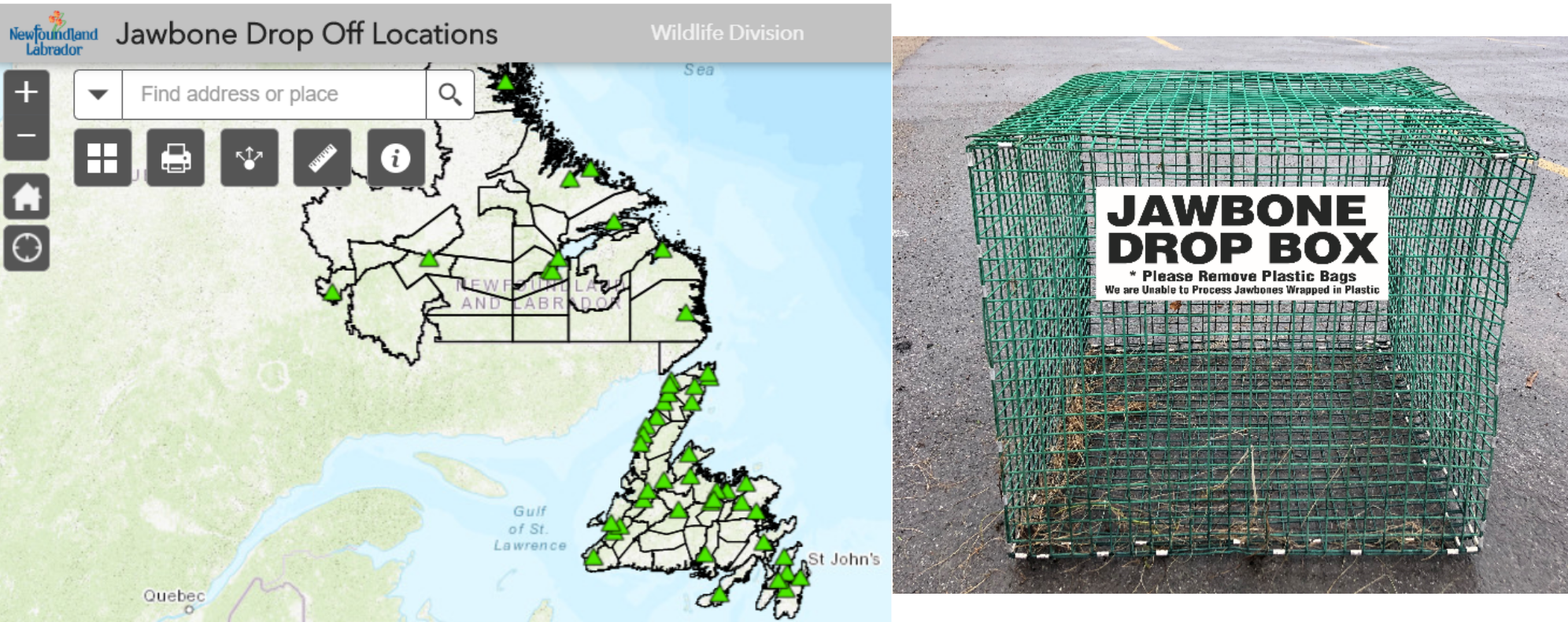
Successful big game hunters will be required to submit the lower jawbone of a moose or caribou that has been harvested under their licence.  A jawbone tag will be included in your big game licence package. Please indicate the sex of the animal you have harvested on the tag. Jawbone drop boxes will be established in 48 locations throughout the province. To view all locations on a map, click here.


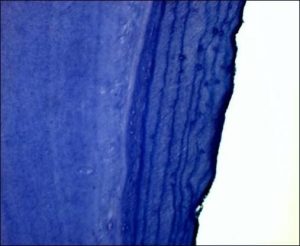
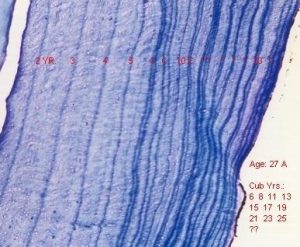
Cementum age is read by counting the layers of growth from each year.

Wear aging estimates age based on the visible wear of the molar teeth. Cementum age interpretation involves counting the layers of bony material deposited each year on the root of the tooth.  These layers appear like rings on a tree as depicted below. Incisor teeth, which are extracted from the lower jawbone and analyzed, give us an accurate age. Knowing the age structure of animals can help determine the health and status of the population. For example, hunters often harvest yearling and two-year old moose, while few calves and old animals are harvested. Other than calves, the age distribution is assumed to resemble the age of the moose population. If there are many young and prime breeding animals present, the population is probably increasing. If there are many older animals, it is likely that birth rates are low and the population is declining.


When you submit your jawbones, please keep the following in mind:

  • A properly cleaned jawbone is important for getting accurate measurements.

    A properly cleaned jawbone is important for getting accurate measurements.

  • Remove as much skin and flesh as possible.
  • Keep in a well-ventilated, cool area.
  • Do not wrap in plastic to avoid the growth of bacteria.
  • Firmly attach the jawbone tag before submitting, and remember to punch out the tab that indicates the sex of the animal harvested.
  • Samples should not be mailed.


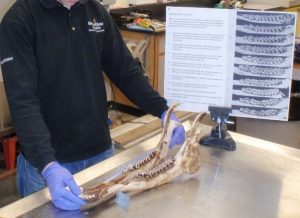
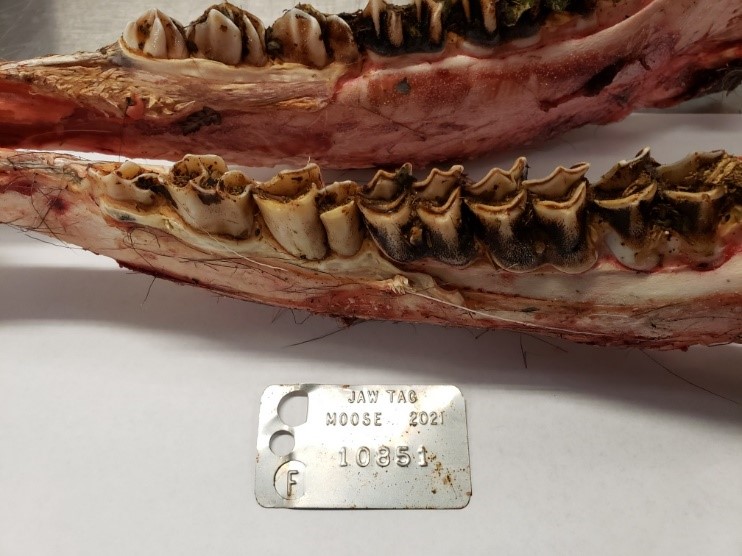
This photo is a moose jawbone received at the wildlife laboratory during Fall 2021. The animal is a yearling indicated by the tooth eruption pattern. The hunter has also indicated that a male has been harvested by punching out the correct tab on the jawbone tag.  Please punch out the sex of the animal you harvested.


Bear Premolar Collection Program

Please submit premolar teeth from your harvested black bears.

The Wildlife Division is requesting successful black bear hunters submit the upper premolar teeth from harvested bears.

  • The information from the collection will help form management decisions, evaluate black bear populations and hunting trends, and provide insight on the age structure and reproductive success of bears in our province.
  • Similar to obtaining the age from moose and caribou, black bears are aged using cementum analysis by microscope examination. The layers of cementum (bony material) deposited each year on the root of a tooth, like rings in a tree, are counted. Additionally, for female bears reproductive success can also be evaluated as a double band of cementum is laid down during cub years

How to submit premolar teeth?

  • Fill out all information on the Cooperating Black Bear Hunter Tooth Submission Form found with your bear license. A printable copy can be found here.
    • Please send your completed sheet with teeth in the envelope provided with your licence to: Wildlife Division Laboratory, Department of Forestry, Agriculture and Lands, 120-132 Main Street P.O. Box 280, Pasadena, NL.
  • Tape dry premolar teeth to the submission form and place in the envelope found with your black bear license. Place the envelope in the mail.
  • Video instruction are available here.
  • Cooperating hunters will receive a “Cooperating Big Game Hunter” crest as well as an age report for your harvested bear(s).


DO NOT SUBMIT BEAR SKULLS OR BEAR JAWBONES: PLEASE SUBMIT PREMOLAR TEETH ONLY AS SKULLS WILL BE DISCARDED.


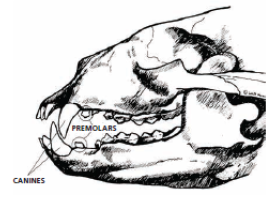
 Please collect the upper premolar teeth (see pictures)

If you can’t find the upper premolars, collect the lower jaw premolars

1) The premolar teeth we need are the very small teeth immediately behind the upper and lower canine teeth (see pictures).

2) Extraction is easily done just after the bear has been harvested when the jaw is still pliable. Use a screwdriver or knife blade to push the gum down and away from the tooth.

3) Gently loosen the tooth by slowly rocking back and forth. Pull the tooth out with pliers or pry it out using the canine as a lever.

Be careful not to break the tooth off at the gum line, the whole tooth, including the root, is needed for age interpretation.

4) If you break the root of an upper premolar or these teeth are gone or cannot be extracted, please try the lower premolars located immediately behind the lower canine.

Please call the wildlife division laboratory at 709 686 5546 or email wildlifelab@gov.nl.ca for help if required

Removing these teeth and cutting into the gum does not impact taxidermy work or your mount.


Results

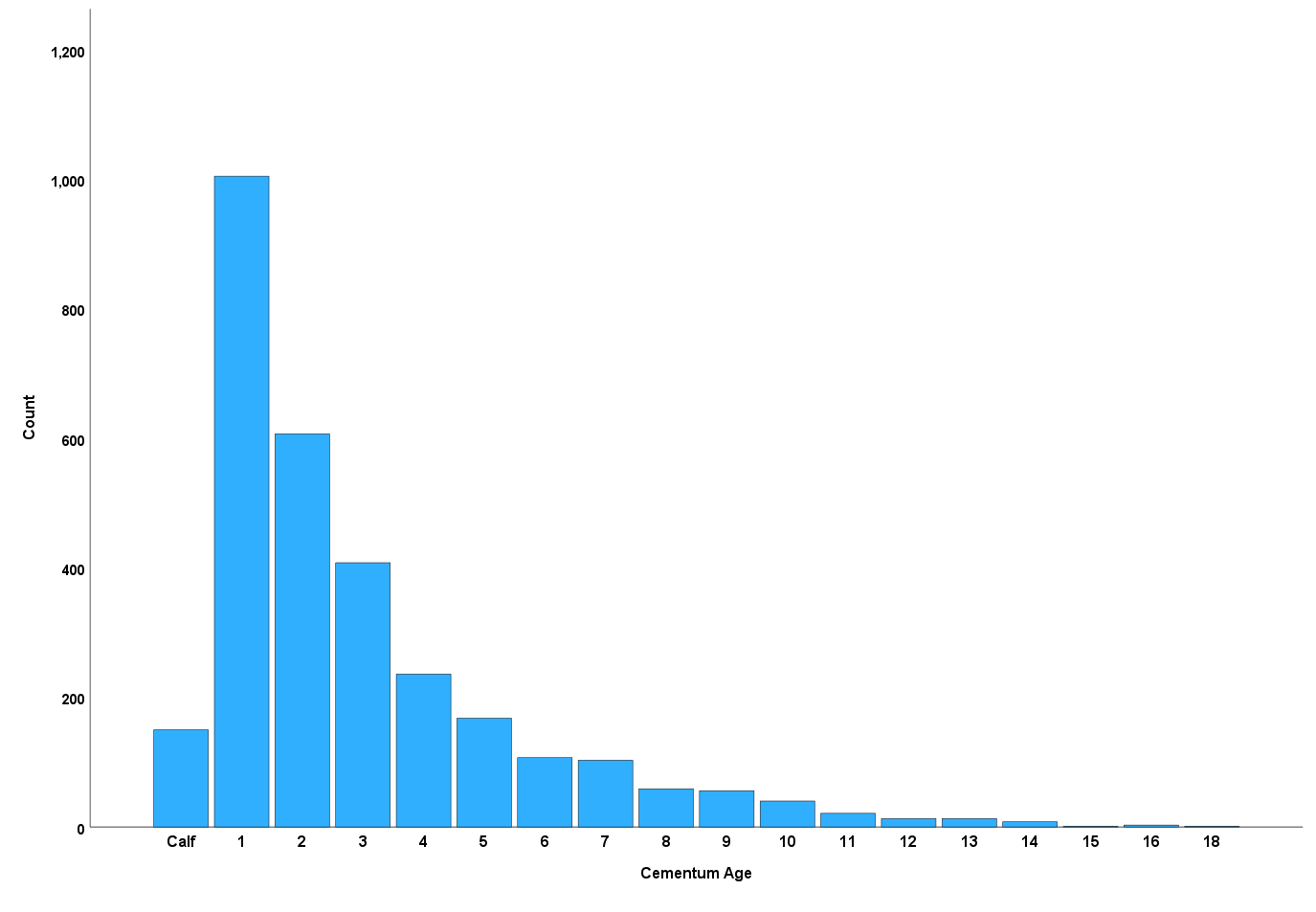
Cooperating hunters from the 2023-24 Island Moose Season enabled the collection of the information represented in this graph. The oldest moose was interpreted at 18 years old. This information is taken from extracted and analyzed moose jawbone teeth.


The greater the participation in these programs the more accurate estimates become. In 2023-24 Island return rates for moose and caribou jawbones were 20% and 30%, respectively. Our goal is 30% or higher, increased cooperation will help better manage.

2023-24 Insular NL Moose Cementum Age


Cooperating Big Game Hunter Crests

Hunters that submit a lower jawbone from a harvested big game animal will receive a cooperating big game hunter crest as a token of appreciation (partner licences will receive two crests). The efforts of hunters to supply data through jawbone submissions are essential to establish the health and status of moose and caribou populations throughout the province. Thanks to the hunting public, age and growth records in the provincial jawbone database represent one of the largest datasets known among North American wildlife management agencies, amassing over 176,000 entries.

Left Footer Right Footer
Left Header Right Header

NEW! Big Game Return Maps

Every holder of a big game licence shall within seven days after the making a kill, fill in and the licence return form attached to the licence. Licence holders failing to make a kill shall also complete and forward the return with seven days of after the close of the season. When you have been successful in harvesting an animal and complete a Big Game Return, information on the location of that harvest is helpful to wildlife managers. Management area maps are all available online to help you provide that information.

Newfoundland

  • Moose Management Zones
  • Caribou Management Zones
  • Bear Management Zones

Labrador

  • Moose Management Areas
  • Black Bear Management Zones

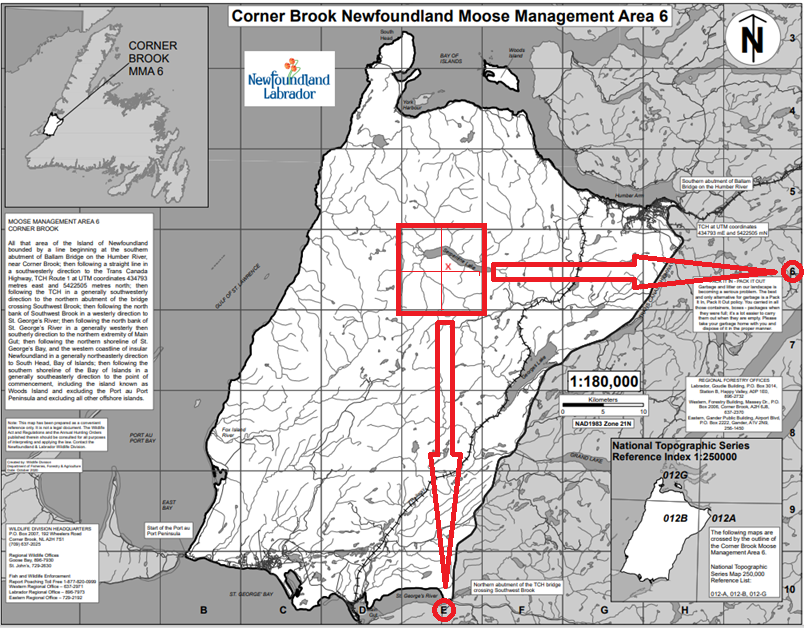
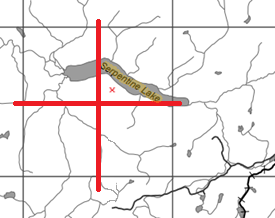
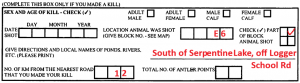
To provide the information on the harvest location use the map to determine general description of the area and the grid (if it is available).

For example:

We can use this map to determine the grid location, section of the grid and provide a general description as demonstrated below.

If you need further assistance, please contact your local Department of Forestry, Agriculture and Lands office, email wildlifelicense@gov.nl.ca or call 709.637.2025

Left Footer Right Footer
Left Header Right Header

Hunting Code of Ethics

Safe

  • Positively identify your target before you shoot.
  • Shoot only at appropriate targets or legal game.
  • Always practice safe gun handling.
  • Practice shooting skills and be sure your rifle or bow is properly sighted in.
  • Pattern your shotgun and know how it shoots.
  • Avoid hunting from roads.
  • It is punishable by law to store or transport a loaded firearm on any vehicle including ATV, snowmobile or aircraft.

Knowledgable

  • Familiarize yourself with provincial and federal regulations.
  • Know the effective range of your firearm or bow.
  • Teach others to become ethical hunters and to care for the countryside in which they hunt.
  • Get to know and support local hunting and conservation organizations.
  • Educate yourself on issues related to hunting, wildlife management and conservation that are important to you and share your opinions.

Responsible

  • Act responsibly to avoid creating a negative image for hunters and firearm users.
  • Only harvest the amount of game that you can use.
  • Ensure that every effort is made to retrieve wounded game.
  • Complete licence returns and participate in surveys.
  • Access private property only with the landowner’s permission.
  • Respect outdoor users including other hunters, hikers, berry-pickers and cabin owners.
  • Report illegal hunting and trapping activity.
Left Footer Right Footer
Left Header Right Header

Hunter Image and Responsibilities

Hunter Image

Hunter image and how the public view hunters’ activities is important.  Here are some of the things that hunters should do to keep a positive image and foster a constructive relationship with the public:

  • Properly dispose of game animal parts.
    • Discarding game heads, hides, bones and other parts in a discrete manner out of public view is a responsible thing to do.
    • Disposed material will attract pests and predators.
    • Offal (organs, waste materials, etc) can be unsightly and unpleasant as it decomposes and shouldn’t be left along roads or around cabins or properties.
  • Be careful with your garbage.
    • Do not litter, and consider picking up litter you find.
    • Clear up camp sites and areas you spend time in and leave them as naturally as possible.
    • Clear up bear sites regularly so that garbage doesn’t blow around or get left in the woods.
  • Be considerate with your placement of traps and snares, and make use of selective harvest techniques.
    • Be conscious of other resource users like hikers, mountain bikers and others that use trail systems.
    • Avoid residential areas with pets where possible and/or use selective harvest equipment or methods.
    • More information can be found here.


Hunter Responsibilities

 Wildlife management is the use of ecological principles to maintain and manage wildlife populations based on the wise use or conservation of the wildlife resource and involves balancing people, wildlife and habitat.  Management goals for game species are to allow for continued consumptive use while distributing hunting pressure more evenly, and keeping populations in balance with available habitat.

Hunters play a crucial role in wildlife management and their contributions are vital to understanding trends and changes.  Some of the valuable input from hunters includes:

  • Licence Returns
    • Completed licence returns provide information on many of the factors that are considered when seasons and quotas are adjusted.
    • Information on hunter success, effort and locations help determine trends and are integral to game management and planning.
  • Submission of Biological Samples
    • The submission of samples such as moose and caribou jawbones, coyote carcasses and black bear teeth allow wildlife managers to look at general population dynamics and specific localized factors.
    • Biological samples are used in conjunction with licence return data to build better understanding of wildlife populations.
    • Drop boxes are available throughout the province.
  • Reporting of Marks and Collars
    • When animals are marked with tags or collars they are usually a part of a study and have information that is important to managers.
    • If you see marked animals consider not harvesting them as the study may still be collecting information and they may have been immobilized and not recommended for consumption.
    • If you do harvest a marked animal please report it, more information can be found here.
  • Participation in Programs
    • Surveys, consultations, and voluntary programs for collection of information and biological samples occur periodically and depend on cooperation of hunters and trappers to collect information, recent moose consultations for example.
    • When asked to participate please consider your inputs and get involved.
    • Take care to preserve samples for collection and take notes to be sure you have a clear record of your information.
Left Footer Right Footer
Left Header Right Header

Canadian Firearms Safety and Hunter Education Course

In Newfoundland and Labrador, a person must pass both the Canadian Firearms Safety Course (CFSC) and the Hunter Education (HE) Course to become eligible to apply for resident hunting licences and to hunt game with a firearm. Participants may take these courses starting at age 12 with parental consent.

Canadian Firearms Safety Course (CFSC)

The Canadian Firearms Safety Course (CFSC) teaches participants the basics of firearms safety and the laws related to firearms storage, handling and transportation. These are basic skills that every hunter, trapper, recreational shooter or gun collector should know. This course consists of one day of classroom instruction followed by a written and practical test. By successfully completing the CFSC a person is eligible to apply for a Possession and Acquisition Licence (PAL) to obtain non-restricted firearms.

Regulations under the Firearms Act require individuals to obtain a PAL to possess and acquire firearms. Applications for firearms licences are issued by the Canadian Firearms Program- Royal Canadian Mounted Police (CFP-RCMP).

Minors Under 18

Conditions exist under the Firearms Act to allow minors less than 18 years of age to obtain a Minor’s Possession Licence. Instead of obtaining a Minor’s Possession Licence, a minor may use firearms while under the immediate and direct supervision of a fully licensed adult.

For further information about minors licensing or to obtain a firearms licence application, contact the CFP at 1.800.731.4000 or online at www.rcmp-grc.gc.ca/cfp

Hunter Education Course

The Hunter Education Course teaches participants basic concepts of wildlife conservation and management, hunting laws, hunter ethics and responsibility, outdoor safety and survival techniques and other skills used for hunting. The duration of this course is 6.5 hours followed by a written exam. By completing the Hunter Education Course, in addition to the CFSC, participants meet the requirement to obtain provincial resident licences to hunt with a firearm or bow.

Other recognized hunter education training courses may also be accepted for new residents moving into the province. Contact the Wildlife Division at 709.637.2025 for more information or visit us online at https://pattern-loop.live/fal/%3C/a%3E%3C/p%3E

Qualified resident hunters in Newfoundland and Labrador will receive an Outdoor Identification Card (OIC) from the Wildlife Division. Hunters must carry their OIC, along with the appropriate hunting licence, while hunting with a firearm. Hunters travelling to other parts of Canada should carry their OIC as proof of completing Hunter Education training requirements.

Register for an in-Class Courses at a College of the North Atlantic Campus

To register for an in-class CFSC or HE Course, visit: https://www.cna.nl.ca/programs-courses/Continuing-Education.aspx to get information on campus contacts & locations/dates for training or call: Toll Free 1-888-982-2268.

NEW – Register for the Online Hunter Education Course

The hunter education component can also be completed online.

Participants who complete the online Hunter Education Course must still complete the in class Canadian Firearms Safety Course to become hunter certified and eligible for resident hunting licences in Newfoundland and Labrador.

Course Fees

Hunter Education Online Course $59
Canadian Firearms Safety Classroom Course (CFSC) $91
Hunter Education Classroom Course (HE) $59
CFSC + HE Combined Classroom Course $150
Minors Canadian Firearms Safety Classroom Course $53
Minors Hunter Education Classroom Course $15
Minors CFSC+HE Classroom Course $68

All fees are subject to HST

^ Top of Page

Left Footer Right Footer
Left Header Right Header

Youth Hunting and Trapping Licences

  • Beginning at age 12 a youth may hold a licence to shoot small game/coyote or wolf, ptarmigan, fur-bearing animals and Migratory Game Birds. Youth may hold a licence to shoot big game beginning at 16.
  • The regulations require youth to have the consent of a parent or person who has custody of the youth to purchase a licence.
  • Where required, a youth must also be accompanied by a Designated Adult while hunting, taking or killing animals by shooting.

Shooting Licences for Small Game/Coyote/Wolf, Ptarmigan and Migratory Game Birds

Youth at age 12 and under 16 may be issued a licence to shoot small game, coyotes, wolves, ptarmigan and wild birds permitted to be harvested under the authority of a Migratory Game Bird Hunting Permit during an open season. Requirements include:

  • A licence to shoot small game/coyotes and wolf and ptarmigan shall not be issued to a youth age 12 and under 16 without written consent of a parent or person who has custody of the youth and must be presented to local vendor outlets at the time of purchase.
  • The written consent must also be carried by the youth or the designated adult while using firearms.
  • Youth must be accompanied by a Designated Adult when operating a shooting licence.
  • A Designated Adult who is not the parent or person who has custody of the youth must be designated in writing.
  • Youth must complete required hunter and firearms training courses and trapper education courses.
  • Youth and the Designated Adult must also possess an Outdoor Identification Card or equivalent document (e.g. Hunter Certification Card from another jurisdiction).
  • Small Game Licences for snaring only are available to youth under 16 years of age shall be marked “not valid for shooting”.

Big Game Licences

Youth at age 16 and under 18 may obtain a licence to shoot big game during an open season. Requirements include:

  • Big game licence applications processed by the Wildlife Division involve conditions to provide a Consent Form before a licence can be issued to a Youth. These forms are normally provided at the time that youth completes the Canadian Firearms Safety/Hunter Education course. Therefore, possession of the licence itself, once issued, acts as implied consent.
  • Youth must carry written Consent Form signed by a parent or person who has custody of the youth for big game licences issued through a vendor (e.g. Labrador Black Bear or non-resident big game licence sold by an outfitter).
  • Youth must be accompanied by a Designated Adult to hunt big game.
  • A Designated Adult who is not the parent or person who has custody of the youth must be designated in writing.
  • Youth must complete required hunter and firearms training courses.
  • Big Game Licence Applications for moose/caribou issued through the draw process may be processed using the online WIMS  for youth who turn age 16 before August 31 and once they complete required hunter and firearm training courses.
  • If not already received by the Wildlife Division, a Consent Form must on file or be provided a parent or person who has custody of  youth age 16 and under 18 be provided before submitting a big game licence application online.  Consent Forms may be faxed to (709)637-2099 or emailed to wildlifelicense@gov.nl.ca
  • Licence applications for black bear may be obtained up until the close of the hunting season.
  • Youth and the Designated Adult must also possess an Outdoor Identification Card or equivalent document (e.g. Hunter Certification Card from another jurisdiction) while hunting.

General Trapper Licence

  • A licence to shoot fur bearing animals shall not be issued to a youth age 12 and under 16 without written consent of a parent or person who has custody of the youth. Youth under age 12 and youth that are not permitted to use a firearm for the purposes of dispatching fur bearing animals are not required to obtain consent to purchase a General Trapper Licence.
  • A written consent of parent or person who has custody of the youth age 12 and under 16 must be provided when submitting a General Trapper Licence application by mail. Online applications cannot be processed unless a Consent Form is on file with the Wildlife Division. Consent Forms may be faxed to (709)637-2099 or emailed to wildlifelicense@gov.nl.ca
  • General trapper licence applications processed by the Wildlife Division involve conditions to provide the Consent Form before a licence can be issued to a Youth. Therefore, possession of the General Trapper Licence itself, once issued, acts as implied consent.
  • General Trapper Licence Applications may be processed up until the close of the trapping seasons.
  • Youth and the Designated Adult must also possess an Outdoor Identification Card or equivalent document (e.g. Hunter Certification Card from another jurisdiction) while trapping.

What has not changed?

  • Youth age 16 and under 18 may continue to be issued a licence to shoot small game, coyote, wolves, ptarmigan, fur bearing animals and wild birds permitted to be harvested under the authority of a Migratory Game Bird Permit during the open season without consent to purchase a licence.
  • A youth at 16 and 17 who holds a valid licence to shoot small game, coyote, wolves, ptarmigan, fur bearers or Migratory Game Birds who does not possess a Minor’s Firearms Possession Licence is required to be accompanied and supervised by a fully licenced adult.

Designated Adult

A Designated Adult must meet the following criteria:

  • is a person who is over the age of 18;
  • is not prohibited from carrying, transporting, possessing or using a firearm or from being a designated adult; and
  • is eligible for the same type of licence under which the youth is hunting, taking or killing an animal by shooting.

While accompanying the youth, a Designated Adult shall:

  • remain at arm’s length of the youth and be able to take control of the firearm if necessary;
  • not accompany and supervise more than two youths at one time;
  • carry evidence of his or her eligibility to hold the same type of licence as the youth (e.g. possess an Outdoor Identification Card or similar document); and
  • if not the parent or person who has custody of the youth, provide a designation in writing signed by a parent or person who has custody of the youth (carried by the youth or Designated Adult).

Injured Animals

  • A Designated Adult may shoot or dispatch an animal that has been injured by a youth for the purposes of assisting the youth and shall keep the youth in sight at all times.
  • A Designated Adult is not required to keep the youth in sight at all times where the Designated Adult is pursuing an animal that has been injured by the youth.
  • With respect to Migratory Game Birds, the Designated Adult would also be required to hold a valid Migratory Game Bird Hunting Permit in addition to the Outdoor Identification Card or similar document.

Youth Consent/ Designated Adult Forms

  • PDF Copy of Youth Consent/Designated Adult Form
  • For more information or to obtain a copy of a Consent/Designate Adult Form, contact your nearest Department of Forestry, Agriculture and Lands Office or email wildlifelicense@gov.nl.ca or write your own Youth Consent/Designated Adult Form that uses the same language as presented in the pdf from.

^ Top of Page

Left Footer Right Footer
Left Header Right Header

Program for Hunters/Anglers with a Disability (PHAD)

Program for Hunters/Anglers with a Disability (PHAD)

  • All first time hunters, including those hunters who have not previously completed a hunter training course or program recognized by the Minister, including a person who has a disability affecting hunting activities, shall, before becoming eligible for a big game licence draw, complete the Canadian Firearm Safety and Hunter Education Course, or similar hunter training course or program in another jurisdiction that is recognized by the Minister.
  • For the purposes of the Wild Life Regulations, a person who is legally blind may be exempted from the standard practical testing in the Canadian Firearm Safety and Hunter Education Course which requires vision to perform if he or she provides a certificate from a health care provider certifying that he or she is legally blind.
  • A person who is legally blind who completes the Canadian Firearms Safety and Hunter Education Course may apply for and receive a big game licence but is not entitled to possess or use a firearm for the purpose of hunting.
  • A hunter with a disability who receives a big game licence, shall in the case of person who is legally blind, and may in the case of a person with a disability affecting hunting, specify one designated hunter to shoot and retrieve the type and sex of big game animal named on the licence of the hunter with a disability provided that;

(a) the designated hunter keeps the hunter with a disability within sight or within 800 meters of the hunter with a disability;

(b) the designated hunter possesses the licence and tags of the hunter with a disability at all times while hunting for that hunter with a disability.

  • Persons with disabilities not able to participate in the CFSC/HE Course or in the hunt itself may apply to become eligible to receive a problem moose from farms or other areas that has been euthanized by a conservation officer. Priority access to this moose meat will be managed by the regional or district Department of Forestry, Agriculture and Lands office where the problem moose occurs. Persons interested in this program must provide a medical note from a doctor. For more information or to add you name to a priority list, please contact your nearest Department of Forestry, Agriculture and Lands office.
  • “Disability affecting hunting activities” means a permanent impairment or other permanent medical condition which, in the opinion of a health care provider, restricts a person’s ability to perform the activities of hunting, including shooting and retrieving a big game animal. General examples of hunting activity may include but is not limited to: walking and negotiating various outdoor terrain, streams, rivers or ponds; carrying, holding, operating and/or discharging a firearm or drawing a bow; and, lifting or carrying animal parts or equipment which may be in excess of 100 pounds.
  • “Designated hunter” means a person who has completed a hunter training course or and is specified by a hunter with a disability to shoot and retrieve a big game animal of the type and sex named on the licence of the hunter with a disability, but does not include a person who is prohibited by the court from possessing a firearm or holding a big game licence.
  • “Hunter with a disability” means a person who holds a valid big game licence issued by the Minister and has a disability affecting hunting activities as prescribed in the Wild Life Regulations.
  • A designated hunter is not required to keep the hunter with a disability within sight when the designated hunter is in pursuit of an animal that he or she has injured.
  • A person may not be specified as a designated hunter more than once in a season.

How to Apply

  1. If you already receive applications for the resident big game licence draw and have a Hunter Certificate Number you may apply for the PHAD by completing an application form, available here and forwarding it to the Wildlife Division’s, Licencing Section via email or Canada Post at the address below, or;
  2. New big game licence applicants not presently receiving an application for the resident big game licence draw may submit the PHAD application form after completing the Canadian Firearm Safety and Hunter Education Course.

Note: A person who is registered with the Wildlife Division as a “Hunter with a Disability” will receive an Outdoor Identification Card (OIC) with the a code “D” or “DN” on the card; D means disability affecting hunting and DN means legally blind. Replacement OIC cards are available upon request.

For more information, please telephone 709.637.2025 or Email: wildlifelicense@gov.nl.ca Include your name, NL Driver’s Licence/NL Photo ID and telephone number.

Mailing Address

Wildlife Division
P.O. Box 2007
Corner Brook, NL
A2H 7S1

Additional Opportunities for Persons with Disabilities to Access Moose

Persons with disabilities not able to participate in the CFSC/HE Course or persons with disabilities who are eligible to hunt big game and are registered for the Program for Hunters with a Disability may become eligible to receive a problem moose from farms or moose that is euthanized by a conservation officer. Priority access to this moose meat is managed by the regional or district Department of Forestry, Agriculture and Lands office where the problem moose occurs.  Persons interested in problem moose must be eligible for the Program for Hunters with a Disability and hold a big game license or provide a medical note from a doctor.  For more information or to add your name to a priority list, please contact your nearest Department of Forestry, Agriculture and Lands office.

^ Top of Page

Left Footer Right Footer
Left Header Right Header

Regulation Summaries

Regulation Summary

This section contains a summary of regulations you must know when hunting in Newfoundland and Labrador. This summary is neither a legal document nor a complete collection of current hunting regulations or firearm laws. It is an abbreviated guide issued for the convenience of hunters. The Wild Life Act and Regulations, www.assembly.nl.ca/legislation/sr/consolidation/ should be consulted for interpreting and applying the law. Contact a Department of Forestry, Agriculture and Lands Office if you have any questions.

Definitions

  • “Hunting” means chasing, pursuing, worrying, following after or on the trail of or searching for, or lying in wait for wildlife whether or not the wildlife is then or later captured, injured or killed. “Hunt” and “hunter” have corresponding meanings.
  • “Open Season” means any period during which it is lawful to hunt, take, or kill, or attempt to hunt, take, or kill wildlife under the provision of the Wild Life Act and Regulations.
  • “Closed Season” means any period during which hunting, taking, or killing of wildlife is prohibited.
  • “Firearm” means a device by which a missile is discharged by means of an explosive propellant or by compressed air or by a spring and includes sporting guns of all calibres, automatic or autoloading guns, repeating guns, pump guns, set guns, swivel guns, punt guns, rifles, pistols and revolvers of every description, crossbows, longbows and compound bows.

General

It is unlawful:

  • to hunt, take or kill any wildlife except during open seasons;
  • to hunt, take, or kill any wildlife without a valid licence;
  • to hunt, take, or kill any wildlife with an air powered firearm;
  • for a resident to hunt with a firearm unless you possess an Outdoor Identification Card or jurisdictional equivalent in the case of a non-resident;
  • to make a false statement or supply false information when applying for a licence;
  • to complete an application form for a big game licence on behalf of another person, without the permission of that person;
  • to apply for a licence/pool advancement if you have been prohibited, by a court, from possessing a firearm;
  • to apply for a licence/pool advancement if you have been prohibited, by a court, from holding a licence;
  • for a resident to apply for a licence with a non-resident;
  • to hunt without your licence and/or tags on your person;
  • to hunt on a licence belonging to someone else (unless designated either by a disabled hunter authorized through the Program for Hunters and Anglers with a Disability or under a NFP licence to do so);
  • to transfer your licence to another person; and
  • to hunt on a licence which has been changed, altered or defaced in any manner.

Licence Returns

  • Big game returns must be submitted within seven days of the season closing date or within seven days of the date of kill.
  • Small game, coyote and trapping returns must be submitted within seven days of the season closing date.

Production of Licences – Checkstations

  • If requested by a conservation officer, a person shall not refuse or neglect to produce or permit the examination of game licences and tags, permissions, consents and other documentation required to be carried under these regulations, or firearms and ammunition and wildlife.

Bag Limit

  • It is unlawful to exceed the bag limits as stated in the Annual Hunting Orders. These can be viewed at http://assembly.nl.ca/legislation/sr/reg_512.htm

Firearms, Ammunition

It is unlawful:

  • to discharge or handle a firearm while hunting without exercising reasonable care for the safety of other persons;
  • to carry, transport or possess firearms or ammunition during a closed season in any area frequented by wildlife, unless you have a permit to transport (these are available from Department of Forestry, Agriculture and Lands offices). A person travelling to a hunting area may, if he/she holds the proper game licence, transport a firearm or ammunition if the firearm is cased or securely wrapped and tied;
  • to carry, transport or possess firearms or ammunition during an open season for shooting in any area frequented by wildlife, unless you have a valid game licence and/or permit;
  • to carry, transport or possess, in any area frequented by wildlife, any pump or autoloading shotgun unless it is plugged or altered so that it cannot carry more than three shells in the magazine and chamber combined;
  • to hunt any wild life, or carry, transport or possess in any area frequented by wild life a firearm which propels a missile by means of compressed air, compressed gas or by a spring.
  • to hunt with any fully automatic rifle (semi-automatic or autoloading rifles may be used);
  • to possess in any camp, tent or summer cottage, any firearm during closed season, unless you have a permit;
  • to carry, transport or possess a loaded firearm in or on, or discharge a firearm from, any aircraft, motor vehicle, snow machine, or all- terrain vehicle. A firearm is considered to be loaded if there is a live shell or cartridge in the chamber or magazine and the magazine is attached to the firearm in its usual position;
  • to use or possess, in any area frequented by wildlife, any ammunition that has been cut, ringed or altered in any way;
  • for a licenced hunter to carry or possess more than one firearm unless each extra firearm is cased or securely wrapped and tied;
  • to discharge a firearm (including bows or crossbows) within 1000 meters of a school, playground or athletic field or within 300 meters of a dwelling;
  • to discharge a firearm or hunt on most community pastures during the period May 1 to November 30 inclusive (for information on pasture locations http://www.assembly.nl.ca/Legislation/sr/Regulations/rc980056.htm or contact your nearest Department of Forestry, Agriculture and Lands office; and
  • to discharge a firearm (including bows or crossbows) within 1000 meters of a commercial woodcutting operation that has been clearly marked by signs stating “No Hunting”.
  • It is unlawful to discharge a firearm from a or across a railway, public road or private road.

Bows and Arrows

It is unlawful:

  • to hunt any wildlife with an arrow tipped with poison or a drug; and
  • to hunt any wildlife with an arrow equipped with barbed or explosive arrowheads.

Hunting at Night: It is unlawful to hunt any game with night lights of any description.

Dogs: It is unlawful to take a dog unleashed or to allow a dog to run in any area frequented by wildlife from April 1 to August 31 inclusive, except in designated field trial/dog training areas and during designated times. A conservation officer may destroy any dog found to be harassing wildlife. For information on field trial/dog training areas, contact your nearest Department of Forestry, Agriculture and Lands office or visit https://pattern-loop.live/fal/wildlife/dog-training-areas/%3C/a%3E%3C/p%3E

Wounded Animals

  • Any person who kills, cripples or wounds any game animal shall make all reasonable efforts to retrieve that animal.
  • Notwithstanding the requirement under these regulations to hold a valid licence in order to hunt, take or kill wildlife with a firearm, a designated adult may shoot an animal that has been injured by youth hunting under a valid licence for the purpose of assisting the youth. The designated adult shall keep the youth in sight at all times, except when it is necessary to pursue the injured animal.

Aircraft (including drones) and Vehicles

It is unlawful:

  • to chase or harass any wildlife with any aircraft, motor vehicle, boat, snow machine or all-terrain vehicle of any type;
  • to hunt any wildlife with, or possess any loaded firearm on, any aircraft, motor vehicle, snow machine or all-terrain vehicle of any type. Such vehicles may be used for transportation to and from a hunting area and for transporting any game taken, except where restrictions apply to the use of all-terrain vehicles; and
  • to use any aircraft to search for or locate any wildlife for hunting on your own behalf or on behalf of any other person.

Guides

It is unlawful:

  • to act as a guide without a valid guide licence;
  • for a guide, while so employed, to kill or take game;
  • for a guide, while so employed, to accept meat in payment or partial payment for services rendered;
  • to hunt/shoot wildlife or to angle while acting as a guide, except to demonstrate casting and hooking of fish.

EXPORT OF GAME

  • If you have a valid hunting licence and an export permit, you may export or take out of the province any game legally taken. Export permits are available free from any Department of Forestry, Agriculture and Lands office. Agriculture and Agri-Food Canada Regulations prohibit the use of used burlap or other used bags. Use new wrapping material only.

PROHIBITION OF WASTE

It is an offence to allow harvested wild game that is suitable for food to be destroyed, wasted or spoiled.

Hunting from Roads

It is unlawful:

  • under the Highway Traffic Act to operate a vehicle in a manner that impedes the normal movement of traffic to discharge a firearm from a vehicle; and
  • to discharge a firearm from or across any railway bed, highway, public or private road.

Wilderness Reserve Entry Permits

It is unlawful to enter the Avalon Wilderness Reserve or the Bay du Nord Wilderness Reserve without an entry permit. A person who holds a valid big game licence for a moose, caribou or black bear management area that is inside a Wilderness Reserve does not require a Wilderness Reserve Entry Permit. For more information on Wilderness Reserve Entry Permits, contact the Natural Areas Program at 709.637.2081 or visit https://pattern-loop.live/ecc/natural-areas/%3C/a%3E%3C/p%3E

All-Terrain Vehicles (ATVs)

It is unlawful for a person to use or operate an ATV vehicle outside an approved area, except:

  • A person who holds a valid big game licence and, as permitted by the licence, has killed a moose, caribou or bear may use or operate an ATV outside an approved area for the purpose of transporting the animal from the place where it was killed. This does not apply to wilderness, ecological or wildlife reserves or National Parks. Hunters are asked to be conscious of this if applying for a licence in management areas which include these areas.
  • A person other than the licence holder may use or operate an ATV for the purpose of transporting an animal from the place where it was killed, but the licence holder shall remain in the immediate area.
  • A moose or caribou shall be properly tagged as required before an ATV is to be used or operated.
  • A person shall not use or operate an ATV more than five times to and from the place where the animal was killed. When traveling from the place where the animal was killed, a portion of the animal shall be on the ATV or on a trailer being towed by the ATV.
  • Where more than one ATV is used or operated in relation to the transporting of a single animal the total number of trips for all the ATVs shall not exceed five.
  • A person shall not carry, transport or have in his or her possession a firearm while using or operating an ATV for the purposes noted above.
  • For more information, please visit https://pattern-loop.live/fal/public-education/forestry/recreation/atv/%3C/a%3E%3C/li%3E

Small Game

Age Requirements

  • Youth less than 16 years of age may obtain a youth snaring licence to take small game by snaring only.
  • Individuals must be 12 years of age or older and have completed the Canadian Firearms Safety/Hunter Education Course or similar training recognized by the Minister of Forestry, Agriculture and Lands in order to hunt with a firearm or bow.
  • Further conditions apply to Youth Hunting and Trapping Licences.

Firearms, Ammunition

It is unlawful:

  • to hunt small game using a shotgun that can hold more than three shells in the magazine and chamber combined, or to use a shotgun shell loaded with a single bullet.

*Small game (excluding ducks, geese and snipe) may be harvested using a rim-fire rifle not greater than a 22 (Note: this includes .17 rim fire calibers such as the 17 HMR)

Bow and Arrows

It is unlawful:

  • to hunt small game with a long bow, recurve bow or compound bow unless it has at least 10 kilograms (22 lbs.) pull at full draw
  • or with a crossbow unless it has 68 kilograms (150 lbs) pull at full draw;
  • to hunt small game with a long bow, recurve bow, compound bow or crossbow unless the arrow is tipped with a blunt small game tip designed to kill by shock. Practice or field tips are not permitted.

Snares

It is unlawful:

  • to set snares for small game until the first day of the open season. Snares must be removed on or before the last day of the open season;
  • for any person to set snares to take or kill wild birds, except the holder of a small game licence for ptarmigan and grouse for an area open to this activity;
  • to use a net of any kind to take or kill any small game;to use a fish hook or snare equipped with a fish hook to take or kill any small game; and on the Island; and
  • to set snares for small game using snare wire other than 22 gauge brass or six-strand braided wire (also known as picture cord).

Dogs

It is unlawful, while hunting small game with a dog, to allow the dog to harass any big game animal.

Sale of Small Game

  • Snowshoe hare and grouse legally taken under licence may be sold to anyone during the open season and within seven days thereafter.
  • Ptarmigan may only be sold if you have a selling permit and the buyer has a Wild Meat Service Licence. Selling permits are available free from the Wildlife Division. Please contact 709.637.2025 for more information.

Big Game

  • Age Requirements: To apply for a big game licence you must be 16 years of age or older by August 31 in the year that the licence is valid. For more information see Youth Hunting and Trapping Licences.
  • Licence Limit: A person who holds a big game licence issued through the draw process may hold only one big game licence to shoot a moose or one big game licence to shoot a caribou in a 12-month period ending April 30.

Co-applicant Licence

  • Each member of a co-applicant licence is considered to be the holder of that licence.
  • Members of the co-applicant licence may carry firearms and hunt, provided they are in the immediate area of and within sight of each other while they are hunting.
  • As a member of a co-applicant licence, you may hunt alone provided you possess the licence and tags.
  • Only the persons named on a co-applicant licence are eligible to hunt with that licence.

Firearms, Ammunition

It is unlawful:

  • unless you hold a valid big game license, to possess firearms and ammunition suitable for hunting big game;
  • to hunt big game (moose, caribou or black bear) with any rifle smaller than a .243 caliber or .22 calibre rifle or any rifle (including muzzle loaders) using ammunition with a bullet weight of less than 100 grains or a muzzle energy less than 1500 foot pounds. For this regulation .22 calibre includes .218, .219, .220, .222, .22-250, .223, .224 and .225 calibre rifles;
  • to hunt big game with a slug with any shotgun smaller than 20 gauge;
  • to hunt big game with or carry in any area frequented by wildlife, full metal cased non-expanding bullets commonly known as service ammunition; and
  • to hunt big game with a firearm using any ammunition other than a single bullet or ball.

Bow and Arrows

It is unlawful:

  • to hunt big game with a long bow, recurve bow or compound bow and arrow unless the bow has at least 20 kilograms (44 lbs.) pull at full draw or with a crossbow and arrow unless it has at least 68 kilograms (150lbs) pull at full draw; and
  • to hunt big game unless the hunting arrows are tipped with a metal hunting head with two or more sharpened cutting edges.

Hunting Hours

It is unlawful to hunt big game earlier than one-half hour before sunrise or later than one-half hour after sunset on any day (firearms must be cased or securely wrapped and tied outside of legal hunting hours).

Snares

It is unlawful to use traps, pitfalls or snares of any description to hunt big game, except licensed black bear hunters may trap black bears using Aldrich foot snares or similar devices designed to capture and hold bears by the foot and must be set in a covered “cubby set”. The set must be clearly marked with a warning sign indicating that a bear snaring device is set in the “cubby”).  Black bear hunters who use these approved devices must possess both a valid black bear licence and a valid trapper’s licence.

Dogs

It is unlawful to use a dog for hunting (tracking, following or pursuing) big game.

Swimming Animals

It is unlawful to hunt or molest any big game animal while it is swimming.

Proof of Sex or Age

The holder(s) of a male-only licence must leave the scrotum of the animal attached to one hind quarter as proof of sex. Note: the testicles and penis may be removed, if desired, but the scrotum must remain attached to the carcass until the animal is transported to the hunter’s home. If a calf is harvested on a male-only or calf or female-only or calf licence, hunters must retain the jawbone of their kill as proof of age. The holder(s) of a female-only licence must retain the head of their kill as proof of sex.

Use of Tags – Transport of Big Game

  • The tags issued with a big game licence must be attached and locked on the animal before it is removed from the place of kill, defined as, the area included in a 10-meter (33 ft.) radius from where the animal is dispatched by the hunter.
  • It is unlawful to possess or transport big game unless the tags are attached and locked to the quarters between the tendon and the leg bone.In rare cases a tag may be faulty, and fail to lock. If this occurs, contact the nearest wildlife officer immediately.
  • It is an offence to transport meat with an unlocked tag, a replacement tag will be issued and must be affixed before the meat is moved from the actual site of the kill.
  • Big game tags that have been damaged, lost or stolen must immediately be reported to a wildlife officer. It is an offence to transport or move a big game animal from the place of kill unless the tag has been properly affixed to the animal. Replacement tags may be acquired by contacting your nearest Department of Forestry, Agriculture and Lands or Wildlife Division office.
  • A big game animal must be removed from the place of kill on or before the closing date of the season. If you cannot remove the animal by that date, you must get a permit to transport game in closed season from your nearest Department of Forestry, Agriculture and Lands office.
  • You must fill in and forward your licence return to the Wildlife Division within seven days of the date of kill or within seven days after the close of the season if no kill is made. If you do not take an animal, you must also return the unused tags issued with the licence.

Gifts of Game

If you wish to give game meat to friends or family or charitable organization, you must provide a signed note indicating the licence number, quantity of game meat, date and the names of the people involved. The individual receiving the game meat must possess the note until the meat is used or consumed.

 Sale and Possession of Big Game

  • You may possess big game meat only if you hold a valid licence or if you have been freely given the meat by a valid licence holder. If you are not the licence holder, you must get written proof that you acquired the meat from a licence holder and you must show this proof if requested by a wildlife officer. You can only sell big game meat if you have a valid selling permit (available free from the Wildlife Division) and the buyer has a valid Wild Meat Service Licence.
  • The holder of a big game licence may obtain a permit from the Wildlife Division to sell big game to any holder of a wild meat service licence during the open season and for 7 days after the open season.
  • The holder of a wild meat service licence shall not sell, serve or offer to sell or serve big game meat or small game meat except in the form of prepared meals.
  • Any religious, charitable or educational organization may serve big game meat in the form of prepared meals, for which a charge is made, where the big game has been taken by the organization in accordance with the Wild Life Regulations or has been donated by a licence holder.  Any big game meat that has been donated by a licence holder to an organization must be treated the same as Gifts of Game above.

Cold Storage

A person may not accept or store any untagged big game or big game parts in a commercial, company or private cold storage, bait depot or other freezer unless the person requesting storage provides a signed document containing the licence number the game was harvested under, date of harvest, names of those involved and the quantity of game being stored.


Coyotes and Wolves

Reminder

Centre-fire rifles not greater than .225 calibre may only be used on the Island portion of the province outside of the open big game season for wolf and coyote.

Coyote Shooting Licence

The coyote shooting licence is combined with the small game licence. During the open shooting season for coyotes, hunters may use centre-fire rifle calibres up to and including a.225 or shotguns using shot size (#2 or larger).

  • There are no bag limits for coyotes.
  • Rim-fire rifles not greater than .22 caliber may be used for small game hunting and may also be used to shoot coyotes during the period that small game seasons are open.
  • Centre-fire rifles not greater than .225 calibre may be used except in the Island portion of the province during the open big game moose season (September 13 – December 31, 2025).

Wolf Shooting Licence

The wolf shooting licence is combined with the small game and coyote shooting licence. During the open shooting season for wolf, hunters may use centre-fire rifle calibres up to and including a.225 or shotguns using shot size (#2 or larger).

  • A Small Game/Wolf/Coyote Shooting Licence has a bag limit of one wolf.
  • Centre-fire rifles not greater than .225 calibre may be used except in the Island portion of the province during the open big game moose season (September 13 – December 31, 2025).
  • Hunters are asked to not shoot wolves that have been marked with radio collars and/or ear tags.

The lower jawbone or complete skull of all harvested wolves must be submitted to a Department of Forestry, Agriculture and Lands or Wildlife Division office by May 15, 2026.

Additional Opportunities to Harvest Coyotes

Holders of a valid big game licence (moose, caribou or black bear) may harvest coyotes during the open season for those species and in the management area for which their licence is valid (licences become invalid when tags have been filled). Hunters must use firearms and ammunition that the big game licence authorizes them to possess.

Trappers who hold a valid trapping licence may also shoot lynx, fox and coyote using rifles up to .225 calibre during the period when trapping seasons for these species are open except on the Island during the big game moose season (September 13 – December 31, 2025).

Wolf and Coyote-Wolf Hybrid Carcass Collection Program

The occurrence of the gray wolf (from Labrador) and wolf-coyote hybrid has been documented by Department of Forestry, Agriculture and Lands on the Island of Newfoundland. To assist with further monitoring of the occurrence and distribution of coyotes, wolves or wolf-coyote hybrids within the province (including Labrador), hunters and trappers are being asked to submit the entire canid carcass to the nearest Department of Forestry, Agriculture and Lands or Wildlife Division office. A $25 fee will be paid to each hunter or trapper for submitting carcasses. Each carcass will be tagged with a unique registration number that is used to identify where and when the animal was harvested and to assist the Department with further genetic analysis work. Harvesters will be required to provide their full name and address for payment and administrative purposes. For more information please contact your nearest Department of Forestry, Agriculture and Lands office.


Migratory Game Birds


The following is a summary of the Migratory Birds Regulations as they apply in Newfoundland and Labrador. Migratory game birds (ducks, geese, snipe) and murres are managed by the federal government under the Migratory Birds Convention Act. For complete information on the Migratory Birds Convention Act and Migratory Birds Regulations, contact the Canadian Wildlife Service (CWS) or visit here.

If you have questions on the Migratory Birds Regulations, you may contact the Canadian Wildlife Service at enviroinfo@ec.gc.ca or to speak to someone please call toll free 1-800-668-6767.

Licence Requirements

To hunt migratory game birds and murres you must possess a valid Migratory Game Bird Hunting Permit.

Age Requirements

To hunt migratory game birds in Newfoundland and Labrador, you must be 12 years of age or older. Please refer to Youth Hunting and Trapping Licence for more information.

Firearms, Ammunition

It is unlawful:

  • to hunt migratory game birds using a shotgun that can hold more than three shells in the magazine and chamber combined;
  • to hunt migratory game birds with a rifle or shotgun shell loaded with a single bullet;
  • to hunt migratory game birds with any shotgun larger than a 10 gauge;
  • while hunting migratory game birds, to possess more than one shotgun unless each shotgun in excess of one is unloaded and cased or securely wrapped and tied; and
  • to hunt migratory game birds using any shot other than non-toxic shot (except murres). Note: The exception for murres applies only to murre hunts. If a multi-species hunt for migratory game birds (e.g., murres and waterfowl) occurs, it is prohibited to have toxic shot in your possession.

Aircraft, Vehicles, Boats

It is unlawful:

  • to shoot migratory game birds from any aircraft, sailboat, power boat, aircraft or motorized vehicle, or any vehicle to which a draught animal is attached; and
  • to use a boat, aircraft or motor vehicle to disturb migratory game birds in order to drive them toward a hunter. It is permitted to retrieve dead or injured birds by the use of a power boat.

Decoys: It is unlawful to use live birds as decoys or to use recorded bird calls when hunting migratory game birds.

Bag Limits: Information concerning seasons and bag limits is available at the time of purchase of your Migratory Game Bird Hunting Permit at a Canada Post Outlet or by visiting here.

Wounded Birds: It is unlawful to kill, cripple or wound a migratory game bird without immediately making all reasonable efforts to retrieve it.

HUNTING HOURS

It is unlawful to hunt migratory game birds earlier than one-half hour before sunrise or later than one-half hour after sunset on any day.

Bait Restrictions

It is unlawful in this province:

  • to deposit bait in any place during the period beginning 14 days before the first day of the open season and ending on the day immediately following the last day of the open season; and
  • to hunt migratory game birds within 400 meters of any place where bait has been deposited unless the place has been free of bait for at least seven days.

Possession and Transport

It is unlawful:

  • to possess or transport a migratory game bird unless the head or at least one wing with its feathers remains attached to the bird. The wing and feathers may be removed when the bird is prepared for immediate cooking or after the bird is stored at the owner’s residence;
  • to ship or transport a package containing migratory birds, unless the package or container is clearly marked with the name and address of the shipper, the Migratory Game Bird Hunting Permit number under which the birds were taken, and the exact contents of the package;
  • to possess a carcass of a migratory game bird belonging to or taken by another person, unless the carcass has attached to it a tag or note that is signed by the holder of the Migratory Game Bird Hunting Permit under which the bird was taken that indicates the name and address of the permit holder, the Migratory Game Bird Hunting Permit number and the date the bird was taken; and
  • to possess any shot other than non-toxic shot for the purpose of hunting migratory game birds (this does not apply to murre hunting).

Egg and Nests: It is unlawful to take, injure or destroy the eggs or nests of migratory birds at any time.

Sale of Migratory Game Birds: It is unlawful to buy or sell any migratory game bird. This includes the buying or selling of murres.

Provincial Regulations: While hunting migratory game birds, you must also abide by all provincial hunting regulations.


Youth Waterfowling

Waterfowler Heritage Days have been replaced with a Migratory Game Bird Hunting permit for youth, which is referred to as the Youth MGBH permit.

Hunters who are minors (less than 18 years old) may now hunt with a Youth MGBH permit. The Youth MGBH permit, as well as the Canadian Wildlife Habitat Conservation stamp, can be obtained through the online purchasing system, free of charge.

The Youth MGBH permit provides young hunters with the opportunity to practice their skills under the supervision of an adult mentor (in possession of a MGBH Permit) throughout the full Open season and the special conservation season, and provides Youth MGBH Permit holders with their own daily bag and possession limits.

Mentors must possess their own MGBH permit, must have held such a permit in a previous year, and may accompany no more than two youth hunters. Mentors may carry a firearm, and may hunt. For more information on the new rules pertaining to hunting migratory game birds in the modernized Migratory Birds Regulations, 2022, please consult the Migratory Game Bird Hunting web page.


^ Top of Page

Left Footer Right Footer
Left Header Right Header

Labrador Inuit Land Claims Agreement

“Labrador Inuit Settlement Area” refers to Labrador Inuit Settlement Area outside the Labrador Inuit Lands and the Torngat Mountains National Park.

The Labrador Inuit Land Claims Agreement (Agreement) between the Labrador Inuit Association, the Government of Newfoundland and Labrador, and the Government of Canada came into effect on December 1, 2005. This Agreement establishes two categories of land the Labrador Inuit Settlement Area (Settlement Area) and Labrador Inuit Lands. The Settlement Area consists of 72,520km2 of land and an adjacent ocean area of 45,690km2 referred to as the Zone and includes Labrador Inuit Lands and the Torngat Mountains National Park. Labrador Inuit Lands consists of 15,800km2 of Inuit-owned land.

The Agreement outlines conditions for individuals who hunt, trap and fish within the Settlement Area and for non-beneficiaries to access Labrador Inuit Lands for harvesting purposes. Non-beneficiaries are required to get permission in the form of a permit from the Nunatsiavut Government to pursue any activities inside Labrador Inuit Lands unless your interests are accommodated under the Agreement.

For further information respecting access to Labrador Inuit Lands, please contact the Nunatsiavut Government’s Department of Lands and Natural Resources by mail at P.O. Box 909, Station B, Happy Valley-Goose Bay, NL, A0P 1E0, by telephone at 709.896.8582, by fax at 896-2610, or via their website at www.nunatsiavut.com.

For further information on interests accommodated under the Agreement or other changes resulting from the Agreement please contact the Wildlife Division, Department of Forestry, Agriculture and Lands by phone at 896-5107 or by fax at 896-0188. The Agreement, including more detailed maps of the Settlement Area, Labrador Inuit Lands and the Torngat Mountains National Park can be found online at

Labrador and Inuit Land Claims Agreement – Document – Office of Indigenous Affairs and Reconciliation (gov.nl.ca)

^ Top of Page

Left Footer Right Footer
Left Header Right Header

Hunting Seasons and Zones

  • Island
    • Moose
    • Moose Reduction Zones
    • Moose Population Reduction in National Parks
    • Caribou
    • Black Bear
    • Small Game
  • Labrador
    • Moose
    • Black Bear
    • Small Game
  • Coyotes/Wolves

^ Top of Page

Left Footer Right Footer
Left Header Right Header

Island

  • Moose
  • Moose Reduction Zones
  • Moose Population Reduction in National Parks
  • Caribou
  • Black Bear
  • Small Game

^ Top of Page

Left Footer Right Footer
Left Header Right Header

Moose

Moose Population Management

Links to select area maps below now also contain mapping for moose population density estimations.  There is also now a second link to tables with information and data used to calculate area population densities.  More information on the process of collection and calculation, as well as uses for the information are available here.

To reference a full map of all Moose Management Areas in Newfoundland and Labrador, see here.

Moose Management Areas (Newfoundland) Season dates 2025-26 Resident Non-Resident
Quota
Total Quota Quota Changes  Success Rate
2023 (%)
Either Sex Male
1 St. Anthony Sept. 13 – Dec. 31 331 182 37 550 -50 61.06
Area Map with Moose Density
Population Information
2 Portland Creek Sept. 13 – Dec. 31 637 239 74 950 0 73.17
Area Map with Moose Density
Population Information
2A Cow Head-St. Paul’s Sept. 13 – Dec. 31 20 0 0 20 0 43.33
2B Sally’s Cove Sept. 13 – Dec. 31 10 0 0 10 0 35
2E GMNP (Zones) Zone 1: Saturday, Sept 20, 2025 to Sunday, Jan 25, 2026 500 0 0 500 0 46.43
Zone 2: Saturday, Oct 18, 2025 to Sunday, Jan 25, 2026
Zone 3: Saturday, Nov 15, 2025 to Sunday, Jan 25, 2026
Zone 4: Closed to hunting
3 Harbour Deep Sept. 13 – Dec. 31 743 0 357 1100 -50 50.69
Area Map with Moose Density
Population Information
4 Taylor’s Brook Sept. 13 – Dec. 31 395 73 157 625 +25** 71.03
5 Trout River Sept. 13 – Dec. 31 706 481 38 1225 75 70.1
5A Rocky Harbour Sept. 13 – Dec. 31 30 0 0 30 0 62.67
6 Corner Brook Sept. 13 – Dec. 31 1112 262 76 1450 0 65.51
7 South Brook Sept. 13 – Dec. 31 434 285 31 750 -50 57.16
Area Map with Moose Density
Population Information
8 St. Georges Sept. 13 – Dec. 31 546 198 126 870 0 55.42
Area Map with Moose Density
Population Information
9 Anguille Mtns. Sept. 13 – Dec. 31 192 143 195 530 0 57.9
Area Map with Moose Density
Population Information
10 Port aux Basques Sept. 13 – Dec. 31 325 254 246 825 -25 61.4
Area Map with Moose Density
Population Information
11 Dashwoods Sept. 13 – Dec. 31 243 88 329 660 0 62.58
Area Map with Moose Density
Population Information
12 Buchans Sept. 13 – Dec. 31 155 35 185 375 0 51.69
Area Map with Moose Density
Population Information
13 Gaff Topsails Sept. 13 – Dec. 31 138 22 160 320 0 65.27
Area Map with Moose Density
Population Information
14 Baie Verte Sept. 13 – Dec. 31 472 423 55 950 -100 59.38
15 Twin Lakes Sept. 13 – Dec. 31 666 367 117 1150 0 58.33
16 Sandy Badger Sept. 13 – Dec. 31 67 43 65 175 0 83.65
Area Map with Moose Density
Population Information
17 Millertown Sept. 13 – Dec. 31 234 186 230 650 0 61.59
Area Map with Moose Density
Population Information
18 Granite Lake Sept. 13 – Dec. 31 100 100 150 350 0 55.38
19 Grey River West Sept. 13 – Dec. 31 227 80 143 450 0 71.19
20 Round Pond Sept. 13 – Dec. 31 70 30 20 120 0 52.08
21 Rattling Brook Sept. 13 – Dec. 31 91 68 116 275 0 69.13
Area Map with Moose Density
Population Information
22 Lewisporte Sept. 13 – Dec. 31 443 295 112 850 0 71.16
Area Map with Moose Density
Population Information
23 Bonavista North Sept. 13 – Dec. 31 388 288 24 700 50 79.74
24 NorthWest Gander Sept. 13 – Dec. 31 56 56 48 160 0 66.24
Area Map with Moose Density
Population Information
25 Bay d’Espoir Sept. 13 – Dec. 31 252 181 92 525 25 77.41
26 Jubilee Lake Sept. 13 – Dec. 31 363 0 87 450 0 46.94
27 Terra Nova Sept. 13 – Dec. 31 93 45 62 200 0 68.09
Area Map with Moose Density
Population Information
28 Black River Sept. 13 – Dec. 31 184 84 32 300 0 66.73
Area Map with Moose Density
Population Information
28A TNNP (Zones) Oct. 14, 2025 – Jan. 31, 2026 25 0 0 25 0 47.56
29 Bonavista Pen. Sept. 13 – Dec. 31 400 300 0 700 0 59.01
30 Burin Pen Knee Sept. 13 – Dec. 31 400 275 0 675 100 74.25
31 Placentia Sept. 13 – Dec. 31 300 0 0 300 50 41.3
Area Map with Moose Density
Population Information
32 Cape Shore Sept. 13 – Dec. 31 225 100 0 325 0 49.91
Area Map with Moose Density
Population Information
33 Salmonier Sept. 13 – Dec. 31 325 0 0 325 0 43.98
34 Bay De Verde Sept. 13 – Dec. 31 450 0 0 450 -50 64.57
35 St John’s Sept. 13 – Dec. 31 375 0 0 375 0 43.47
Area Map with Moose Density
Population Information
36 Southern Shore Sept. 13 – Dec. 31 700 350 0 1050 0 54.6
37 Grey River East Sept. 13 – Dec. 31 242 0 108 350 0 57.66
38 Burin Pen. Foot Sept. 13 – Dec. 31 200 150 0 350 0 79.51
39 Cloud River Sept. 13 – Dec. 31 280 0 70 350 0 47.77
Area Map with Moose Density
Population Information
39A Cloud River Sept. 13 – Dec. 31 17 0 83 100 0 58.67
40 Conche Sept. 13 – Dec. 31 690 191 119 1000 -100 57.25
Area Map with Moose Density
Population Information
41 Sheffield Lake Sept. 13 – Dec. 31 143 95 62 300 0 66.69
Area Map with Moose Density
Population Information
42 Gambo Sept. 13 – Dec. 31 88 63 44 195 +75** 73.62
Area Map with Moose Density
Population Information
43 Port Au Port * Sept. 13 – Dec. 31 100 0 0 100 0 65.87
44 Bellevue Sept. 13 – Dec. 31 150 0 0 150 50 61.88
45 Ten Mile Lake Sept. 13 – Dec. 31 659 161 80 900 0 67.14
47 Random Island Sept. 13 – Dec. 31 20 20 0 40 0 79.17
100 Avalon MRZ Sept. 13 – Dec. 31 600 0 0 600 0 39.51
101 Central MRZ Sept. 13 – Dec. 31 400 0 0 400 0 56.53
Charitable/NFP 460 460 0
Totals 17472 6213 3930 27615 +25** 61.11
  • NFP licences: Fisheries, Foresty & Agriculture, 370; Gros Morne National Park 75; Terra Nova National Park 15.
  • Bow hunting begins August 30, 2025 (Note: this does not include cross bows) for areas opening on September 13, 2025
  • ** Quotas updated based on winter survey results.

Moose Management Area Map

Advisories

Quotas for some Moose Management Areas (MMAs) may change pending aerial census work being carried out during the winter
of 2024/25. Changes will be announced through a Departmental News Release prior to the big game licence draw. News releases
are available online at https://pattern-loop.live/releases/%3C/a%3E%3C/p%3E

Over 75 percent of meat spoilage cases that are reported occur as a result of improper handling or field care by the
hunter. A replacement licence will only be issued if an animal is found to be unfit for consumption because of disease
or previous injury and the entire carcass has been submitted for disposal. Contact your nearest
FAL office for more information.

Piebald Moose

Characterized by patches of white fur or uneven color distribution, piebald is a rare genetic variation and not a distinct subspecies of moose. This unique coloration results from a recessive genetic mutation that affects the animal’s pigment. The recessive gene must be carried by both parents in order for the trait to be expressed in their offspring, though they may not display the trait themselves.

* Hunters are reminded that for MMA 43 there is no open season for the hunting of moose that are predominately white in color.

^ Top of Page

Left Footer Right Footer
Left Header Right Header

Moose Population Management

The Wildlife Division is responsible for the sustainable management of moose as a game species for Newfoundland and Labrador.  The Division attempts to maintain population size below the carrying capacity of the ecosystem, while retaining enough animals to maximize the opportunity to hunt and keep hunter satisfaction at acceptable levels. To learn more about the Department’s 2022-2026 Moose Management Plan, click here.

The island of Newfoundland, does not have an apex predator capable of naturally controlling moose population size.  The implication of this is the Division and the hunting public are charged with this task.  Without adequate population control, moose can increase in number unchecked until habitat and food availability become limiting factors to population growth.  This can result in habitat degradation and population crashes in moose and other species within the ecosystem.

The Division controls moose populations through a quota allocation distributed across a management unit system (Moose Management Areas, or MMAs).  Many sources of data inform decisions around quota development including winter population census, population modeling, and license return harvest statistics.  Public opinion and feedback are also very important, as is expert knowledge and experience.

During the annual quota development process, a population estimate and trajectory is established for each MMA, which is then assessed against the target population size.  The harvest required to manage the species towards the target is established and a quota developed based on recent success rates in the area.

However, moose do not occur uniformly across an MMA.  Quotas are developed to manage the MMA as a single unit, so an over or under abundant portion of the management unit can impact the resulting quota.  Due to the naturally patchy distribution of moose, moose habitat, and hunter access (i.e. woods road access, as well as reasonable terrain to allow for effective hunting), hunters are not always aware of the variation in moose density within and MMA.  This can make it difficult for management biologists to address over or under abundant regions within an MMA, and in some cases difficult to manage the MMA as a whole.  It can also frustrate hunters trying to hunt an area they perceive is being mismanaged.

The goal of this moose density mapping project was to address this disconnect by creating a product that is easy to interpret to help inform the general public around the wider distribution of moose within each MMA.  It is the hope of the Division that a well-informed public can better participate in productive discussion around moose management.  A possible secondary benefit to the hunting public in particular, and another hope of the Division, is that this mapping may aid in planning a hunt away from or towards these under or over abundant portions of management areas helping to address some of the more extreme variations in density.

It is important to note that population estimates developed from these aerial surveys do not rely on this mapping methodology.  This mapping was developed using a “spatial statistical model” in order to create a visual product to provide to hunters for descriptive purposes only.  Though useful, this methodology has its limitations and they should be understood and considered when using these maps to plan a hunt:

  • Moose census data is collected between January and March each year. This mapping will only reflect moose distribution during the winter months.  Distribution during spring, summer and fall may be different, the extent to which will depend on the area.
  • During the winter survey, moose densities are measured at randomly selected locations within an MMA. These locations are referred to as survey blocks.  Survey blocks account for approximately 12% of a given MMA, so densities for remaining 78% of each MMA in this product have been estimated by a statistical modeling software.  This methodology uses the measured densities and the distances between them to “interpolate” moose density across the MMA (i.e. create a smooth surface from one measured density to another).  To be clear, the area of land between survey blocks has not been surveyed, no moose have been counted there, and the model does not incorporate habitat, human development, hunter access, harvest pressure, or any other factor that may influence moose occurrence.  This mapping is very useful in highlighting general areas where moose are more or less abundant, but will not pick up the finer points of the patchy distribution mentioned earlier.
  • Due to the random placement of survey blocks (required by the census methodology), this mapping may be less reliable in underrepresented regions within an MMA. For example, an area of low moose density without a survey block, but surrounded by high moose density survey blocks (eg barren mountain top, or rugged coastline) maybe be incorrectly classified by the software as high density.  Examples of this include:
    1. MMA 1 – the large yellow “medium density” area towards the eastern portion of the MMA.
    2. MMA 10 – the large orange “medium density” area along the western portion of the coast.
    3. MMA 22 – The large red “high density” area in the north east of the MMA.


To assist with interpretation of this mapping, the surveyed blocks (measured density) have been indicated by a black outline and hash marks.  A black dot, sized relative to the measured density (the larger the dot the higher the density), has been placed inside each block. Please be aware, each MMA is classified (i.e. blocks colored green to red indicating low to high moose density) independently of each other. A high density in one MMA may not be equal in value to the high density in another.

It is important to use this product as one tool in your tool box, and to consider other information and local knowledge of the area when planning a hunt.


New information is added to the Island Moose Season Table here.

Left Footer Right Footer
Left Header Right Header

Moose Reduction Zones

The Moose Reduction Zone (MRZ) project was established in 2015 to study the effects of directed moose hunting and adaptive moose management strategies that could potentially address Moose Vehicle Collisions (MVCs) on our highways.

The project has been implemented in two locations: the Avalon MRZ – Moose Management Area 100 and the Central Newfoundland MRZ – Moose Management Area 101. Each MRZ is a unique and separate moose management area (MMA) that is a maximum 6 kilometres wide by approximately 268 km and 98 km long respectively and excludes the actual traveled portion of any roadway or highway. These study areas were selected based on the reported rates of MVCs as determined by the Department of Transportation and Works. A total quota of 1000 either sex licences has been allocated for these MRZs that eligible resident big game hunters may apply for as part the 2025 annual big game licence draw; 600 licences are available for the Avalon MRZ and 400 licences for the Central MRZ.

The Avalon MRZ and the Central MRZ opens September 13, 2025 and closes December 31, 2025. Hunters who hold a valid licence for an MMA that overlaps with a portion of an MRZ are permitted to hunt the portion of the MRZ that is within their MMA boundary; including during the pre-season bow hunt.


Central MRZ (MMA 101)
Avalon MRZ (MMA 100)

Note: MRZ maps are for general reference purposes only. For further information on maps and boundaries visit https://pattern-loop.live/fal/%3C/a%3E or contact a FAA office nearest you

As a hunter, your cooperation and participation in this project is very important. While this project involves studying the direct effects of using hunting to reduce moose populations in the MRZs, it is also especially important that hunters travelling along any section of highway or roadway in search of moose recognize that existing traffic and hunter safety laws must be observed at all times. Please be safe and hunt responsibly. Hunters who are successful in receiving a licence in a MRZ through the big game draw will also receive additional information with their licence that will outline other essential details concerning moose hunting in the MRZs and how to report their activities as part of their participation in the project. For more information about sample collection please call 709.637.2025

^ Top of Page

Left Footer Right Footer
Left Header Right Header

Moose Population Management in Terra Nova and Gros Morne National Parks 2025-26

Parks Canada is seeking the assistance of qualified moose hunters to participate in an ecosystem health program to manage moose populations in Terra Nova and Gros Morne National Parks. The purpose of the program is to allow the forests in these national parks to continue to recover from the damaging effects of moose over browsing.

Twenty-five (25) licences will be available in Terra Nova National Park and five hundred (500) in Gros Morne National Park. In addition, both parks will make not-for-profit (NFP) licences available to registered NFP organizations. A total of (15) and (75) NFP licences will be available for Terra Nova National Park and Gros Morne National Park, respectively.

Licences for both national parks (MMA 28A and MMA 2E) will be issued through the existing provincial draw system. If you are successful in the draw for one of these areas, in addition to your provincial licence and tags, you will receive a separate package containing your Superintendent’s permit from Parks Canada together with an area map and additional information. For the purpose of the licencing draw and pool status, these MMAs will be treated the same as all others and standard provincial licencing fees will apply. For more information on NFP licences contact Parks Canada.

Before applying for a national park licence, please note that there are differences between provincial hunting regulations and what is permissible under this ecosystem management program in a national park. For example:

  • Moose is the only species permitted for hunting. Hunting licences for other species are not valid in national parks.
  • Open fires and tree cutting are prohibited.
  • Failure to comply with regulations may result in charges under the Canada National Parks Act.


TERRA NOVA NATIONAL PARK (MMA 28A)

There is a single MMA (28A) for Terra Nova National Park with one hunting zone identified within this area:

  • Zone 1 – Shared Access Area (opens Tuesday, October 14, 2025). This area allows visitor and hunter access simultaneously, and includes most areas of the park.
  • Zone 1 will close on Sunday, January 31, 2026.
  • A description of Zone 1, as well as all closed areas, will be identified in hunter information packages, on our website (https://www.pc.gc.ca/en/pn-np/nl/terranova/nature/forets-forests/harv), and through in-park signage.
  • Applications for not-for-profit licences for Terra Nova National Park must be received by 4:30 pm on August 15, 2025. Application forms can be obtained by contacting John Gosse (Parks Canada) at 709-533-3204 or john.gosse@pc.gc.ca.


Important Information for Hunters in Terra Nova National Park:

  • There may be construction projects ongoing within Terra Nova National Park during the hunting season. Hunting is NOT permitted within construction zones. Construction zones and work areas throughout the Park may change daily. Please pay close attention to posted signs and call 709-533-2801 or visit our website (https://www.pc.gc.ca/en/pn-np/nl/terranova/nature/forets-forests/harv) for up-to-date information.
  • A 20-metre no hunting roadside buffer will remain in effect along the Trans-Canada Highway and Route 301 (to the community of Terra Nova). A 50-metre buffer will remain in effect alongside Route 310 (Eastport Peninsula).
  • The use of motorized watercraft on inland waterways, as well as all-terrain vehicles (ATVs) and snowmobiles within Terra Nova National Park, is prohibited for any purpose, including carcass retrieval.
  • There are few access roads within Terra Nova National Park. Public highways, community and service roads, and boat accessible coastline generally provide motorized access only to the margins of the MMA.
  • In the interest of public safety and to allow for visitor use, NOT ALL areas within the MMA are open to hunting. These areas are indicated on the map for MMA 28A and are also marked by signage in the Park. Moose harvesters are responsible for knowing which areas are closed and must refrain from hunting within these areas.
  • Back-country camping is permitted at designated campsites. Moose harvesters are required to register with the Park if they are overnighting in back-country areas. Coordinates of all backcountry campsites will be available in the information package.


GROS MORNE NATIONAL PARK (MMA 2E)

  • There is a single MMA for Gros Morne National Park that will be divided into three hunting zones. Each hunting zone has a different opening date. Your MMA 2E licence and tags are valid in all zones:
    • Zone 1 (opens Saturday, September 20, 2025). This zone is limited to backcountry areas greater than 2 km from park highways.
    • Zone 2 (opens Saturday, October 18, 2025). This zone includes the majority of the remainder of the park and is accessible by road.
    • Zone 3 (opens Saturday, November 15, 2025). This zone surrounds the Killdevil Camp and areas adjacent to heavily-used park trails.
  • All zones close on January 25, 2026.
  • There will be ongoing construction projects within Gros Morne National Park during the hunting season. Hunting is NOT permitted within 1 km of construction zones. Construction zones and work areas throughout the park may change daily. Please pay close attention to posted signs and
  • Call 709-458-2417 or visit our website https://www.pc.gc.ca/en/pn-np/nl/grosmorne/bulletins for up-to-date information.
  • Applications for not-for-profit licences for Gros Morne National Park must be received by 4:30 pm on August 15, 2025. Late applications will not be considered. Application forms can be obtained by contacting Gros Morne National Park.


Important Information for Hunters in Gros Morne National Park:

  • All-terrain vehicle (ATV) use, including for carcass retrieval, is prohibited.
  • There are few access roads within the national park. Public highways, community roads, and boat-accessible coastline generally provide motorized access only to the margins of the MMA.
  • Hunters may use snowmobiles to access areas of Gros Morne National Park for the purpose of harvesting a moose. Successful applicants will receive a permit to use a snowmobile in Gros Morne National Park, however certain restrictions apply; for example, some areas of the park are closed to all snowmobiling and snowmobiling can only occur when there is adequate snow cover. Call 709-458-2417 or visit our website https://www.pc.gc.ca/en/pn-np/nl/grosmorne/bulletins for up-to-date information.
  • Hunters may use motorized/non-motorized boats to access the MMA in accordance with park regulations.
  • Hunter information packages that will be mailed before the start of the season will contain more information such as maps and relevant operational details.


For more information:
Terra Nova National Park: 709-533-2801   •   Gros Morne National Park: 709-458-2417
www.pc.gc.ca/foresthealth

Left Footer Right Footer
Left Header Right Header

Caribou

Caribou Management Areas 2025 Season Resident Non-Resident
Quota
Total Quota Quota Changes  Sucess (%) 2023
Either Sex Male
61 Lapoile Sept. 13– Dec. 7 38 0 27 65 0 76.43
62 Buchans Sept. 13– Dec. 7 48 0 37 85 0 74.61
63 Grey River CLOSED 0 0 0 0 0
64 Middle Ridge Sept. 13– Dec. 7 150 38 82 270 0 81.56
65 Avalon Pen CLOSED 0 0 0 0 0
66 Gaff Topsails Sept. 13– Dec. 7 15 10 19 44 0 79.71
67 Pot Hill Sept. 13– Dec. 7 0 16 14 30 0 62.78
68 Mount Peyton Sept. 13– Dec. 7 10 0 5 15 0 100.00
69 Northern Pen CLOSED 0 0 0 0 0
70 Merasheen Sept. 13– Oct. 5 25 0 0 25 15 40.00
71 Lower Grey Island Sept. 13– Nov. 30 5 0 0 5 0
72 Fogo Island Sept. 13– Oct. 12 4 0 0 4 0 53.14
76 St. Anthony Sept. 13– Dec. 7 19 0 26 45 0 82.00
77 Cape Shore Sept. 13– Dec. 7 10 0 0 10 0 65.19
78 Hampden Downs Sept. 13– Dec. 7 2 0 3 5 0 86.08
79 Adies Lake Sept. 13– Dec. 7 2 0 3 5 0 81.12
80 Upper Grey Island Sept.13 – Nov 30 0 0 4 4 1 N/A
Totals 328 64 220 612 16 76.37
  • Bow hunting season begins August 30, 2025 in all CMAs, excluding 70, 71, 72 & 80 and does not include cross bows.
  • Hunters are advised against harvesting adult male caribou during the peak of the rut, generally the first three weeks of October, due to the possibility of the meat being unpalatable.

Advisory

Quotas for some Caribou Management Areas (CMA) may change pending aerial census work being carried out during the winter of 2025. Changes will be announced through a Departmental News Release prior to the big game licence draw. News releases are available online at https://pattern-loop.live/releases/%3C/a%3E%3C/p%3E

Hunting Seasons and Zones Island Caribou

^ Top of Page

Left Footer Right Footer
Left Header Right Header

Black Bear

Black Bear Management Areas

Regional Black Bear Management Areas come into effect with the Spring 2025 Season on the island of Newfoundland.  Regional BBMAs incorporate the area boundaries for previous Black Bear Management Areas (BMAs) that correspond to Moose Management Areas (MMAs).

When applying for a 2025 Black Bear Licence you can use the map and table below to identify the new area number to apply for.  If, for example, you previously applied for a BMA 1 licence, you would now apply for the new BBMA 201- Northern Peninsula licence. If you purchased multiple licences in the past, you may not need to this year if those areas fall in the same BBMA; for example, if you applied for BMA 40 and BMA 45 previously, both areas will be included in the BBMA 201 – Northern Peninsula Licence.

Black Bear Management Area Former Management Area and Corresponding MMA Black Bear Season Dates
Spring 2025
Black Bear Season Dates
Fall 2025
201 – Northern Peninsula 1 ST. ANTHONY May 1-July 15 Sept. 13 – Nov.30
2 PORTLAND CREEK
3 HARBOUR DEEP
39 CLOUD RIVER
40 CONCHE
45 TEN MILE LAKE
2A COW HEAD-ST. PAUL’S
2B SALLY’S COVE
202 – Western 4 TAYLOR’S BROOK May 1-July 15 Sept. 13 – Nov.30
5 TROUT RIVER
6 CORNER BROOK
7 SOUTH BROOK
8 ST. GEORGES
9 ANGUILLE MTNS.
10 PORT AUX BASQUES
5A ROCKY HARBOUR
203 -North East Coast 14 BAIE VERTE May 1-July 15 Sept. 13 – Nov.30
15 TWIN LAKES
22 LEWISPORTE
23 BONAVISTA NORTH
24 NORTH WEST GANDER
42 GAMBO
204 – Interior 12 BUCHANS May 1-July 15 Sept. 13 – Nov.30
13 GAFF TOPSAILS
16 SANDY BADGER
17 MILLERTOWN
21 RATTLING BROOK
41 SHEFFIELD LAKE
205 – South Coast 11 DASHWOODS May 1-July 15 Sept. 13 – Nov.30
18 GRANITE LAKE
19 GREY RIVER WEST
20 ROUND POND
25 BAY D’ESPOIR
37 GREY RIVER EAST
206 – Eastern 26 JUBILEE LAKE May 1-July15 Sept. 13 – Nov.30
27 TERRA NOVA
28 BLACK RIVER
29 BONAVISTA PEN.
30 BURIN PEN. KNEE
38 BURIN PEN. FOOT
47 RANDOM ISLAND
31 PLACENTIA Closed Closed
32 CAPE SHORE Closed Closed
33 SALMONIER Closed Closed
34 BAY DE VERDE Closed Closed
35 ST JOHN’S Closed Closed
36 SOUTHERN SHORE Closed Closed
43 PORT AU PORT Closed Closed
44 BELLEVUE Closed Closed

 ** The open seasons for the trapping and shooting of black bear noted above for the island of Newfoundland means those moose management area boundaries described in Schedule A of the Moose Hunting Order, Newfoundland and Labrador.

Please Note: Map is for general reference, refer to the links to BBMA online maps included in the table above for detailed information.

Licence Returns and Reporting Harvest

When filling out 2025 Licence returns to report a harvest, please include the relevant MMA map and appropriate block information to complete your return. Maps are available through the links in the table above.

Important Notes:

  • A valid black bear licence may be used for both the spring and fall 2025 season.
  • Bag limits remain at two black bears per licence. Hunters may either harvest two bears in spring, two in fall, or one in each season.
  • Female bears (sows) with cubs may not be harvested.
  • Black bear hunters may apply for additional licences if they wish to harvest more than two black bears.
  • The fall bow hunting season on the island of Newfoundland begins on August 30, 2025 (Note: this does not include cross bows). There is no preseason bow hunt for the spring season.
  • Licenced black bear hunters are permitted to trap black bears using Aldrich foot snares or similar devices (designed to capture and hold bears by the foot) set in a covered “cubby set”. The set must be checked daily and clearly marked with a warning sign indicating that a bear snaring device is set in the cubby.
  • Black bear hunters must possess a valid big game black bear licence and a valid trapping licence to set foot hold trapping devices for black bear.
  • Note that for licencing purposes for the 2025 spring Black Bear season, individuals who possess a 2024-25 General Trapper’s Licence and a 2025 Black Bear Licence will be permitted to use Aldrich foot holding traps or similar devices for harvesting Black bear.  A person who intends on using these trapping devices during the 2025 fall Black Bear season will be required to purchase a 2025-26 General Trapper’s Licence which will be available during the normal trapper application/licence processing period in July.
  • Apply for your 2025 Resident Black Bear licence online by visiting wildlife.gov.nl.ca.

^ Top of Page

Left Footer Right Footer
Left Header Right Header

Small Game

NOTICE TO HUNTERS

It is unlawful to set snares for small game until the first day of the open season. Snares must be removed on or before the last day of the open season.

It is unlawful to set snares for small game using anything other than brass wire not larger than 22 gauge or six-strand braided wire (also known as picture cord).

Willow and Rock Ptarmigan (combined)

Area Shooting Snaring Bag/Possession Limits
Avalon/Swift Current Sept 20-Nov 9, 2025 Oct 04/25-Mar 08/26 Bag Limit    6,
not more than 3 rock ptarmigan
Possession    12,
not more than 6 rock ptarmigan
Burin Sept 20-Nov 9, 2025 CLOSED Bag Limit     6,
not more than 3 rock ptarmigan
Possession    12,
not more than 6 rock ptarmigan
The Topsails Sept 20-Nov 16, 2025 Oct 04/25-Mar 08/26 Bag Limit      6,
not more than 3 rock ptarmigan
Possession    12,
not more than 6 rock ptarmigan
Remainder of Island Sept 20-Dec 7, 2025 Oct 04/25-Mar 08/26 Bag Limit     12,
not more than 6 rock ptarmigan
Possession    24,
not more than 12 rock ptarmigan

Note:

  • Bell Island is closed to snaring of ptarmigan.
  • Hunters must possess a Ptarmigan Shooting Licence in order to harvest ptarmigan by shooting.

Ruffed and Spruce Grouse 1Ruffed and Spruce Grouse 2

Photo by Mike McGrath:  Willow Ptarmigan(L) and Rock Ptarmigan (R)

Ruffed and Spruce Grouse

Zone Shooting Season Snaring Season Daily Bag/ Possession Limit
Island of Newfoundland Sept 20-Dec 28/25 Oct 04/25-Mar 08/26 20/40

Note:

  • Bell Island is closed to snaring of grouse.

Snowshoe Hare

Area Shooting Snaring Possession Limit
Great Island Oct 04-Dec 28, 2025 Oct 04-Dec 28, 2025 40
Little Bay Islands Oct 04-Nov 02, 2025 Oct 04-Nov 02, 2025 40
Bell Island CLOSED CLOSED CLOSED
Remainder of Island Oct 04/25-Mar 08/26 Oct 04/25-Mar 08/26 40

Note: Bell Island is closed to shooting and snaring of snowshoe hare.

Sowshoe Hare Bell Island Conception Bay

Snowshoe Hare Great Islands Ramea

Snowshoe Hare Little Bay Islands Notre Dame Bay

Red Squirrel

Area Shooting Snaring Possession Limit
Great Island Oct 04-Dec 28, 2025 N/A N/A
Little Bay Islands Oct 04-Nov 2, 2025 N/A N/A
Bell Island CLOSED CLOSED CLOSED
Remainder of Island Oct 04/25-Mar 08/26 N/A N/A


^ Top of Page

Left Footer Right Footer
Left Header Right Header

Labrador

  • Moose
  • Black Bear
  • Small Game
  • Caribou Conservation and Management

^ Top of Page

Left Footer Right Footer
Left Header Right Header

Moose

To reference a full map of all Moose Management Areas in Newfoundland and Labrador, see here.

Moose Management Areas (Labrador) Season Dates Either Sex Quota Change
2025-26
48 Wabush September 13 – March 8 8 3
49 Lower Mecatina September 13 – March 8 10
50 Natashquan September 13 – March 8 5
51 Baikie Lake September 13 – March 8 15
52 Grand River September 13 – March 8 30
53 Muskrat Falls September 13 – March 8 35 -5
54 Grand Lake September 13 – March 8 35
57 Paradise River September 13 – March 8 30
58 Alexis River September 13 – March 8 35
59 Upper Kenamu September 13 – March 8 15
60 Upper Mecatina September 13 – March 8 10
84 Traverspine September 13 – March 8 25
85 Snegamook September 13 – March 8 10
86 St. Augustin September 13 – March 8 5
87 Eagle Plateau September 13 – March 8 10
90 Mokami September 13 – March 8 5
93 Straits September 13 – March 8 30 5
94 Atikonak September 13 – March 8 20
95 Churchill Falls North September 13 – March 8 10
96 Shallow Lake September 13 – March 8 5
Total 348 3

Note: An additional 25 licences are assigned to moose management areas 88, 89, 91, and 92 and issued by the Nunatsiavut Government. Non-beneficiaries of the Labrador Inuit Land Claims Agreement are required to get permission to access Labrador Inuit Lands unless your interests are accommodated under the Agreement.

* Bow hunting begins August 30, 2025 (Note: this does not include cross bows).

^ Top of Page

Left Footer Right Footer
Left Header Right Header

Black Bear

Black Bear Management Area  Spring Season  Fall Season
200 Labrador April 1 to July 13  August 10 to November 30

Regulations

  • A valid black bear licence may be used for both the spring and fall 2025 season.
  • Bag limits remain at two black bears per licence. Hunters may either harvest two bears in spring, two in fall, or one in each season.
  • Female bears (sows) with cubs may not be harvested.
  • Black bear hunters may apply for additional licences if they wish to harvest more than two black bears.
  • There is no preseason bow hunt for black bears in Labrador during either the spring or fall season.
  • Licenced black bear hunters are permitted to trap black bears using Aldrich foot snares or similar devices (designed to capture and hold bears by the foot) set in a covered “cubby set”. The set must be checked daily and clearly marked with a warning sign indicating that a bear snaring device is set in the cubby.
  • Black bear hunters must possess a valid big game black bear licence and a valid trapping licence to set foot hold trapping devices for black bear.
  • Note that for licencing purposes for the 2025 spring Black Bear season, individuals who possess a 2024-25 General Trapper’s Licence and a 2025 Black Bear Licence will be permitted to use Aldrich foot holding traps or similar devices for harvesting Black bear.  A person who intends on using these trapping devices during the 2025 fall Black Bear season will be required to purchase a 2025-26 General Trapper’s Licence which will be available during the normal trapper application/licence processing period in July.
  • Apply for your 2025 Resident Black Bear licence online by visiting wildlife.gov.nl.ca.

Labrador Inuit Settlement Area

Non-beneficiaries of the Labrador Inuit Land Claims Agreement are required to get permission from the Nunatsiavut Government to access Labrador Inuit Lands unless your interests are accommodated under the Agreement.

^ Top of Page

Left Footer Right Footer
Left Header Right Header

Small Game


Species

Management Zone


Shooting Season


Snaring Season


Bag/Possession Limits

Ptarmigan

All of Labrador


Oct 01/25-Apr 20/26 Oct 1/25- Mar 31/26 25 / 50
 Ruffed and Spruce Grouse (combined)

Labrador Southern Zone


Oct 01/25-Apr 20/26


Oct 1/25- Mar 31/26

25 / 50
Labrador Northern Zone Oct 01/25-Apr 20/26 Oct 1/25- Mar 31/26 No limit


Snowshoe Hare

All of Labrador

Oct 01/25-Apr 20/26 Oct 1/25- Mar 31/26 No Limit
Arctic Hare

All of Labrador

Oct 01/25-Apr 20/26 Oct 1/25- Mar 31/26 No Limit
Porcupine

All of Labrador

Oct. 1/25 to Mar. 31/26 N/A 1/1
Red Squirrel Oct 1/25 – Apr 20/26 N/A No Limit
All of Labrador

Note: Hunters must possess a Ptarmigan Shooting Licence in order to harvest ptarmigan by shooting.

Labrador Inuit Settlement Area

Non-beneficiaries of the Labrador Inuit Land Claims Agreement are required to get permission from the Nunatsiavut Government to access Labrador Inuit Lands unless your interests are accommodated under the Agreement.

Akami-Uapishkᵁ-KakKasuak-Mealy Mountains National Park Reserve

For 2025-26, small game, waterfowl hunting and fur-bearer trapping will continue to be permitted within the national park reserve boundary under the authority of a valid provincial licence.  For more information concerning other activities inside the national park reserve boundary, please consult the Parks Canada website, www.parkscanada.gc.ca  or contact Parks Canada Western Newfoundland and Labrador Field Unit (709)458-2417 or email: info@pc.gc.ca


^ Top of Page

Left Footer Right Footer
Left Header Right Header

Caribou Conservation and Management

Newfoundland and Labrador is home to four of 12 nationally significant caribou groups in Canada. These include:

  • Newfoundland Caribou – Island population (population 27,115 in 2021);
  • George River Caribou Herd – part of the Eastern Migratory Caribou unit (population 8,600 in 2024);
  • Torngat Mountains Caribou (population 2,422 in 2021); and
  • Boreal Caribou populations of southern Labrador (combined population of fewer than 4,000 caribou across five local populations).

Labrador’s Boreal Caribou – known as the Lac Joseph, Red Wine Mountains (Dominion Lake) and Mealy Mountain (Joir River) populations – are considered ‘threatened’ and have been protected under the Newfoundland and Labrador Endangered Species Act since July 2002. All Boreal Caribou in Canada have been listed as ‘threatened’ under the federal Species at Risk Act since June 2003.

Given their scattered distribution across the forested landscape of southern Labrador, it is difficult to conduct surveys to estimate population numbers for Boreal Caribou herds. As part of the four-year Boreal Caribou Conservation Agreement with Environment and Climate Change Canada, the province has been working to monitor the trends in each of the five local populations. Adult survival, calf recruitment rates, and ongoing reports of harvesting indicate that caribou numbers in the Lac Joseph, Joir River and Mealy Mountain caribou ranges are declining. The Red Wine Mountains and Dominion Lake populations have been stable or growing over the past four years but remain very small.

Unlike the situation in almost all other areas of Canada, Boreal Caribou habitat in Labrador is relatively undisturbed, and the combined level of human disturbance across all ranges is only two per cent. The decline and continued low numbers of these caribou populations is driven by natural threats, combined with unsustainable and unsanctioned harvesting.


George River Caribou Update

The latest population estimate survey of the George River Caribou Herd (GRCH) was conducted in July 2024 by the Department of Forestry, Agriculture and Lands (FAL), in partnership with the Quebec Ministry of Environment, the Fight Against Climate Change, Wildlife, and Parks, and the Nunatsiavut Government. The findings estimate the population to be 8,600 animals, around 1% of its previous maximum size. Although the population is still very small, the adult proportion of the population increased an average of seven per cent per year from 2018 to 2024, which is cause for optimism for the persistence and eventual recovery of this vital caribou herd.

A classification survey was completed in October 2024, estimating that 3.8 of every 10 adult female caribou were with a calf. This represents a fair level of calf recruitment but is much lower than the 7 of every 10 females found to have a calf in October 2023. Recruitment in migratory caribou – or more simply, the number of new calves added annually to the population – varies from year to year. Any true indication of population recovery will require several years of consistent improvement in the survival levels of calves and adults; but high calf recruitment values in 2020 and 2023, with fair values in between are promising signs.

In 2013, the department issued a hunting ban on the George River Caribou Herd in Labrador for conservation purposes, as the population had drastically declined from greater than 750,000 caribou in the early 1990s to just 27,600 animals in 2012.  Despite the ban, some harvesting has continued each year through to the present, contributing to the further decline of the population and delaying recovery.

Research and monitoring of the George River Herd is extensive, and the population estimates are highly accurate. The promising findings over the past 4 years should be viewed as an opportunity to fully support the hunting ban to allow the herd to recover. Maintaining the hunting ban, along with careful stewardship, is essential at this critical point in the caribou population cycle. The next population estimate will be in July 2026.

Left Footer Right Footer
Left Header Right Header

Coyotes and Wolves

ATTENTION HUNTERS

It is punishable by law;

  • to chase or harass any wildlife with any aircraft, motor vehicle, boat, snow machine or all-terrain vehicle of any type;
  • to hunt any wildlife with, or possess any loaded firearm on, any aircraft, motor vehicle, snow machine or all-terrain vehicle of any type. Such vehicles may be used for transportation to and from a hunting area and for transporting any game taken, except where restrictions apply to the use of all-terrain vehicles.

See the Hunting Code of Ethics for more reminders.

Species Zone Shooting Season Bag Limit
Coyote Province-wide* Sept 13/25 – July 15/26 N/A
Wolf Island*

Labrador South**

Labrador North

Oct 15/25 – Mar 31/26

Nov 1/25 – Mar 31/26

Oct 15/25 – Mar 31/26

1

*Centre-fire rifles not greater than .225 calibre may be used except during the open big game moose season (September 13 – December 31, 2025) on the Island portion of the province for wolf and coyote.

**Labrador South Wolf Shooting Zone coincides Labrador South Trapping Zone.

Note: In Labrador, wolf skulls or lower jaws must be submitted to the Wildlife Division office in Goose Bay no later than May 15, 2026.

Wolf and Coyote-Wolf Hybrid Carcass Collection Program

The occurrence of the gray wolf (from Labrador) has been documented by Department of Forestry, Agriculture and Lands on the Island of Newfoundland. To assist with further monitoring of the occurrence and distribution of coyotes or wolves within the province (including Labrador), hunters and trappers are being asked to submit the entire canid carcass to the nearest Department of Forestry, Agriculture and Lands office. A $25 fee will be paid to each hunter or trapper for submitting carcasses. Each carcass will be tagged with a unique registration number that is used to identify where and when the animal was harvested and to assist the Department with further genetic analysis work. Harvesters will be required to provide their full name and address for payment and administrative purposes. For more information please contact your nearest Department of Forestry, Agriculture and Lands office.

Addition efforts to encourage hunters and trappers to submit canid carcasses is also being supported by the Newfoundland and Labrador Outfitters Association (NLOA).  The NLOA’s Canid Incentive Program works in conjunction with the Wildlife Division’s Carcass Collection Program.  Hunters and trappers who submit canid carcasses to the Wildlife Division may be eligible for an additional $35 from the NLOA by submitting harvest information directly to the NLOA.  Forms for this program are available at the time of dropping off canid carcasses to your nearest Forestry/Wildlife Office.

^ Top of Page

Left Footer Right Footer
Left Header Right Header

General Information for Trappers

Notices

Breakaway Devices (Island)

Use of breakaway devices added to neck snares will become mandatory on the island of Newfoundland starting in the 2025-26 season trapping for terrestrial furbearers such as lynx, fox, coyote and wolf.  The snare shall include a breakaway device to cause the snare loop to disassemble when 340 kilograms or less of static force is applied. These measures are being implemented to reduce incidental captures of moose and caribou.    More information is available in the Trapping Practices to Avoid Non-Target Species section.

Beaver Trapline Licensing System (Island)

Beginning in 2025-26, beaver traplines that are vacant at the start of the trapping season will be included for the entire season on a general areas list that will then be made available to holders of a trapper’s beaver licence. A person who is currently assigned a beaver trapline and continues to hold a valid beaver trapline licence and engages in active trapline activities required as part of the licence conditions will not be impacted by this change. See link here for a full map.

Agreement on International Humane Trapping Standards (AIHTS)

The AIHTS sets performance standards for traps used in the harvest of eight species of furbearers in Newfoundland and Labrador. All trappers are required to use trap types for certain species that have been regulated for use under the Agreement. To see a list of traps currently certified for Newfoundland and Labrador check the Fur Bearing Animals and Coyote Trapping and Shooting Order, Newfoundland and Labrador see here.

Ongoing Research on Humane Killing Neck Snares for Canids

On behalf of Canadian provinces and territories, the Trap Research and Development Committee (TRDC) of the Fur Institute of Canada coordinates various activities to determine whether killing and restraining trapping methods, as defined in the AIHTS, are in compliance with the established animal welfare criteria relevant to trapping twelve Canadian wild furbearers. Part of this effort is dedicated toward continuous refinement of trapping systems and field systems for enhanced animal welfare. A current initiative has been the evaluation of various designs of killing neck snares for canids (coyote, wolf) to evaluate their level of effectiveness in terms of animal welfare and capture performance. The work of the TRDC has led to the development of the best trap design and trapping techniques for canids using killing neck snares. Current guidance on the best snare design can be found here: Certified Traps | Fur Institute of Canada

Trapper Education Course

  • All new trappers must complete the Trapper Education Course. For information on courses to be held in your area, contact the Newfoundland and Labrador Trappers Association by phone at 709.691.0268 or by email at nltrappers@hotmail.com. Course fees: Adults $150, Age 17 and under $80.
  • There is no age restriction for participation in the Trapper Education Course; however, minors must provide a consent form and/or be accompanied by a parent/guardian.
  • If you complete a trapper education course after August 20, 2025 you are not guaranteed to receive a trapper’s licence for the 2025-26 season.
  • Only licenced trappers may harvest furbearers and participate in trapping activities.

Newfoundland and Labrador Trappers Association (NLTA)

The NLTA welcomes new members and invites existing members to renew their memberships. A one-year membership costs $30. For further information, contact the NLTA at P.O. Box 215, Chapel Arm, NL, A0B 1L0, by phone at 709.691.0268 or by email at nltrappers@hotmail.com

The NLTA’s next annual general meeting will be held at the Mt. Peyton Hotel on April 5, 2025.

Beaver

  • Beaver are managed through a combination of general beaver trapping areas available to holders of a trapper’s beaver licence and a beaver trapline system on the Island of Newfoundland. Only trappers that have been approved to hold a trapline can legally be issued a beaver trapline licence to trap beaver in their assigned area.
  • A trapper cannot hold both a beaver trapline licence and a trapper’s beaver licence at the same time.
  • Beaver trapline boundaries and availability information is now available online at the following link: https://pattern-loop.live/fal/public-education/wildlife/trapping/maps/%3C/a%3E%3Cu%3E%3C/u%3E%3C/li%3E
  • Areas that will be made available to holders of a trapper’s beaver licence will be added to the link above before the licence application recommended renewal date in August.
  • Beaver trapline holders are required to harvest a minimum of five beavers per season unless justification is presented otherwise. If not carried out, the trapline may be cancelled and assigned to another trapper.
  • Trapper’s beaver licence holders may only harvest a maximum of 5 beaver per season under this licence.
  • Should a beaver trapper choose not to harvest beaver on their trapline due to low population levels, provide this information in writing to the Wildlife Division (attention: Beaver Trapline). Regulations permit the temporary closure of a trapline to allow the population to recover. Unless it can be shown that a trapper was responsible for the population decline, the trapper who held the trapline prior to closure can be reassigned once it reopens.
  • A harvest of five beaver does not necessarily reflect proper utilization of the trapline. Trappers are advised that an appropriate harvest equates to one beaver per active beaver lodge on their trapline. High beaver densities and increasing problem complaints may result in cancellation of a trapline if sufficient numbers of animals are not harvested.
  • Beaver trappers are reminded that each year many complaints are received about damaged property, flooded culverts and roadways and the presence of beavers in water supplies. Nuisance beavers must often be removed in the spring and summer when pelts are not prime. Beaver trappers are asked to focus efforts on these potential problem areas.
  • Pelt stamping will continue to be delivered through Department of Forestry, Agriculture and Lands offices in an effort to accommodate trappers, particularly those living in remote areas. Regulations require that all beaver be pelted and stamped by fourteen days after the season closes.
  • Beaver trappers are responsible for completing and submitting the Beaver Data Information Form enclosed with your licence. Send them to the Wildlife Division (attention: Beaver Trapper).
  • It is illegal for beaver trappers to accept beavers or unregistered beaver pelts caught under someone else’s beaver trapping licence. This jeopardizes the management strategy for beavers. General trappers must surrender accidentally caught beavers to the registered trapline owner or a Department of Forestry, Agriculture and Lands office.

Lynx Skins and Carcasses

  • On the Island of Newfoundland, all lynx harvested during an open season must be registered at a Department of Forestry, Agriculture and Lands office. Skins must be stamped by February 10, 2026.
  • On the Island of Newfoundland, all lynx (pelt and carcass) trapped accidentally during the closed season or in a closed area must be turned into a Department of Forestry, Agriculture and Lands office within seven days of capture.

Wolves

Labrador trappers are required to submit either the entire skull or lower jawbone of harvested wolves. The information gathered will aid in better understanding the biology of wolves. These can be submitted to your nearest Department of Forestry, Agriculture and Lands or Wildlife Division office. Contact the Wildlife Division office in Happy Valley-Goose Bay for more information. Skulls or jawbones must be submitted by May 15, 2026.

Non-beneficiaries of the Labrador Inuit Land Claims Agreement are required to get permission to access Labrador Inuit Lands unless your interests are accommodated under the Agreement.

Newfoundland Marten

  • To avoid conflicts with the vulnerable Newfoundland marten, best management practices outline the techniques, trap types and areas where trapping can occur by categorizing various trap types permitted in these areas. See Best Practices for Newfoundland Marten for approved methods.
  • Marten which are accidentally trapped or snared on the Island must be immediately turned over to the nearest Department of Forestry, Agriculture and Lands office. Information on the date and location of capture, along with the method of capture used, will be requested.

Application Deadlines

  • The is no deadline for receipt of general trapper’s or beaver trapline licence applications, however, to receive a licence prior to the start of the trapping season applications and payments must be received by August 29, 2025. Applications and payments received after these dates will be processed as soon as possible.
  • Beaver trapline licence renewals must be received by October 6, 2025 or your trapline may be forfeited.

How Do I Get A Licence?

Trapper licence renewal is now available as an online service only. Eligible trappers must have an online account to log into the Department’s Wildlife Information Management System (WIMS) portal.  For further information about our online services, please contact the Wildlife Division at 709-637-2025/709-729-2630 or by email at wildlifelicense@gov.nl.ca. Please include your name, NL Driver’s Licence/NL Photo ID and telephone number in your email correspondence.

When applying and providing payment please allow 48 hours for payments to go through.  If you are concerned about your payment going through please contact the Wildlife Division through the means listed above.

Trapping in the Labrador Inuit Settlement Area (LISA)

The Labrador Inuit Land Claims Agreement specifies that before a non-Inuit resident of Labrador residing outside of LISA can trap in LISA, they must demonstrate that they held a commercial trapping license on June 25, 2001 and trapped there traditionally.  Non-Inuit living inside LISA must have held a commercial trapping license on December 1, 2005.  Both these groups of non-Inuit may harvest furbearers in Labrador Inuit Lands without the consent of the Nunatsiavut Government.

Upon the recommendation of the Torngat Wildlife and Plants Co-management Board, the Department of Forestry, Agriculture and Lands may issue a commercial trapping license to other individuals to trap in the LISA as set out in the Labrador Inuit Land Claims Agreement.  These individuals are required to seek the consent of the Nunatsiavut Government to access Labrador Inuit Lands.  Please refer to the section entitled “Labrador Inuit Land Claims Agreement” in this guide.

Online Services

Many of the services provided by the Wildlife Division, such as submitting trapping licence applications and payments, and submitting licence returns can be accessed online at www.wildlife.gov.nl.ca provided that you have your login identification and password.

Firearms Regulations for Trappers

  • In Labrador, holders of a general trapper’s licence may use firearms to harvest furbearers during the trapping season.
  • On the Island of Newfoundland, Trappers who hold a valid trapping licence may also shoot lynx, fox and coyote (including wolf-coyote hybrids) using centerfire rifles up to .225 calibre during the period when trapping seasons for these species are open except during the big game moose season (September 13 – December 31, 2025) on the island.
  • Holders of trapper’s licence are also permitted to use a rim-fire rifles of not greater than .22 calibre to dispatch live furbearers caught in traps.
  • Trappers can only use firearms if they have completed the Trapper Education Course and the Canadian Firearms Safety and Hunter Education Course, have in their possession an Outdoor Identification Card, and possess a valid Trapper’s Licence.  Click here for more information concerning Youth Trapping Licences.

Closed Areas

All Provincial and National Parks and listed Ecological Reserves are closed to trapping except as permitted by specific regulation or Land Claims Agreement. See here for additional areas that are closed to trapping. For specific boundary descriptions, contact the Wildlife Division office.

Fur Sales and Permits

Fur Export Licences must be acquired by trappers who send furs directly to companies, agents, or buyers outside the province. A Fur Export Permit is also required for each shipment. Licences are available from the Wildlife Division. Permits are available at Department of Forestry, Agriculture and Lands offices.

Trappers typically sell their pelts at fur auctions. Top and average prices for well prepared, seasoned skins are usually higher when goods are sold by auction as opposed to a fur buyer.

Fur Buyer Agents

Fur Harvesters Auction Inc.
Newfoundland Agent
Sheldon Mosher

102 Fudges Rd. Corner Brook
A2H 2C8

Phone: 632-3665

Fur Harvesters Auction Inc.
Labrador Agent
Jim Shouse
P.O. Box 483, Stn. C
Happy Valley-Goose Bay, NL
A0P 1C0

Phone: 896-1036

Trappers providing furs to auctions/agents should note that:

  • When shipping to Fur Harvesters Auction Inc. use the addresses as listed above. Some trappers choose to ship their fur direct to the mainland. There is no advantage to this practice since: a) commission rates are the same (11%) whether you ship direct or via a local agent; and b) persons who ship direct must go through the trouble of obtaining an export licence. Therefore, it is more convenient to ship via the local fur auction agents.
  • If you choose to ship directly to the mainland to a fur auction or fur buyer, please remember that an export licence is required for each shipment. It is an offense under the Wild Life Act and Regulations to ship furs directly out of the province without an export licence.
  • When dealing with auction companies/agents or buyers within the province, trappers need only to maintain their own individual records of furs being processed for auction.

*Updated 9/12/25

^ Top of Page

Left Footer Right Footer
Left Header Right Header

Trapping Seasons and Zones

  • Island
  • Labrador
Left Footer Right Footer
Left Header Right Header

Island

SPECIES Season Dates
   Beaver    Oct 20/25 – April 15/26
   Muskrat    Oct 20/25 – Mar 15/26
   Otter    Oct 20/25 – Mar 15/26
   Mink    Nov 1/25 – Feb 28/26
   Coyote    Oct 20/25 – Feb 1/26
   Fox, Coloured     Oct 20/25 – Feb 1/26
   Fox, White     Oct 20/25 – Feb 1/26
   Lynx Zone A-January 1 – February 1, 2026

Zone B- January 15– February 1, 2026

   Wolf    Oct 20/25 – Feb 1/26
   Ermine (weasel)     Oct 20/25 – Feb 28/26
   Squirrel     Oct 20/25 – Feb 28/26


*Trappers who hold a valid trapping licence may also shoot lynx, fox and coyote using rifles up to .225 calibre during the period when trapping seasons for these species are open except during the big game moose season (September 13 – December 31, 2025) on the island of Newfoundland.


Lynx Zone A: Northern Region and Lynx Zone B: Southern Region

More detailed descriptions of lynx zones are available in the Fur Bearing Animals and Coyote Trapping and Shooting Order, Newfoundland and Labrador


Newfoundland Trapping Zone

^ Top of Page

Left Footer Right Footer
Left Header Right Header

Labrador

   SPECIES    Labrador North    Labrador South
  Beaver    Oct 15/25 – May 31/26    Oct 15/25 – May 31/26
   Muskrat    Oct 5/25 – May 31/26    Oct 15/25 – May 31/26
   Otter    Oct 15/25 – March 31/26    Oct 15/25 – March 20/26
   Mink    Nov 1/25 – March 31/26    Nov 1/25 – March 20/26
   Coyote    Oct 15/25 – March 31/26    Nov 1/25 – March 20/26
   Fox-Coloured    Oct 15/25 – March 31/26    Nov 1/25 – March 20/26
   Fox-White    Oct 15/25 – May 31/26    Nov 1/25 – March 20/26
   Lynx    Oct 15/25 – March 31/26    Nov 1/25 – March 20/26
   Wolf    Oct 15/25 – April 30/26    Nov 1/25 – April 30/26
   Ermine (Weasel)    Oct 15/25 – March 31/26    Nov 1/24 – March 20/25
   Squirrel    Oct 15/25 – March 31/26    Nov 1/25 – March 20/26
   Marten    Oct 15/25 – March 31/26    Nov 1/25 – March 20/26
   Fisher    No Open Season    No Open Season
   Wolverine    No Open Season    No Open Season

Labrador North Fur Zone: All that area of Labrador, including offshore islands, lying north of a line commencing at a point on the coast at 54 degrees north latitude, then west along 54 degrees north latitude to its intersection with 62 degrees west longitude, then north along 62 degrees west longitude to 55 degrees north latitude and then west along 55 degrees north latitude to its intersection with the Labrador – Quebec border.

Labrador South Fur Zone: All the remainder of Labrador not described in the Labrador North Fur Zone.

For information respecting the harvesting of fur-bearers in the Labrador Inuit Settlement Area please refer to the section entitled Trapping in the Labrador Inuit Settlement Area (LISA)


Akami-Uapishkᵁ-KakKasuak-Mealy Mountains National Park Reserve

For 2025-26, small game, waterfowl hunting and fur-bearer trapping will continue to be permitted within the national park reserve boundary under the authority of a valid provincial licence.  For more information concerning other activities inside the national park reserve boundary, please consult the Parks Canada website, www.parkscanada.gc.ca  or contact Parks Canada Western Newfoundland and Labrador Field Unit (709)458-2417 or email: info@pc.gc.ca


^ Top of Page

Left Footer Right Footer
Left Header Right Header

Agreement on International Humane Trapping Standards

Humane trapping is every trapper’s responsibility. It ensures that the taking of furbearers is conducted with the least amount of stress to the target animal. All trappers have an ethical and legal responsibility to select the most humane and efficient method possible to capture furbearers.

Newfoundland and Labrador has had regulated humane trapping standards since 1985. Requirements for locking neck snares, prohibition against the use of serrated or tooth-edged traps, and drowner set requirements for aquatic species are just a few examples of humane trap standards. However, to ensure that our wild-caught furs could continue to be sold on the European markets, Canada, along with Russia and the European Union (EU) signed the Agreement on International Humane Trapping Standards (AIHTS). The Agreement sets performance standards for traps used in the harvest and control of 19 furbearer species. Eight (8) of these species exist in our province. These species are beaver, ermine (weasel), coyote, lynx, marten, muskrat, otter, and wolf. The Agreement does not apply to mink, fox or squirrel.

AIHTS Advisories

  • Leghold restraining traps include the modified versions (padded, laminated or offset) and the conventional steel-jawed leghold traps. The use of all unmodified leghold restraining traps is prohibited on land except for taking fox. Modified traps may continue to be used on land for taking wolf and coyote, however only certified and approved leghold restraining traps may be used for lynx as outlined here. When setting a drowner set for aquatic species, modified or conventional steel-jawed traps are permitted.
  • There are no changes associated with neck snares.
  • Killing traps are generally referred to as the conibear body-gripping trap. In Newfoundland and Labrador, only killing traps that meet AIHTS requirements and are certified are permitted for trapping beaver, muskrat, otter, weasel and marten. Sufficient numbers of killing traps have not yet been certified for wolf or coyote. Until then, trappers may continue to use traps currently permitted by provincial legislation for those species.
  • Trappers should note that some traps, while not yet required in legislation, have already been certified by species and should consider this when purchasing new traps.
  • For further information on the Agreement on International Humane Trapping Standard’s Certified Traps, check here.
  • To see a list of traps currently certified for Newfoundland and Labrador check the Fur Bearing Animals and Coyote Trapping and Shooting Order, Newfoundland and Labrador, check here.

^ Top of Page

Left Footer Right Footer
Left Header Right Header

Best Management Practices for Newfoundland Marten

Newfoundland Marten have recently been downlisted from Threatened to Vulnerable under the Newfoundland and Labrador Endangered Species Act due to an increase in numbers and expanded distribution over the last two decades. It is important that best management practices designed to minimize the non-targeted mortality of marten remain in place at this time. These practices will help to ensure that the species continues towards recovery while allowing time to develop a species and habitat management plan for the future.

Category One Areas

In Category One areas, traps must be set in such a manner as to avoid the capture of non-target species, specifically the Newfoundland Marten. This applies to the Pine Marten Study Area, Main River Study Area, Little Grand Lake Wildlife Reserve (LGL) and the Glover Island Public Reserve. The LGL Provisional Ecological Reserve is closed to all trapping except for beaver.

Prohibited Traps in this category would include:

  • All land-based traps (including leg hold and conibear sets on dry land).
  • All land-based locking neck snares (fox/lynx/coyote).

Note: Category One areas are closed to all small game snaring (including LGL Provisional Ecological Reserve).

Table 1: Permitted Traps in Category One Areas

Trap Type and Target Species Regulated Setting Requirements
Beaver Conibear Trap jaws shall remain completely submerged requiring target species to dive.
Beaver Submarine Cage Cage shall be completely submerged.
Beaver Snare Pole Snares shall be completely submerged.
Ermine (weasel) or Squirrel Rat Trap Victor Rat Trap, whether baited or not, shall be completely enclosed inside a wooden box with a 1.5” hole at one end.
Fox or Coyote or Lynx Restraining Neck Snare Wire shall be 3/32” or greater.

A 360 degree swivel is required at the attachment point.

The stop on the loop shall be fastened so that the loop will close to a minimum 8” circumference.

The snare shall be fastened to an immovable object, no drags.

The snare may be set with or without the use of bait.

This is a live holding device and requires a daily trap check.

The snare shall include a breakaway device to cause the snare loop to disassemble when 340 kilograms or less of static force is applied.

Mink Conibear Floating Mink Box – Trap shall be set in the entrance of a floating wooden box, whether or not the trap is baited, and the entrance to the box shall be completely submerged.
Otter or Mink or Muskrat Conibear Trap jaws shall be completely submerged requiring target species to dive.
Otter or Mink or Muskrat Submarine Cage The cage shall be completely submerged.
Beaver or Otter or Muskrat or Mink Slide-lock Drowner The trap shall be a foothold type with a slide lock attached.

The trap shall be placed at least five feet from the shoreline or on a semi-submerged log with no land-based access.

The water shall be sufficiently deep so as to ensure drowning.

The trap may be set with or without the use of bait.

Squirrel Pole Snares shall use 16 pound test snare wire attached to a horizontal or leaning pole, snares 3/4”-1’’ above the pole and having a 1.5”- 1.75” diameter loop. No bait shall be used.

Category Two Areas

Snares/traps found in this category acknowledge the potential for accidental harvest but mitigate for marten mortality. This applies to the Red Indian Lake, Northwest Grand Lake, Terra Nova and Charlottetown Enclave modified snaring and trapping areas (MSTA). Additional Category Two areas may be considered by the Department of Fisheries, Forestry and Agriculture in the future to help facilitate marten recovery.

Prohibited Traps in this category would include: All land-based traps.

Table 2: Permitted Traps in Category Two Areas

Trap Type and Target Species Regulated Setting Requirements
All those listed in Table 1 All corresponding regulated setting requirements in Table 1
Fox, Coyote or Lynx Killing Neck Snare The snare shall be equipped with lock. The snare can be baited or not.

The snare shall include a breakaway device to cause the snare loop to disassemble when 340 kilograms or less of static force is applied.

Category Three Areas

Category Three allows the use of all legal snaring/trapping devices, including those listed under Categories One and Two, but also all other legal traps. Category Three areas would reflect all other landbases not covered under Category One or Two.

Trapping Management Areas

*Updated 9/12/25

^ Top of Page

Left Footer Right Footer
Left Header Right Header

Trapping Practices to Avoid Non-target Species

Non Target Species

Responsible and humane harvest of furbearers is a primary objective for all trapping activities and is guided by legislation and standards of conduct that have been developed over time with input of trappers and wildlife managers. Whether your trapping pursuits involve setting snares for fox, coyote, wolf or lynx, using body grippers for mink or marten (Labrador) or using water sets for aquatic furbearers, choosing the appropriate location for your set is an important consideration to help avoid capturing animals that are not legal to trap. Similar to Best Management Practices for Newfoundland Marten (page 43-44) there are also a number of trap designs and/or adaptations to existing gear that trappers can use generally to avoid accidental and sometimes lethal capture of non-target animals.

Additional guidance on best trapping practices and ways to avoid capture of non-target species can be found here.

BAW FerruleBreak-away devices such as “S” or “J” hooks placed on fox, coyote, lynx or wolf snares is an easy adaptation that trappers who build their own snares can use to potentially reduce capture of wildlife such as moose, caribou and black bears or free ranging livestock. This is achieved by adding a “J” hook to the base of a slide-lock or “S” hook to a cam type lock or by adding a breakaway release ferrule (BAW) to the end of snare. The S, J hook or BAW ferrule retains enough strength to capture the intended animal but the strength of larger animals will break the hook or breakaway ferrule and allow them to escape relatively unharmed. Purchasing snares constructed in this fashion from trapping suppliers is widely available. Adding a stop to the snare so that it is still effective for capturing furbearers but allows a moose or caribou’s leg to slip through is also beneficial. There is some variability in the cost and effectiveness of break-away devices that trappers will need to consider, particularly for larger furbearers such as wolves. The end result, however, is that these devices can make a difference towards protecting wildlife or livestock that are not meant to be captured in the first place. Learn more about their use by contacting trapping supply retailers, the Newfoundland and Labrador Trappers Association or the Wildlife Division.

The table below summarizes results of current research by the Trap Research and Development Council for guidance on appropriate breakaways to use for capturing target canids/felids but allowing the release of moose and/or caribou.

“Contained” body gripper traps are very effective and, in certain circumstances, can be used to avoid non-target animals. For example, body grippers set inside baited floating wooden boxes (mink box) work very well for capturing mink over water and reduce the risk of trapping species such as the Newfoundland Marten. Body gripper traps set inside a floating mink box also make it very difficult for domestic animals to get into. Where there are no concerns for Newfoundland Marten, mink boxes set on land that have a cover with a 2 ½ inch hole also become quite effective for reducing captures of other non-target animals.


*Updated 9/12/25

^ Top of Page

Left Footer Right Footer
Left Header Right Header

Ptarmigan Survey

2025 Island Ptarmigan Mail Out Survey

In 2022, the Wildlife Division of the Department of Forestry, Agriculture and Lands introduced a separate license for individuals wishing to shoot ptarmigan in the province. This change was made to isolate ptarmigan hunters from others who purchased small game licenses in the province and allow for a targeted study of ptarmigan harvest and hunter behavior.

More specifically, this study is designed to better quantify the number of ptarmigan hunters in the province and to gather valuable data on harvest and hunter attitudes. The survey will explore the social dynamics and harvest patterns providing insights into the motivations and experiences of hunters, thereby informing better management practices and policy decisions.

In collaboration with Grenfell Campus of Memorial University, a targeted study on ptarmigan harvest and hunter attitudes will be conducted this fall/winter through a mail-out survey. This survey will be sent to a subset of license holders on the island of Newfoundland. The data gathered will give managers a clearer understanding of harvest and hunting activity and at the same time provide an opportunity for hunters to provide feedback to resource managers.

Participation in the survey is completely voluntary and anonymous. As a thank you for participating, survey respondents will have the chance to enter a prize draw for a $200 gift certificate.

A similar survey is intended to be developed and delivered to Labrador ptarmigan hunters in 2026.

Left Footer Right Footer
Left Header Right Header

Closed Areas

Hunting is prohibited in Salmonier Nature Park, Pippy Park and all Provincial Parks throughout the province, with the exception of waterway Provincial Parks. Hunting is prohibited in National Parks, except as permitted by specific regulations or Land Claims Agreement. Hunting is prohibited in Migratory Bird Sanctuaries and Seabird Ecological Reserves with the exception of Lawn Islands Archipelago Provisional Ecological Reserve (migratory game bird hunting only). Unless otherwise indicated, all big game hunting on the Island of Newfoundland and all moose hunting in Labrador is prohibited on offshore islands.

Special Notice

There are special conditions for the T’Railway Provincial Park; Hunting and trapping are both prohibited inside the boundary of T ’Railway Provincial Park (this is generally defined as 25 feet from each side of the centerline of the rail-bed in most areas). Hunting, trapping and snaring is prohibited inside the boundary of the T’Railway Provincial Park. Hunters and trappers may transport firearms under the authority of a valid hunting licence along the T’Railway Provincial Park, however, it is unlawful to discharge a firearm or set traps inside the Park boundary.

Hunting is permitted within the Main River Waterway Provincial Park in accordance with permits and licenses issued under the Wild Life Act or the Migratory Birds Convention Act, 1994 (Canada)  or regulations made under these acts.

Please contact Provincial Parks for more information at 709.637.2040 or info@parksnl.ca or visit www.parksnl.ca

There are some Ecological and Wilderness Reserves which do not have prohibitions on hunting. These include Watts Point Ecological Reserve, Table Point Ecological Reserve, Redfir Lake-Kapitagas Channel Ecological Reserve, West Brook Ecological Reserve, Little Grand Lake Provisional Ecological Reserve, Bay du Nord Wilderness Reserve and the Avalon Wilderness Reserve. A person who holds a valid big game licence for a moose, caribou or black bear management area that is inside a Wilderness Reserve does not require a Wilderness Reserve Entry Permit. Within Mistaken Point Ecological Reserve, a permit is required to access the Fossil Protection Zone. For more information, contact the Natural Areas Program at (Tel) 709.637.4066 or naturalareas@gov.nl.ca or visit https://pattern-loop.live/ecc/natural-areas/%3C/a%3E%3C/p%3E

The following areas are also subject to hunting, shooting, snaring and/or trapping prohibitions (see maps for further details):

  • Baccalieu Island Ecological Reserve (Map 1)
    • Closed to Shooting, Snaring and Trapping
  • Brunette Island, Fortune Bay (Map 2)
    • Closed to Shooting, Snaring and Trapping
  • Burnt Cape Ecological Reserve (Map 3)
    • Closed to Shooting (except sea ducks
      and murres), Snaring and Trapping
  • Cape St. Mary’s Ecological Reserve (Map 10)
    • Closed to Shooting, Snaring and Trapping
  • Carmanville Pond Closed Area (Map 17)
    • Closed to Shooting
  • Clarenville Canada Goose Area (Map 13)
    • Closed to Shooting
  • Codroy Valley Waterfowl Area (Map 26)
    • Closed to Shooting
  • Corduroy Brook, Grand Falls-Windsor Closed Area (Map 27)
    • Closed to Shooting
  • Cormack Closed Area
    • Closed to Shooting
  • Fortune Head Ecological Reserve (Map 21)
    • Closed to Shooting, Snaring and Trapping
  • Foxtrap Closed Area (Map 24)
    • Closed to Shooting
  • Funk Island Ecological Reserve (Map 4)
    • Closed to Shooting, Snaring and Trapping
  • Gannet Islands Ecological Reserve (Map 5)
    • Closed to Shooting, Snaring and Trapping
  • Glover Island Public Reserve (see page 41)
    • Closed to all small game snaring. Trapping conditions apply, see Best Management Practices for Newfoundland Marten
  • Great Southern Harbour Closed Area (Map 6)
    • Closed to Shooting, Snaring and Trapping
  • Hare Bay Islands Ecological Reserve (Map 7)
    • Closed to Shooting, Snaring and Trapping
  • Hawke Hill Ecological Reserve (Map 8)
    • Closed to Shooting, Snaring and Trapping
  • King George IV Ecological Reserve (Map 9)
    • Closed to Shooting, Snaring and Trapping
  • Kelly’s Island, Conception Bay (Map 25)
    • Closed to Shooting and Snaring
  • Lawn Islands Archipelago Provisional Ecological Reserve (Map 11)
    • Closed to Shooting (except migratory
      game birds), Snaring and Trapping
  • Little Grand Lake Wildlife Reserve (see page 41)
    • Closed to all small game snaring. Trapping conditions apply, see Best Management Practices for Newfoundland Marten
  • Main River Study Area (see page 41)
    • Closed to all small game snaring. Trapping conditions apply, see Best Management Practices for Newfoundland Marten
  • Marshy Pond, Daniel’s Harbour Closed Area (Map 16)
    • Closed to Shooting
  • Massey Drive Local Development Area (Map 20)
    • Closed to Shooting
  • Middle Arm, Carmanville Closed Area (Map 14)
    • Closed to Shooting
  • Pine Marten Study Area (see page 41)
    • Closed to all small game snaring. Trapping conditions apply, see Best Management Practices for Newfoundland Marten
  • Reidville-Deer Lake Closed Area (Map 15)
    • Closed to Shooting
  • Saltwater Pond, Sweet Bay Closed Area (Map 19)
    • Closed to Shooting
  • Sandy Cove Ecological Reserve (Map 22)
    • Closed to Shooting, Snaring and Trapping
  • St. George’s River, Stephenville Crossing Closed Area (Map 18)
    • Closed to Shooting
  • Winterland EcoMuseum (Map 23)
    • Closed to Shooting
  • Witless Bay Ecological Reserve (Map 12)
    • Closed to Shooting, Snaring and Trapping
Burnt Cape Ecological Reserve
Map 1: Baccalieu Island Ecological Reserve
Brunette Island Fortune Bay
Map 2: Brunette Island, Fortune Bay
Baccalieu Island Ecological-reserve
Map 3: Burnt Cape Ecological Reserve
Funk Island Ecological Reserve
Map 4: Funk Island Ecological Reserve
Gannet Islands Ecological Reserve
Map 5: Gannet Islands Ecological Reserve
Great Southern Harbour
Map 6: Great Southern Harbour
Hare Bay Islands Ecological Reserve
Map 7: Hare Bay Islands Ecological Reserve
Hawke Hill Ecological Reserve
Map 8: Hawke Hill Ecological Reserve
King George IV Ecological Reserve
Map 9: King George IV Ecological Reserve
Cape St. Mary’s Ecological Reserve
Map 10: Cape St. Mary’s Ecological Reserve
Lawn Islands Archipelago Provisional Ecological Reserve
Map 11: Lawn Islands Archipelago Provisional Ecological Reserve
Witless Bay Ecological Reserve
Map 12: Witless Bay Ecological Reserve
Clarenville Canada Goose Area
Map 13: Clarenville Canada Goose Area
Middle Arm Carmanville
Map 14: Middle Arm, Carmanville
Reidville Deer Lake
Map 15: Reidville-Deer Lake
Marshy Pond Daniels Harbour
Map 16: Marshy Pond, Daniels Harbour
Carmanville Pond
Map 17: Carmanville Pond
St. George's River Stephenville
Map 18: St. George’s River Stephenville
Saltwater Pond Sweet Bay
Map 19: Saltwater Pond Sweet Bay
Massey Drive
Map 20: Massey Drive
Fortune Head Ecological Reserve
Map 21: Fortune Head Ecological Reserve
Sandy Cove Ecological Reserve
Map 22: Sandy Cove Ecological Reserve
Winterland EcoMuseum
Map 23: Winterland EcoMuseum
Foxtrap
Map 24: Foxtrap
Kellys Island Conception Bay
Map 25: Kellys Island, Conception Bay
Codroy Valley Waterfowl Area
Map 26: Codroy Valley Waterfowl Area
Corduroy Brook Grand Falls
Map 27: Corduroy Brook Grand Falls

^ Top of Page

Left Footer Right Footer
Left Header Right Header

Penalties for Wildlife Offences

Penalties for Offences Involving Moose or Caribou

The minimum penalties upon conviction for an offence relating to moose or caribou are:

  1. for a first offence, a fine of $1,000 or imprisonment for not less than one month and the court shall make an order prohibiting the person from holding a moose or caribou licence for a period of five years;
  2. for a second offence within five years, a fine of $3,000 and imprisonment for not less than one month and the court may, depending upon the circumstances, permanently prohibit the person from holding a moose or caribou licence;
  3. wildlife, firearms, and in some cases, vehicles, may be forfeited.

Please read the Regulation Summaries for Big Game in Hunting and Trapping Guide carefully. If you are not sure that your planned hunting methods are legal, contact a Department of Forestry, Agriculture and Lands office. A mistake could cost you $1,000 and five years’ hunting privileges.

Penalties for Offences Involving Inland Fish

A person who contravenes a provision of or a requirement or obligation imposed upon him or her under the Wild Life Act; contravenes an order made under the Wild Life Act; or fails to observe or fulfil a condition attached to a licence or permit issued to him or her under the Wild Life Act that relates to fish is guilty of an offence and is liable on summary conviction to a fine of not more than $5,000 or to imprisonment for a term of not more than six months or to both the fine and imprisonment.

Penalties for Offences Involving Threatened and Endangered Species

Under the Endangered Species Act, a person who disturbs, harasses, injures, or kills an individual of a species designated as threatened, endangered, or extirpated; or a person who captures, possesses, buys, sells or trades a specimen of a species designated as threatened, endangered or extirpated or part of it and anything derived from it; or a person who disturbs the residence of an individual of a species designated as threatened, endangered or extirpated is liable:

  1. for the first conviction, to a fine not less than $1,000 and not more than $50,000, or to imprisonment for a term of not more than three months, or to both;
  2. for a second conviction, to a fine of not less than $2,000 and not more than $100,000, or to imprisonment for a term of not more than six months, or to both;
  3. for a third and subsequent conviction, to a fine of not less than $4,000 and not more than $200,000, or to imprisonment for a term of not more than 12 months, or to both.

Where a corporation is convicted of an offence, the corporation is liable:

  1. for the first conviction, to a fine not less than $2,000 and not more than $100,000;
  2. for a second conviction, to a fine not less than $4,000 and not more than $200,000; and
  3. for a third and subsequent conviction, to a fine of not less than $8,000 and not more than $400,000.

Hunting in National Parks and National Historic Sites

It is illegal to hunt, traffic in, or possess wildlife taken in Gros Morne National Park, Terra Nova National Park and Torngat Mountains National Park or in the National Historic Sites of L’Anse aux Meadows, Port au Choix, Cape Spear, Castle Hill, and Signal Hill in Newfoundland and Labrador, except as permitted by specific regulation or Land Claims Agreements. Beneficiaries of the Labrador Inuit Land Claims Agreement and the Nunavik Inuit Land Claims Agreement have the right to harvest in the Torngat Mountains National Park subject to the terms of these Agreements.

Persons convicted of hunting may face severe fines, prison sentences, a criminal record and/or other sanctions. For information on National Park and National Historic Sites regulations please contact Parks Canada.

To report emergencies and National Park violations on Parks Canada’s lands in Newfoundland and Labrador call 1-877-852-3100.

Penalties for Offences Involving Migratory Game Birds

Penalties for offences under the Migratory Birds Convention Act state that every person or vessel that contravenes any regulation is liable:

  1. on conviction on indictment, to a fine of not more than $1,000,000 or to imprisonment for a term of not more than three years, or to both; and
  2. on summary conviction, to a fine of not more than $300,000 or to imprisonment for a term of not more than six months, or to both.

Please contact the Canadian Wildlife Service for more information or to report illegal activity related to endangered species or migratory birds.

^ Top of Page

Left Footer Right Footer
Left Header Right Header

Wildlife Information

  • Wildlife Diseases
  • Beaver Problem Mitigation
  • etick Information
Left Footer Right Footer
Left Header Right Header

Wildlife Diseases

Guidance to Reduce Risk of COVID-19 When Handling Wildlife

Canada and the United States have recently reported the presence of SARS-CoV-2, the virus that causes COVID-19, in wild white-tailed deer, providing the first evidence that the virus can circulate in wild animal populations. Studies have revealed that the virus has spread from humans to deer on multiple occasions, with subsequent spread from deer to deer. To date, there has been no known transmission of SARS-CoV-2 from white-tailed deer to humans. There is potential risk that those in contact with infected deer or carcasses could be exposed to the virus. Up-to-date vaccination remains one of the most effective ways to help protect yourself, your family, and your community against COVID-19.

Currently there have been no known cases of SARS-CoV-2 in game species in Newfoundland and Labrador and the susceptibility of other animals such as moose, caribou and other game species is unknown in Canada. Bird species are not susceptible to COVID-19. Efforts to monitor wildlife diseases, including SARS-CoV-2, are ongoing throughout Canada.

Until more is known, to help protect yourself and reduce your risk while hunting or trapping, it is recommended that you wear a well-fitting mask and practice good hand hygiene. Additional recommendations for handling and dressing the carcass are available on the Government of Canada’s Animals and COVID-19 webpage and on the Canadian Wildlife Health Cooperative’s COVID-19 webpage.

Government of Canada – Animals and COVID-19: www.canada.ca/en/public-health/services/diseases/2019-novel-coronavirus-infection/prevention-risks/animals-covid-19.html

Canadian Wildlife Health Cooperative – COVID-19: www.cwhc-rcsf.ca/covid-19.php


Avian Influenza

Avian influenza, or “bird flu”, occurs in many strains and is a contagious viral infection that normally affects a variety of wild bird species, food producing birds, and pet birds. The virus is classified into two categories, low pathogenicity and high pathogenicity, depending on the severity of the illness in birds.

Influenza viruses are very adaptable, and occasionally there are strains that adapt to infect other animals. Recently there is a high pathogenicity strain in birds (H5N1), that can also rarely infect mammals including humans.

Although H5N1 spreads easily in birds and usually causes severe symptoms in bird species, it is rare for transmission to humans to occur and symptoms in humans are usually more subdued. Infected people may not develop any symptoms at all. However, if symptoms do develop, illness can range from mild to very severe, rarely including death. Human symptoms include cough, shortness of breath, achy muscles, conjunctivitis, headache, and other flu-like symptoms. If you are concerned you have been exposed to Avian Influenza, contact your physician for advice.

Human infection is most common through close contact with infected birds or time spent in heavily contaminated environments (feather dust or bodily secretions). With the potential risk for human infection, it is highly recommended that people handling birds that may be infected with avian influenza wear protective equipment such as face masks, goggles, gloves, and boots. If you come across multiple sick or dead birds in close proximity, do not handle the birds and instead call your local regional services office.

There is no evidence of Avian Influenza being transmitted through meat or eggs that are properly cooked.

Information regarding avian influenza from the Government of Canada can be found here.


Giardiasis

Also known as Beaver Fever is caused by a parasite: Giardia lamblia

Contracted by mouth, usually by drinking contaminated water. This parasite is passed on via feces of infected animals such as human and beaver. However, it may also be contracted by putting something in your mouth that has come in contact with the parasite. Symptoms include diarrhea, cramps, and upset stomach. Giardia can be prevented if you sterilize all drinking water while outdoors, properly clean uncooked food, (especially vegetables), and practice proper hygiene.


Lyme Disease

Bacteria: Borrelia burgdorferi

Contracted through bite of infected deer ticks. Symptoms include reddish “bulls-eye” rash around the bite, nausea, dizziness, fatigue, memory loss, heart disease, temporary or chronic arthritis. Can be prevented if you dress to minimize exposed flesh when traveling through heavy vegetation. Apply tick repellent to clothing. Check for and remove ticks found on your body after outdoor excursions. Transmission of the bacteria usually occurs late in the process of a tick bite, if you check and remove ticks prior to 24hrs of attachment, the chances of infection are very low.

Lyme disease does not typically cause symptoms in wildlife and humans cannot contract Lyme disease from properly handled meat or animal products.

More information regarding Lyme disease can be found here.


Rabies

Virus: Rabies

Contracted through contact with saliva of infected animals through bites, scratches, or mucous membranes such as the eyes, mouth, and nose. Symptoms in people include fever, headache, confusion, agitation, and eventual fatal infection of brain and spinal cord. There can also be a distinct prickling/burning sensation at the site of the bite or scratch that slowly spreads towards the head. This infection is usually fatal once first symptoms appear.

Rabies can be prevented if you avoid contact with wild animals acting sick or strange. Rabid animals can be agitated and jump or bite at imaginary objects or stimuli, have no fear of humans or be especially tame suddenly, act non-reactive and staring, pace in circles or wobble, drool excessively, or bite themselves. If you see any of these signs in wildlife, contact your local regional services office and do not approach the animal. Any mammal can become infected with rabies, but the most common carrier species that live in Newfoundland and Labrador include foxes, coyotes, dogs, and bats.

Keep pet vaccinations up to date. See your physician immediately if bitten or scratched by any animal. Do not handle the carcass of any animal suspicious of having rabies.


Trichinosis

Parasite: Trichinella

Contracted through eating raw or undercooked pork and wild game products, particularly bear, wild boar, and seals infected with Trichinella roundworms. The infective larvae are not visible to the naked eye. Symptoms include nausea, diarrhea, vomiting, fatigue, fever, and muscle pains. Death is possible in severe cases. Can be prevented if you cook meat products well. Curing (salting), drying, smoking, freezing, or microwaving meat does not consistently kill infective trichinella larvae. Clean meat grinders and utensils thoroughly if you process your own meat. Avoid infecting pets by feeding them raw meat.


Echinococcus

Parasite: Echinococcus

Contracted through contact with contaminated feces (primarily canids like dogs or coyotes) or eating raw or undercooked wild game products infected with Echinococcus eggs. Common symptoms include nausea, diarrhea, vomiting, fatigue, fever, muscle pains, while death is possible in severe cases. Can be prevented by cooking meat products well, washing your hands after handling dogs and before handling food, and cleaning meat grinders and utensils thoroughly if you process your own meat. Avoid feeding pets raw meat or organs as this may cause infection. and deworm dogs regularly, especially outdoor/hunting dogs.

The larval phase of the Echinococcus life cycle can be found as cysts in the lungs, liver, and other organs of herbivores like moose, caribou, deer, and bison. These larval cysts do not infect people but can infect dogs and scavengers. Do not eat any tissue or organ containing parasite cysts.


Intestinal Parasites in Newfoundland and Labrador

A recent study of Trichinella and Echinococcus in coyotes harvested in Newfoundland, by the University of Saskatchewan, can be found here.  Below are general precautions for hunters, trappers and the general public.

  • Avoid contact with fecal material when handling and skinning coyote carcasses, traps and contaminated soil.
  • Choose reliable sources of drinking water
  • Avoid feeding uncooked meat or organs from harvested big game to dogs
  • Consult a vet about regular deworming of dogs
  • Wash hands after handling pets and before handling food. Wash fruits and vegetables, including berries, with clean water before eating
  • Always cook game meats to appropriate internal temperatures (at least 74 degrees C) before consuming.
  • Curing (salting), drying, smoking or microwaving meats alone does not consistently kill Trichinella
  • Freezing wild game meats may not effectively kill all worms because some worm species that infect wild game are freeze-resistant (ex. Trichinella).
  • Clean meat grinders thoroughly after each use.


Tularemia

Bacteria: Francisella tularensis

Most commonly contracted through handling infected animal carcasses, especially rodents (muskrat, beaver, mink), rabbits, and hares. However, also possible from the bites of infected ticks and deerflies, by consuming contaminated food and water, and from inhaling aerosolized bacteria while mowing or brushing lawns heavily contaminated by infected rabbits/hare.

Symptoms in people include skin ulcers, swollen lymph glands, inflamed eyes, sore throat, and pneumonia. Most infections can be treated with antibiotics, but in severe cases the infection can be lethal. Tularemia can be prevented if you wear gloves and a mask when cleaning or handling animal carcasses, especially hares, wear appropriate long sleeve clothing and insect repellents, wear masks and goggles when mowing in rabbit/hare habitat, and thoroughly cook wild game prior to consuming. Practice proper hygiene.

The symptoms of Tularemia in animals include fever, diarrhea, vomiting, discharge from the eyes and nose, ulcers of the mouth and tongue, abscesses, starvation, and death. Do not eat animals you suspect of having Tularemia and contact your local regional services office if you see these symptoms in rodents, especially rabbits/hares.


West Nile Virus

Virus: West Nile Virus

Contracted through mosquito bites. Also direct contact with the blood of infected animals. Symptoms include fever, headache, body aches. May develop into lethal encephalitis, or swelling of the brain. Can be prevented if you wear gloves when cleaning game and cook all meat thoroughly. Reduce mosquito bites by wearing protective clothing and using insect repellents.

More information regarding West Nile Disease can be found here.


Wildlife Diseases: Important Considerations for Human Health and Food Safety

A study summary for foxes and lynx harvested in Nunatsiavut and Western and Central Labrador by the University of Saskatchewan, can be found here.


More information about health risks for hunters and trappers can be found here.
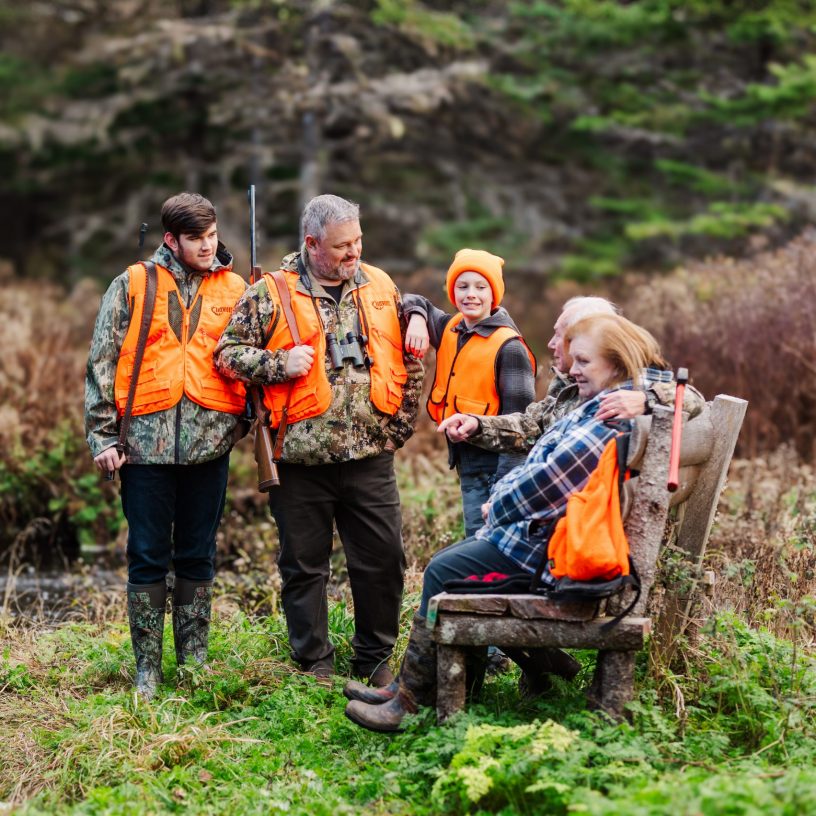
Left Footer Right Footer
Left Header Right Header

Migratory Game Bird Hunting

The Canadian Wildlife Service of Environment and Climate Change Canada (ECCC) are responsible for migratory game bird management and have highlighted several important considerations for migratory gamebird hunting in Newfoundland and Labrador (NL).

Modernization of Migratory Bird Hunting Regulations

As of September 2024, the season dates for duck hunting in Newfoundland and Labrador have been changed from the third Saturday in September to a fixed date of September 16th for all areas on the Island portion of the province. This change was implemented to ensure all species were open for the maximum allowable 107 days, therefore providing more hunting opportunity and to compensate for the removal of Waterfowl Heritage Day. This change does mean that some years the season will open on a day other than Saturday, but it also ensures consistency among jurisdictions in Atlantic Canada.

CWS values and relies on the input of hunters when making proposing regulatory changes, so your feedback is welcomed. If you have additional concerns, you may contact the Canadian Wildlife Service at enviroinfo@ec.gc.ca or to speak to someone please call toll free 1-800-668-6767.

A free Migratory Game Bird Hunting Permit for minors (under 18 years of age) has been introduced.  This initiative was suggested by hunters and will encourage younger hunters to hunt waterfowl with their mentor without the cost of having to purchase a Migratory Game Bird Hunting Permit.

There are also new provisions that allow legally harvested waterfowl to be transported with either a fully feathered wing or head to be used for species identification.  This change provides hunters’ choice on how they field dress birds for transportation.
Waterfowl that are preserved in a location outside of the hunting area do not count towards the possession limit.  Preserved means eviscerated and plucked, or edible portions removed, and then frozen, made into sausage, cooked dried, canned or smoked.

For murres, the possession limit applies to all murres including those that have been preserved.

Under the Migratory Birds Regulations, it is prohibited to abandon migratory game bird meat harvested under a migratory game bird hunting permit, and there are rules surrounding the gifting of migratory game bird meat to another person or the holder of a charity permit.

For more information on the modernized Migratory Birds Regulations please consult the ECCC web site Hunting regulations summary for migratory birds: Newfoundland and Labrador – Canada.ca

If you have questions on the Migratory Birds Regulations, you may contact the Canadian Wildlife Service at enviroinfo@ec.gc.ca or to speak to someone please call toll free 1-800-668-6767.

Reporting Bands

We remind hunters that it is important to report any band found on a migratory bird by entering its number on reportband.gov. Recovered banding data is essential for many conservation projects, as well as for setting waterfowl hunting regulations and understanding how diseases like Avian Influenza and Avian Cholera affect waterfowl populations.

Avian Influenza

Hunter Safety

Avian influenza has been documented in waterfowl and other gamebirds throughout Atlantic Canada, including strains that are highly pathogenic to both wild and domestic birds.  Hunters should consult Public Health Agency of Canada’s “Recommendations for Hunters of Wild Birds and Other Susceptible Wildlife” before handling and consuming wild birds.   Hunters should not harvest or consume birds found dead or that look sick.  Hunters should cook game meats thoroughly before consumption.  There is no evidence to suggest that fully cooked game meat, organs, or eggs are a source of avian influenza infection for people.
Use of Retrieving Dogs

Standing advice prepared by the British Association for Shooting and Conservation, and endorsed by U.K. Governments, is that retrieving dogs are not at any particular risk from bird flu but as a precaution do not allow dogs to eat any wild birds found dead and do not feed uncooked birds to animals. Well cooked birds can be safely consumed by humans and animals alike. Dogs are known to have contracted certain strains of flu and therefore precautions are warranted. Dog owners should prevent contact with sick or dead birds that were not harvested and should as a safety precaution limit the amount of time that dogs are interacting with retrieved birds. Owners should prevent contact between their dogs and wild bird feces, to the extent possible.

Export of Migratory Game Birds

As of 2024-02-13, there is one primary control zone in Atlantic Canada (near Bridgewater Nova Scotia). However, hunters that are transporting birds in Canada should check the map on the CFIA website regularly as control zones may change.

On September 2, 2022, US Department of Agricultrue Animal and Plant Health Inspection Serivce (USDA APHIS) issued a stakeholder alert implementing restrictions on hunter harvested wild bird meat/carcasses from all of Canada, regardless of province, due to the risk of transmitting highly pathogenic avian influenza (HPAI). HPAI is an extremely infectious poultry disease spreading throughout North America, primarily by wild birds. APHIS regulations implement strict import controls to prevent HPAI introductions resulting from people transporting contaminated wildlife meat, carcasses, and trophies into the United States.

APHIS has been working with stakeholders and other federal agencies to provide options for importing hunter-harvested wild bird meat/carcasses that address the HPAI transmission risk to our domestic poultry. Effective September 12, APHIS will allow the import of hunter harvested wild bird meat/carcasses as outlined below.

Unprocessed hunter-harvested wild game bird carcasses, originating from or transiting Canada, must meet following conditions:

  • Viscera, head, neck, feet, skin, and one wing have been removed; and
  • Feathers have been removed, with the exception of one wing – as required by U.S. Fish and Wildlife Service (FWS) for species identification; and
  • Carcasses must be rinsed in fresh, clean, potable water prior to packaging and must not have visible evidence of contamination with dirt, blood, or feces; and
  • Carcasses must be imported in leak-proof plastic packaging and stored in a leak proof cooler or container during transport and import; and
  • Carcasses must be chilled or frozen during transport and import.

APHIS further recommends that boots and any equipment used to process the carcasses should be clean and visibly free from dirt, blood, tissue, and feces.

Cooked or cured meat and meat products (for example, sausage, jerky, etc.) will not be allowed import as U.S. FWS requirements cannot be met to identify the species of wild bird.

Hunter-harvested wild game bird trophies entering the United States from Canada must be fully finished, or accompanied by a VS import permit, or consigned directly to a USDA Approved Establishment. Hunters may find an approved taxidermy establishment by visiting the Veterinary Services Process Streamlining (VSPS) search page and searching for a taxidermist with the HPAI product code in your state.

For any questions regarding import of animal products and by-products, please contact Animal Product Imports at 301-851-3300 or send an email to APIE@usda.gov.

For US Fish and Wildlife requirements for the hunter harvested wild game birds from Canada, please contact them at www.fws.gov.

Status of Murre populations and harvest in Canada

Following an episode of mortality caused by avian influenza during 2022, the Canadian Wildlife Service (CWS) has reviewed abundance, population trends, and mortality incidents for Common Murres and Thick-billed Murres in eastern Canada. CWS continues to monitor hunter harvested murres for the presence of HPAI.

CWS is not considering changing migratory bird hunting regulations to reduce the harvest of Murres in Newfoundland and Labrador during the 2025-26 hunting season. CWS can however invoke an emergency closure of murre hunting on a local or province-wide scale at a future date if conditions lead to excessive harvest.

  • most birds harvested by murre hunters are Thick-billed Murres. Mortality associated with highly pathogenic avian influenza (HPAI) has been largely restricted to Common Murres, which represent a smaller portion of birds harvested
  • based on the best available data at this time, the mortality of Common Murres along with observed overwinter mortality (unrelated to HPAI) of Thick-billed Murres in 2022, while concerning, is not sufficient to warrant a change in hunting regulations when total population size is considered

Two species of Murres comprise the harvest in Newfoundland and Labrador: the Thick-billed Murre and the Common Murre.

In Canada, the total number for these two species is approximately 8.7 million individuals.

The number of Common Murres is estimated at 3.2 million reproductive and non-reproductive individuals in Canadian waters of the North Atlantic. It is estimated that there are 789,000 breeding pairs of Common Murres at 25 colonies in Newfoundland and Labrador, in addition to 96,000 breeding pairs at colonies in Quebec.

The total number of Thick-billed Murres attributed to Canadian colonies is estimated to be 5.5 million reproductive and non-reproductive individuals. The Canadian breeding population of Thick-billed Murres is approximately 1.5 million pairs mostly from colonies in the Eastern Canadian High Arctic and the Hudson Bay / Strait area.

The estimated annual harvest of Murres in Canada ranges from 60,000 to 120,000. On average, 75% of murres harvested in Newfoundland and Labrador are Thick-billed Murres.

All hunters are reminded that it is an offense to harvest more than 20 murres per day or to be in possession of more than 40 murres. It is illegal to sell, buy or barter murres. Members of the public can support the sustainable management of murres by not engaging in the illegal sale or purchase of murres. Wildlife Enforcement officers will be actively pursuing offenders, and upon conviction, the mandatory minimum fine of $5000 per offence is consistently being applied in the courts of NL, in addition to the potential forfeiture of guns, boats and vehicles.

Harvest and Avian Influenza

Avian influenza has been documented in waterfowl and other gamebirds throughout Atlantic Canada, including strains that are highly pathogenic to both wild and domestic birds. Hunters should consult Public Health Agency of Canada’s “Recommendations for Hunters of Wild Birds and Other Susceptible Wildlife” before handling and consuming wild birds. Hunters should not harvest or consume birds found dead or that look sick.

Hunters should cook game meats thoroughly before consumption. There is no evidence to suggest that fully cooked game meat, organs, or eggs are a source of avian influenza infection for people.

All hunters are reminded that it is an offense to harvest more than 20 murres per day or to be in possession of more than 40 murres.  It is illegal to sell, buy or barter murres.  Members of the public can support the sustainable management of murres by not engaging in the illegal sale or purchase of murres.  Wildlife Enforcement officers will be actively pursuing offenders, and upon conviction, the mandatory minimum of $5000 per offence is consistently being applied in the courts of NL, in addition to the potential forfeiture of guns, boats and vehicles.

Left Footer Right Footer
Left Header Right Header

Newfoundland and Labrador Murre Conservation Fund

What is the Newfoundland and Labrador Murre Conservation Fund?

Each year a portion of the revenue from the sale of the Canadian Wildlife Habitat Conservation Stamps in Newfoundland and Labrador is put towards murre conservation and management. This financial support helps to ensure a sustainable murre population by improving our understanding of how best to manage murres. The fund supports avian research with the goal of maintaining a healthy murre population so that the species are successful for future generations.

How the fund came to be

Residents of Newfoundland and Labrador have harvested murres (turrs) for food for generations. During the 1970s and the 1980s it became apparent that the murre harvest was unsustainable and regulation commenced in the early 1990s under special authorities of the Migratory Bird Convention Act. Starting in 1999, murre hunters were required to purchase a Migratory Game Bird Hunting Permit. More effective regulation of the hunt was also achieved through bag limits and seasonal restrictions to ensure the long-term sustainability of murre populations. A portion of the money from the hunting permit (from the Canadian Wildlife Habitat Conservation Stamp) sold in across the country is directed to murre conservation activities. These funds are managed by Wildlife Habitat Canada, in consultation with the Canadian Wildlife Service and the Wildlife Division of the Province of Newfoundland and Labrador.

What the fund supports

By providing funds to projects that support the conservation, management and sustainable harvest of murre populations, the Newfoundland and Labrador Murre Conservation Fund encourages the conservation of murres through research and education and aims to further this support. Over the years, this fund has supported research on several aspects of murre biology and conservation, including breeding ecology and productivity; assessment of diet and foraging ecology; the role of annual survival, harvest, oiling and other mortality factors; as well as studies on migration, distribution, and overwintering areas. Hunters can take pride in being part of the efforts to support research on murres in Newfoundland and Labrador.

For more information on the Newfoundland and Labrador Murre Conservation Fund and what the Stamp on your permit supports, visit Bird Studies Canada www.birdscanada.org and Wildlife Habitat Canada www.whc.org


Murre Parental Tactics Researchers from Memorial University attached small GPS monitors to Common Murres to determine foraging tactics and ocean habitat use for breeding. Photo by Laura McFarlane Tranquilla
Photo by Laura McFarlane Tranquilla

Left Footer Right Footer
Left Header Right Header

Outreach Programs

Youth Outdoor Skills Workshops

The Department of Forestry, Agriculture and Lands, Wildlife Division, partners with local Rod and Gun Clubs to offer outdoor skills workshops and events for youth aged 12 to 17. These events provide youth with the opportunity to enhance their knowledge and skills in a safe environment with qualified instructors and volunteers. Youth participants must be accompanied by a parent or guardian.

Events for 2025 will be announced at a later date.

Youth Dream Adventure Newfoundland and Labrador

The Youth Dream Adventure provides young people of our province a chance to win an inclusive trip to an incredible destination here at home, building from the Atlantic Provinces Youth Hunting and Fishing Exchange.  This program is intended to engage local experts in outdoor pursuits (angling, hunting, etc.) that youth may not otherwise have opportunity to encounter and provide them with an exceptional opportunity.  These experiences will help develop interest and involvement in outdoor activities and offer skills development at the same time.

A youth winner (aged 12-17) is chosen by random draw from all those who have participated in the provincial Firearms Safety/Hunter Education Course or other outdoor skills events sanctioned by the Department of Forestry, Agriculture and Lands each year.

Significant support has been received for this program each year including consistent support from the Newfoundland and Labrador Outfitters Association and individual outfitters, the Newfoundland and Labrador Trappers Association, Rod and Gun Clubs and local businesses.


Thanks to our 2024 Sponsors.

  • Caines Adventure Outfitters
  • Newfoundland and Labrador Outfitters Association
  • Newfoundland and Labrador Trappers Association
  • Upper Humber Rod and Gun Association
  • St. John’s Rod and Gun Club
  • Gander Rod and Gun Club
  • Northwest Arm Rod and Gun Club
  • Notre Dame Rod and Gun
  • Friends of Salmonier Nature Park
  • Long Range Outdoors
  • Blue Ridge Inc.

For more information, contact:

Department of Forestry, Agriculture and Lands
Wildlife Division
P.O. Box 2007
Corner Brook, NL A2H 7S1
Ph: 637-2025 or email: nathanspence@gov.nl.ca


Becoming an Outdoors Woman (BOW)

BOW Program Offers Women Opportunity to Expand Outdoor Skills

The Becoming an Outdoors Woman Program is an outdoor education skills program sponsored by the Department of Forestry, Agriculture and Lands and the Friends of Salmonier Nature Park. The BOW program is delivered in several formats – the traditional 3-day weekend event, as well as Beyond BOW workshops of various lengths. All classes are taught at the entry level in a safe, non-intimidating outdoor setting.  Courses such as archery, fishing, canoeing, shotgun, rifle, outdoor cooking, hiking, and many more, are offered.


Becoming an Outdoors Family (BOF)

Becoming an Outdoors Family teaches skills for a lifetime of outdoor recreation. In this camping experience, we’ll introduce you to several outdoor activities, providing all the instruction and equipment you need to try it yourself. During the weekend the whole family will become one with nature with help from our friends at Salmonier Nature Park and Newfoundland’s Provincial Parks.

For more information contact the Salmonier Nature Park at 229-7888 or visit our website at: https://pattern-loop.live/fal/%3C/a%3E%3C/p%3E


^ Top of Page

Left Footer Right Footer
Left Header Right Header

Contact

Wildlife Division Offices

Corner Brook 
192 Wheeler’s Rd
P.O. Box 2007
Corner Brook, NL A2H 7S1
709.637.2025 (Tel)
709.637.2099 (Fax)
Email. wildlifelicense@gov.nl.ca

Happy Valley-Goose Bay 
15 Cherrywood Drive
P.O. Box 3014, Stn. B
Happy Valley-Goose Bay, NL A0P 1E0
709.896.7930 (Tel)
709.896.0188 (Fax)

St. John’s 
Provincial Agriculture Bldg., 204 Brookfield Rd.
P.O. Box 8700
St. John’s, NL A1B 4J6
709.729.2630 (Tel)
709.729.0751 (Fax)
Email wildlifelicense@gov.nl.ca

Salmonier Nature Park
Route 90, Holyrood
Mailing Address:
Provincial Agriculture Bldg., 204 Brookfield Rd.
P.O. Box 8700
St. John’s, NL A1B 4J6
709.229.7888 (Tel)
salmoniernaturepark@gov.nl.ca

Resource Enforcement Division Offices

Provincial Headquarters
115 Riverside Drive
Corner Brook, NL, A2H 2N2
709.637.2971 (Tel)
709.637.2975 (Fax)

Western Regional Office
1 Massey Drive
Massey Drive, NL A2H 7A9
709.637.8088 (Tel)
709.639.1377 (Fax)

Eastern Regional Office
P.O. Box 8700
21 Hallett Crescent
St. John’s, NL A1B 4J6
709.729.2192 (Tel)
709.729.2375 (Fax)

Labrador Regional Office
1 Kessessaskiou Street
Mail: P.O. Box 3014, Station “B”
Happy Valley-Goose Bay, NL A0P 1E0
709.896.7973 (Tel)
709.896.7986 (Fax)

Report Poaching
Toll Free: 1.877.820.0999
Report Poaching – Feedback Forms (gov.nl.ca)
REOutreach@gov.nl.ca

Regional Services Division Offices

To report any animal related emergencies, please call 685-7273.

Baie Verte 709-673-3821
Bay D’Espoir 709-882-2200
Bishop’s Falls 709-258-5334
Cape Broyle 709-729-4180
Carbonear 709-729-4180
Cartwright 709-938-7362
Churchill Falls 709-925-3179
Clarenville 709-466-7439
Gander 709.256.1450
Gambo 709-674-4625
Heart’s Content 709-729-4180
Lewisporte 709-535-2706
Massey Drive 709-637-2370
Millertown 709-673-3821
North West River 709-497-8479
Paddy’s Pond-St. John’s 709-729-4180
Pasadena 709-686-2071
Port Hope Simpson 709-938-7362
Port Saunders 709-861-3502
Roddickton 709-457-2300
Salmonier 709-729-4180
Southern Bay 709-462-3491
Springdale 709-673-3821
St. Anthony 709-454-8435
St. George’s 709-646-3720
Wabush 709-282-6881
Whitbourne 709-729-4180
Wings Point 709-676-2260
Winterland 709-279-3980

Additional Contact Information

Tourism, Culture, Industry and Innovation
Parks Division 709.637.2040 (Tel)
Email. info@parksnl.ca

Newfoundland and Labrador Outfitters Association
1.866.470.6562 (Toll Free)

Central Cashier’s Office
P.O. Box 8700, St. John’s, NL
A1B 4J6
709.729.3042 (Tel)

RCMP Canadian Firearms Program

7 Pippy Place, PO Box 8218
St. John’s,  NL
A1B 3N4
1.800.731.4000 (Toll Free)

Newfoundland and Labrador Trapper’s Association
709.592.2416 (Tel)

Canadian Wildlife Service (NL)
Mt. Pearl 709.772.5585 (Tel)
Corner Brook 709.637.4377 (Tel)

Parks Canada
Gros Morne National Park
709.458.2417 (Tel)

Terra Nova National Park
709.533.2801 (Tel)

Torngat Mountains National Park
709.922.1290 (Tel)

To report incidents in national parks and sites
1.877.852.3100 (Toll Free)

Report Suspected Illegal Activity 1.877.820.0999 stoppoaching.ca


^ Top of Page

Left Footer Right Footer